

The EB-2 visa category is defined as the Employment-Based Second Preference immigrant visa, designed for foreign nationals with advanced degrees or exceptional ability in the sciences, arts, or business. Understanding the EB-2 visa category is the first step toward securing permanent U.S. residency if you hold a master's degree, a bachelor's degree plus five years of progressive experience, or a record of exceptional professional achievement. The EB-2 category includes three distinct subcategories: advanced degree professionals, exceptional ability individuals, and National Interest Waiver (NIW) applicants. Each path carries different requirements, timelines, and documentation demands.
What are the EB-2 visa eligibility criteria?
The EB-2 visa splits into two primary eligibility tracks before you even consider the NIW option.
EB-2(A): Advanced degree professionals qualify by holding a U.S. master's degree or its foreign equivalent. Alternatively, a U.S. bachelor's degree combined with five years of progressive experience in the specialty field satisfies this requirement. That "progressive" standard matters. USCIS expects each role to show increasing responsibility, not just repeated years in the same position.
EB-2(B): Exceptional ability applies to individuals who demonstrate a degree of expertise significantly above the ordinary in sciences, arts, or business. USCIS evaluates exceptional ability using at least three of the following criteria:
- An official academic record showing a degree, diploma, or certificate in the field
- Letters from current or former employers documenting at least ten years of full-time experience
- A license to practice the profession or certification for a particular occupation
- Evidence of a salary or remuneration that demonstrates exceptional ability
- Membership in professional associations that require outstanding achievement for admission
- Recognition for achievements and contributions by peers, government entities, or professional organizations
Meeting three of these six criteria is the minimum threshold. Meeting more strengthens the petition considerably.
Pro Tip: Document every promotion, title change, and expanded responsibility in writing. The "bachelor's + 5 years progressive experience" route fails most often when employer letters describe duties without showing clear career advancement in the specialty area.
A common mistake is treating EB-2(B) as a fallback for applicants who lack a master's degree. Exceptional ability is a high bar. Salary evidence, peer recognition, and professional memberships must all point to the same conclusion: this person performs at a level well above the norm in their field.
How does the National Interest Waiver (NIW) work?
The NIW is a subset of the EB-2 category that waives two standard requirements: employer sponsorship and PERM labor certification. That means you can self-petition directly to USCIS without needing a U.S. employer to file on your behalf.
One critical point that trips up many applicants: the NIW does not waive EB-2 eligibility. You must first prove you qualify under EB-2(A) or EB-2(B). Only then can you argue for the waiver itself. Skipping or weakening the EB-2 eligibility layer is the leading cause of NIW petition denials.
To win the waiver, USCIS applies the Dhanasar three-prong test, established in Matter of Dhanasar (2016). You must prove all three prongs:
- Substantial merit and national importance. Your work must have clear value to the United States, not just to your employer or industry. Fields like STEM research, public health, education, and clean energy regularly satisfy this prong.
- Well-positioned to advance the proposed endeavor. Your education, experience, and track record must show you are the right person to carry this work forward. Publications, patents, grants, and citations all serve as evidence here.
- Benefit of waiving the job offer and labor certification. USCIS must conclude that requiring a specific job offer would harm the national interest. Researchers, entrepreneurs, and physicians serving underserved communities often meet this standard.
Fields that succeed most consistently under NIW include medical research, engineering, data science, academia, and healthcare delivery in shortage areas. That said, NIW petitions have been approved across a wide range of disciplines when the evidence is strong.
Pro Tip: Build your NIW petition around concrete outcomes, not job descriptions. Published papers, funded grants, licensed patents, and letters from recognized experts in your field carry far more weight than a strong resume alone. Visit Hasan-legal's guide on EB-2 NIW eligibility for a detailed breakdown of what USCIS looks for.

What are the key steps in the EB-2 application process?
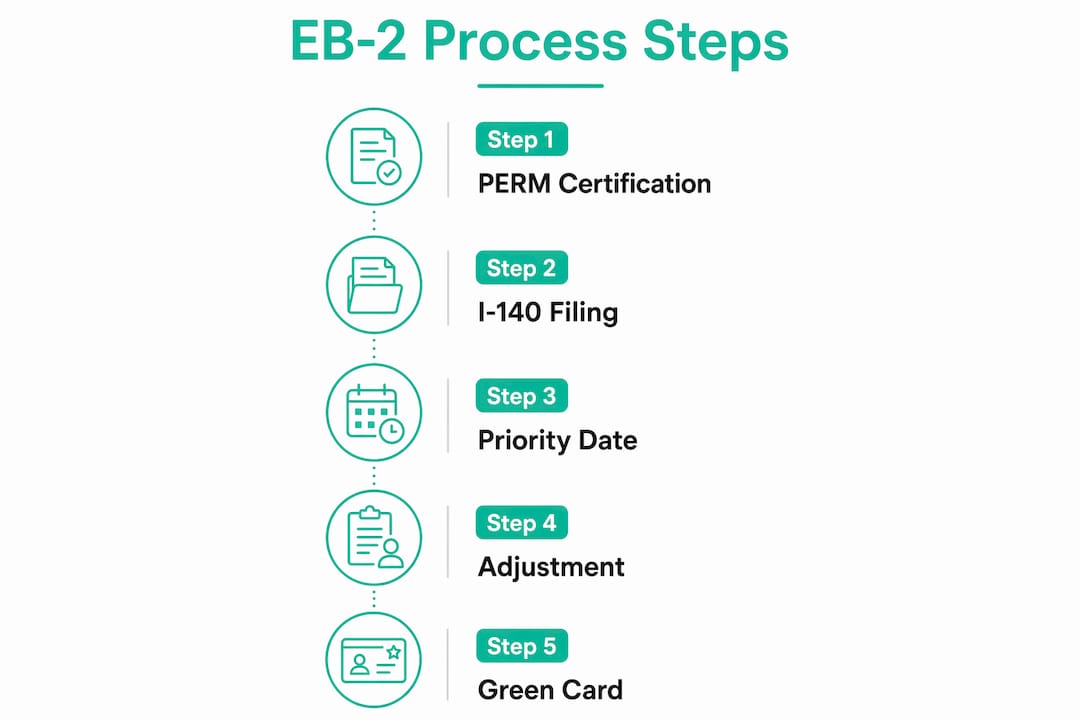
The EB-2 process follows a defined sequence, and where you start depends on whether you are filing with employer sponsorship or self-petitioning under the NIW.
Standard EB-2 (employer-sponsored) process:
- Employer files a PERM labor certification with the Department of Labor to prove no qualified U.S. worker is available for the role
- Upon PERM approval, employer files Form I-140 (Immigrant Petition for Alien Workers) with USCIS
- Your priority date is set as the date the Department of Labor accepted the PERM application
- Once your priority date becomes current per the Visa Bulletin, you file for Adjustment of Status (Form I-485) if inside the U.S., or pursue consular processing abroad
NIW self-petition process:
- You file Form I-140 directly with USCIS, with no PERM requirement
- Your priority date is the I-140 receipt date at USCIS
- All subsequent steps mirror the standard process once the I-140 is approved
The Visa Bulletin, published monthly by the U.S. Department of State, governs when you can move forward after I-140 approval. USCIS instructs applicants to check both the Final Action Dates chart and the Dates for Filing chart each month. Visa availability depends on your country of chargeability and your EB-2 subcategory.
| Step | Standard EB-2 | NIW Self-Petition |
|---|---|---|
| PERM labor certification | Required | Not required |
| I-140 filed by | Employer | Applicant |
| Priority date set | PERM acceptance date | I-140 receipt date |
| Employer sponsorship | Required | Not required |
| Adjustment of Status (I-485) | After priority date current | After priority date current |
Country of birth matters significantly. Applicants born in India or China face priority date backlogs that can extend the wait by years beyond what applicants from other countries experience. Tracking the Visa Bulletin monthly is not optional. It is the only way to know when you can file your I-485 or schedule your consular interview. Hasan-legal's July 2026 Visa Bulletin analysis breaks down what current dates mean for EB-2 applicants.
How does EB-2 compare to EB-1 and EB-3?
The three main employment-based green card categories serve different applicant profiles. Choosing the right one affects both your eligibility and your wait time.
| Category | Qualification bar | Labor certification | Self-petition option | Typical priority |
|---|---|---|---|---|
| EB-1 | Extraordinary ability, outstanding professors, or multinational managers | Not required | Yes (EB-1A) | Highest |
| EB-2 | Advanced degree or exceptional ability | Required (waived for NIW) | NIW only | Second |
| EB-3 | Bachelor's degree, skilled workers, or unskilled workers | Required | No | Third |
The EB-1A visa (what is EB-1A, formally called "aliens of extraordinary ability") sets the highest bar of any employment-based category. It requires sustained national or international acclaim. EB-2 sits below that threshold but well above the EB-3 standard, which covers professionals with a bachelor's degree and skilled or unskilled workers.
A few practical comparisons worth knowing:
- EB-1 carries no labor certification requirement and no employer sponsorship requirement for EB-1A filers, making it faster for those who qualify
- EB-2 with NIW offers a similar self-petition advantage but at a lower qualification threshold than EB-1A
- EB-3 requires labor certification and employer sponsorship with no self-petition option, making it the most employer-dependent path
- For applicants from countries without significant backlogs, EB-2 and EB-3 wait times are often comparable, making EB-2 the stronger choice given its higher green card priority
Applicants who cannot meet the EB-1A extraordinary ability standard but have a strong national interest argument often find EB-2 NIW the most practical route. Those with a straightforward employer sponsor and a bachelor's degree may find EB-3 simpler, but they give up priority and self-petition flexibility.
Key Takeaways
The EB-2 visa category offers three distinct paths to permanent U.S. residency: advanced degree, exceptional ability, and National Interest Waiver, each with specific evidence requirements and timelines.
| Point | Details |
|---|---|
| Three EB-2 subcategories | Advanced degree, exceptional ability, and NIW each require separate, layered evidence. |
| NIW does not replace EB-2 proof | You must first qualify under EB-2 before arguing for the national interest waiver. |
| Priority date drives your timeline | Your wait depends on your country of birth and when USCIS or DOL received your petition. |
| Visa Bulletin is monthly | Check Final Action Dates and Dates for Filing each month to know when you can file I-485. |
| EB-2 outranks EB-3 | EB-2 carries higher green card priority and offers a self-petition option EB-3 does not. |
What I've learned from EB-2 cases that most guides won't tell you
After working through a significant number of EB-2 petitions, the pattern I see most often is this: applicants spend months building a strong national interest argument and then submit thin EB-2 eligibility evidence. USCIS adjudicators review eligibility first. A brilliant NIW argument attached to a weak EB-2 foundation gets denied.
The second thing I see consistently is applicants underestimating the priority date problem. Many people focus entirely on I-140 approval timelines. They celebrate when USCIS approves the petition, then discover their priority date is years away from becoming current. For applicants born in India, the EB-2 backlog can be substantial. That reality needs to be part of your planning from day one, not a surprise after approval.
My honest advice: if you have a genuine choice between NIW and standard EB-2, evaluate your evidence honestly before choosing. NIW gives you independence from an employer, but it demands a higher quality of documentation. Standard EB-2 with a strong employer sponsor can move faster if your PERM is clean and your priority date is current. Neither path is universally better. The right choice depends on your specific credentials, country of birth, and career situation.
One more thing most applicants overlook: the NIW without a PhD is absolutely possible. I have seen successful petitions from professionals with bachelor's degrees who built exceptional ability cases under EB-2(B) and then layered a strong Dhanasar argument on top. Do not assume a doctorate is required.
— Mahmudul
Hasan-legal's EB-2 legal services
Hasan-legal's team at Hasan Legal PC handles EB-2 cases from initial case evaluation through green card approval. Attorney Mahmudul Hasan, Esq. personally oversees every petition, whether you are pursuing a standard employer-sponsored path with PERM labor certification or filing a self-petition under the National Interest Waiver.
Hasan-legal offers case evaluation, petition drafting, recommendation letter preparation, and priority date monitoring. If you are ready to assess your EB-2 options with an attorney who will review your specific credentials, schedule a free case evaluation with Hasan Legal PC. You can also review the full range of U.S. immigration services the firm provides.
FAQ
What is the EB-2 visa category?
The EB-2 visa is the Employment-Based Second Preference immigrant visa for foreign nationals with a U.S. master's degree, a bachelor's degree plus five years of progressive experience, or exceptional ability in sciences, arts, or business.
Can I apply for EB-2 without an employer sponsor?
Yes. The National Interest Waiver allows you to self-petition under EB-2 without employer sponsorship or PERM labor certification, provided you meet EB-2 eligibility and satisfy the Dhanasar three-prong test.
What is a priority date and why does it matter?
Your priority date is either the date USCIS received your I-140 (for NIW) or the date the Department of Labor accepted your PERM application. It determines your place in the green card queue and when you can file for Adjustment of Status.
How long does the EB-2 process take?
Processing time varies widely. I-140 adjudication typically takes several months, but the total timeline depends on your priority date becoming current in the Visa Bulletin. Applicants born in India or China may wait years beyond I-140 approval due to per-country backlogs.
What is the difference between EB-2 and EB-3?
EB-2 requires an advanced degree or exceptional ability and offers higher green card priority plus the NIW self-petition option. EB-3 covers professionals with a bachelor's degree and skilled workers but requires employer sponsorship and labor certification with no self-petition path.