

A Green Card application step by step is a structured legal process managed by U.S. Citizenship and Immigration Services (USCIS) and the Department of State, covering eligibility determination, petition filing, medical exams, documentation, and interviews. The two central forms are Form I-485 for applicants inside the U.S. and Form DS-260 for those applying through a U.S. consulate abroad. Your path splits early based on where you live, and choosing the wrong route wastes months. This guide walks you through every stage, including critical 2026 updates to Form I-693 medical exam rules that can get your application rejected if you miss them.
How to determine green card eligibility and choose your path

Your eligibility category determines everything: which forms you file, which fees you pay, and how long you wait. USCIS recognizes several major categories, each with distinct requirements.
The main eligibility categories are:
- Family-based: Immediate relatives of U.S. citizens (spouses, unmarried children under 21, parents) have no annual visa cap. Other family preference categories face waiting periods.
- Employment-based: Covers five preference categories (EB-1 through EB-5), from priority workers to investors.
- Asylum or refugee status: Asylees and refugees can apply for a Green Card one year after receiving protected status.
- Diversity Visa Lottery: Winners of the annual DV Lottery program may apply through consular processing.
- Special immigrant categories: Includes religious workers, certain broadcasters, and others.
Once you confirm your category, you choose your filing path. The table below shows the core distinction.
| Path | Who Uses It | Primary Form | Where Filed |
|---|---|---|---|
| Adjustment of Status | Applicants physically inside the U.S. | Form I-485 | USCIS |
| Consular Processing | Applicants outside the U.S. | Form DS-260 | U.S. Consulate |
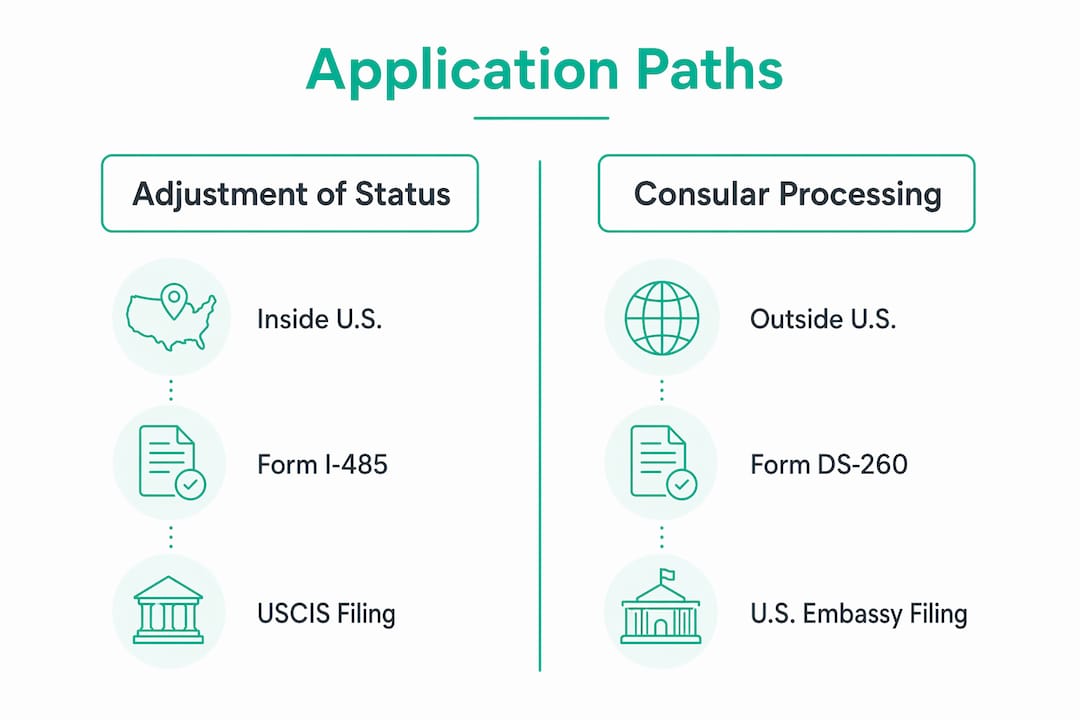
Application paths diverge significantly based on your location, making this early decision the most consequential one in the entire process. Getting it wrong means refiling, paying duplicate fees, and losing months of processing time.
How to file form i-485: adjustment of status inside the u.s.
Form I-485 is the key adjustment of status form for applicants already inside the United States. Filing it correctly the first time protects you from Requests for Evidence (RFEs) and delays.
-
Confirm visa availability. Before filing, check the USCIS Visa Bulletin to confirm a visa number is available in your category. Immediate relatives of U.S. citizens skip this step since no cap applies to them.
-
File the underlying immigrant petition. Most applicants need an approved petition first. Family-based applicants use Form I-130; employment-based applicants use Form I-140. In some cases, you can file Form I-485 concurrently with the petition if a visa is immediately available.
-
Complete your medical exam. Visit a USCIS-designated civil surgeon to complete Form I-693, the Report of Immigration Medical Examination and Vaccination Record. As of december 2, 2024, Form I-693 must be submitted with Form I-485 at the time of filing, or USCIS may reject your application outright. This is the single most common procedural mistake in 2026.
-
Assemble your supporting documents. Your package should include a copy of your passport and visa, two passport-style photos, birth certificate, marriage certificate (if applicable), police clearances, tax records, and Form I-864 Affidavit of Support for family-based cases. A thorough document checklist prevents missing items that trigger RFEs.
-
Choose your filing method. Online filing of Form I-485 is currently available only for certain employment-based applicants. All other applicants must file by mail to the correct USCIS lockbox facility based on their state and category. Sending to the wrong address causes processing delays.
-
Handle the I-693 sealed envelope correctly. If you file by mail, submit the sealed envelope from your civil surgeon unopened. If you file online, you must open the sealed envelope to upload the form digitally, but keep all original documents until USCIS makes a final decision.
Pro Tip: Submitting all required evidence upfront with Form I-485 can avoid RFEs and delays. Build a cover sheet that lists every document in your package and check it twice before mailing.
Review the I-485 filing instructions for signature requirements and visa availability rules specific to your category before you submit.
How does consular processing work for applicants outside the u.s.?
Consular processing is the path for applicants who live outside the United States. The steps include petition filing, document preparation at the National Visa Center (NVC), a consular interview, and Green Card issuance after entry.
-
File the immigrant petition with USCIS. A U.S. citizen or lawful permanent resident sponsor files Form I-130 for family-based cases. Employment-based applicants need an employer to file Form I-140. USCIS approves the petition and forwards it to the NVC.
-
Complete NVC processing. The NVC collects fees, assigns a case number, and requests your civil documents. You submit Form DS-260 (the immigrant visa application) and supporting documents through the NVC's CEAC online portal. The NVC reviews everything before scheduling your interview.
-
Submit financial evidence. Your U.S.-based sponsor must file Form I-864, the Affidavit of Support, proving they can financially support you at 125% of the federal poverty guideline. Missing or incomplete I-864 submissions are a leading cause of interview delays.
-
Schedule and attend your consular interview. The NVC forwards your case to the U.S. Embassy or Consulate in your home country. You receive an interview appointment notice. Bring all original documents, including birth certificates, police clearances, financial records, and your medical exam results from an approved panel physician.
-
Pay required fees. Consular processing involves paying the immigrant visa application fee and the Affidavit of Support fee during the NVC stage. Budget for these costs before your case reaches the consulate.
-
Receive your immigrant visa and enter the U.S. If approved, you receive an immigrant visa in your passport. You enter the U.S. as a lawful permanent resident, and your physical Green Card arrives by mail within a few weeks of entry.
For a detailed breakdown of each consular stage, Hasan-legal's guide on consular processing covers documentation requirements and common interview questions.
What to expect at biometrics and your green card interview
Biometrics and interviews are not formalities. They are active decision points where incomplete preparation leads to delays or denials.
Biometrics appointment: After USCIS receives your I-485, you receive an appointment notice for an Application Support Center (ASC). You provide fingerprints, a photo, and a signature. Bring your appointment notice and a valid government-issued photo ID. Missing this appointment without rescheduling stops your case entirely.
The adjustment of status interview: Not all I-485 applicants are called for an interview, but most family-based applicants are. The officer reviews your application, asks about your relationship or employment, and verifies your documents. Bring originals of everything you submitted, plus any updates to your circumstances since filing.
Common pitfalls to avoid:
- Submitting Form I-485 without Form I-693 sealed inside the package (or uploaded, for online filers)
- Using an outdated version of any USCIS form (always download forms directly from USCIS.gov)
- Failing to update your address with USCIS using Form AR-11 after moving
- Missing the biometrics appointment without requesting a reschedule
- Leaving gaps in employment or travel history on your application
Pro Tip: Organize your documents in a tabbed binder sorted by form number. Bring two copies of everything to your interview: one for the officer and one for your records. Officers notice when applicants arrive prepared, and it sets a confident tone for the entire session.
I-485 processing times vary by category and field office. Immediate relatives of U.S. citizens typically wait under 15 months, while other preference categories can wait years depending on visa availability. Check USCIS processing time tools regularly to track your case.
Key takeaways
A complete, correctly assembled application package is the single most effective way to avoid delays, RFEs, and rejections in the Green Card process.
| Point | Details |
|---|---|
| Choose your path early | Determine adjustment of status vs. consular processing before filing any forms. |
| Submit Form I-693 with I-485 | As of december 2, 2024, the medical exam must be included at initial filing or USCIS will reject your application. |
| Match your filing method to your category | Online I-485 filing is only available to certain employment-based applicants; others must file by mail. |
| Complete your document package upfront | Submitting all evidence at once prevents Requests for Evidence and speeds up adjudication. |
| Track processing times actively | Immediate relatives wait under 15 months on average; other categories face longer, category-dependent timelines. |
What i've learned after years of green card cases
After handling hundreds of Green Card cases at Hasan-legal, one pattern stands out above everything else: applicants who treat the application as a checklist exercise almost always receive an RFE. Applicants who treat it as a legal argument almost never do.
What I mean by that is this. Every document you submit should answer a question the officer is going to ask. Your birth certificate proves identity. Your tax returns prove the sponsor's income. Your police clearances prove admissibility. When you think about each document as evidence rather than paperwork, you stop leaving gaps.
The I-693 rule change that took effect in december 2024 caught a lot of applicants off guard. I saw cases rejected simply because the civil surgeon's sealed envelope was not in the initial mailing. That is an entirely preventable mistake. Schedule your medical exam at least three weeks before your planned filing date so the civil surgeon has time to complete the form properly.
One more thing I want to say directly: do not assume your category is straightforward. Different immigrant categories have unique filing and procedural requirements that trip up even experienced filers. If you are filing under an employment-based preference category, the concurrent filing rules alone require careful timing. Get the category right before you spend money on filing fees.
— Mahmudul
Ready to file? Hasan-legal can guide you through every step
Navigating the Green Card process on your own is possible, but one missed form or wrong filing method can set you back by months. Hasan-legal's team, led by managing attorney Mahmudul Hasan, Esq., reviews every case personally to build a filing strategy matched to your specific category and circumstances.
Whether you are adjusting status from inside the U.S. or applying through a U.S. consulate abroad, Hasan-legal provides personalized guidance at every stage. Start with a free case evaluation to understand your eligibility and filing options before you spend a dollar on fees. When you are ready to move forward, explore Hasan-legal's full range of immigration services and schedule a consultation with our team today.
FAQ
What is the difference between i-485 and ds-260?
Form I-485 is filed with USCIS by applicants physically inside the United States to adjust their status to lawful permanent resident. Form DS-260 is filed through the National Visa Center by applicants outside the U.S. pursuing an immigrant visa through consular processing.
How long does a green card application take in 2026?
Processing times depend on your category. Immediate relatives of U.S. citizens typically wait under 15 months, while employment-based and family preference categories can take significantly longer due to annual visa caps.
Do i need a medical exam for my green card application?
Yes. All Green Card applicants must complete a medical exam with a USCIS-designated civil surgeon (for I-485 filers) or an approved panel physician (for consular processing). Since december 2, 2024, Form I-693 must be submitted with Form I-485 at the time of initial filing.
What documents do i need for a green card application?
Core documents include a valid passport, birth certificate, two passport photos, police clearances, financial records, and Form I-864 Affidavit of Support for family-based cases. Review a full document preparation guide to confirm category-specific requirements before filing.
Can i file form i-485 online?
Online filing is available only for certain employment-based I-485 applicants. All other applicants must file by mail to the correct USCIS lockbox facility. Check USCIS.gov directly to confirm whether your specific category qualifies for online submission.
Recommended
- Adjustment of Status, Explained: How to Apply for a Green Card from Inside the U.S. | Hasan Legal PC
- Consular Processing, Explained: How to Obtain a Green Card from Outside the United States | Hasan Legal PC
- How to Build an EB-2 NIW Case That Stands Out | Hasan Legal PC
- Green Card for Asylees: Eligibility, How to Apply, and What to Submit | Hasan Legal PC