

Hiring an immigration attorney is the single most consequential decision you will make in your visa or residency process. The right attorney brings specialized knowledge of USCIS filings, immigration court procedures, and the specific forms that govern your case. The wrong one, or worse, an unlicensed provider, can cost you time, money, and your legal status. These hire immigration attorney tips walk you through every step: assessing your needs, verifying credentials, asking the right questions, and spotting red flags before they become disasters.
How do you assess your immigration needs before hiring?
The first step in choosing an immigration attorney is knowing exactly what type of case you have. Immigration law covers dozens of distinct categories: family-based petitions, employment visas, asylum claims, removal defense, and naturalization. Each requires a different skill set. An attorney who excels at H-1B filings may have limited experience with EOIR removal proceedings.
Start by identifying your case type clearly:
- Family-based immigration: Spousal visas, parent petitions, sibling preference categories under family preference categories
- Employment-based visas: H-1B, L-1B, O-1, EB-1, EB-2 NIW, and PERM labor certification
- Humanitarian cases: Asylum, refugee status, DACA renewals, U visas
- Court proceedings: Removal defense, bond hearings, appeals before the Board of Immigration Appeals
- Adjustment of status: Green card applications filed with USCIS
Once you know your category, you can target attorneys who handle that specific volume of work. Review U.S. visa types to clarify which category fits your situation before your first attorney call.
Pro Tip: Before contacting any attorney, prepare a one-page summary of your immigration history, including all prior visas, entries, exits, and any prior filings. This saves time during consultations and signals to the attorney that you are organized and serious.

Preparing your documents in advance also matters. An immigration document checklist tailored to your case type helps you arrive at consultations ready to discuss specifics rather than generalities.
What are the key ways to verify an attorney's credentials?
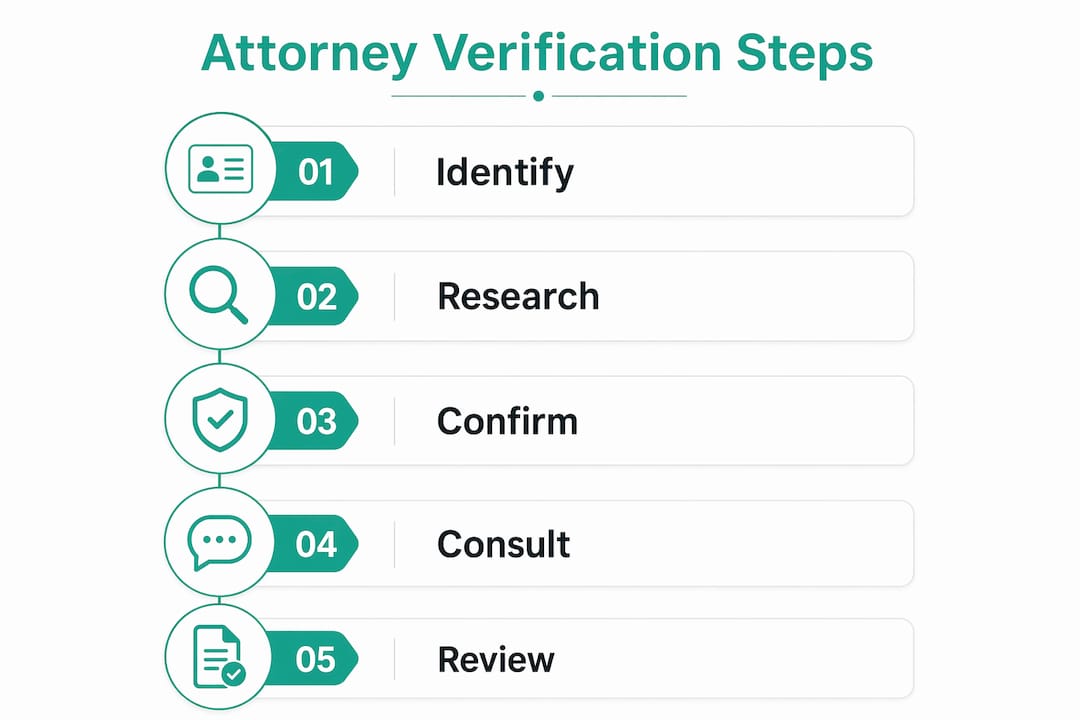
Credential verification is non-negotiable. The U.S. immigration system allows three types of authorized representatives: licensed attorneys, accredited representatives, and law graduates appearing with judge approval. Everyone else, including notarios and immigration consultants, is unauthorized to appear in immigration court.
Follow these steps to verify any attorney you consider:
- Check state bar membership. Every licensed attorney must be in good standing with at least one state bar. Use your state bar's online directory to confirm active status and check for disciplinary history.
- Verify EOIR eRegistry status. Attorneys who practice before immigration courts must register with the Executive Office for Immigration Review. Confirm their registration is current and their contact information is up to date.
- Confirm accredited representative status if applicable. The EOIR Recognition and Accreditation Program allows non-attorney representatives to provide legal help, but only through recognized nonprofit organizations. Their accreditation is organization-specific and valid for up to three years. If someone claims accredited representative status, verify the organization is currently recognized by EOIR.
- Ask about Form G-28 and Form EOIR-28. A legitimate attorney will know exactly when and how to file these forms. Confusion about these documents is a warning sign.
"Marketing claims and testimonials do not guarantee court-authorized representation. Verification of legal authorization through official EOIR and state bar records is the only reliable standard." — EOIR policy guidance
The distinction between a licensed attorney and an unlicensed consultant is not a technicality. Only authorized practitioners can file appearances, access case records, and represent you in court proceedings.
What questions should you ask during the initial consultation?
The initial consultation is your interview of the attorney, not the other way around. Come prepared with specific questions that reveal experience, communication habits, and fee transparency. Generic answers to specific questions are a red flag on their own.
Ask these questions directly:
- How many cases like mine have you handled in the past 12–24 months? Case-type volume in recent years is a stronger indicator of competence than total years of practice. An attorney with 20 years of experience but only two NIW petitions in the last year is not your best option for an EB-2 NIW case.
- What were the outcomes of those recent cases? You want specifics, not general success rates.
- What is your fee structure? Clarify whether fees are flat rate or hourly, what services each covers, and what happens if your case requires additional filings.
- Will you provide a written fee agreement? Any reputable attorney provides this without hesitation.
- What is your refund policy if I withdraw or the case is denied?
- How often will you update me, and who is my primary contact?
- What is the expected timeline for my case type?
Pro Tip: If an attorney cannot give you a clear answer about their recent caseload in your specific category, treat that as a signal to keep looking. Specialization in immigration law is narrow. The attorney who handles your NIW petition should be able to cite recent approvals and explain what made them successful. For context on what strong NIW cases look like, review common NIW petition mistakes before your consultation.
Fee transparency matters as much as legal skill. Unclear billing practices lead to disputes that distract from your case.
What red flags should you watch for when choosing an attorney?
Fraud in immigration legal services is a documented problem in the United States. Knowing the warning signs protects you from losing money and jeopardizing your case.
Watch for these specific red flags:
- Use of the title "notario." In Latin American countries, a notario publico holds significant legal authority. In the United States, the title carries no such standing. Notarios cannot appear before immigration courts or USCIS as authorized representatives. Using this title to attract clients is a common fraud tactic.
- Guaranteed outcomes. No attorney can guarantee a visa approval or a specific court result. Anyone who promises a guaranteed outcome is either misleading you or does not understand immigration law.
- No written fee agreement. Verbal agreements are unenforceable and leave you with no recourse if disputes arise.
- Pressure to sign quickly. Legitimate attorneys give you time to review agreements and ask questions.
- Missed deadlines or poor communication. Immigration cases run on strict USCIS and court deadlines. An attorney who does not respond promptly or misses filing windows puts your case at risk.
The government does not provide legal counsel in immigration proceedings. Respondents may represent themselves, but this is rarely advisable in complex cases. Free and low-cost legal services exist for eligible individuals through EOIR-recognized nonprofits, which is a legitimate alternative to unlicensed consultants.
How do forms g-28 and eoir-28 affect your case?
Two forms define the legal relationship between you and your attorney. Understanding them helps you confirm your attorney is handling your representation correctly.
| Form | Filed With | Purpose | Consequence of Improper Filing |
|---|---|---|---|
| G-28 | USCIS | Establishes attorney as point of contact for all USCIS matters | USCIS rejects unsigned or incomplete forms, leaving you without recognized representation |
| EOIR-28 | Immigration Court or BIA | Authorizes attorney to represent you and access court records | Attorney cannot appear or act on your behalf in proceedings |
Form G-28 must be completed in full, signed by both you and your attorney, and submitted with all pages from the same edition. USCIS rejects forms that are unsigned or use mixed edition pages. This is not a minor administrative detail. A rejected G-28 means USCIS does not recognize your attorney as your representative, and all correspondence goes directly to you.
Form EOIR-28 serves the same function before immigration courts and the Board of Immigration Appeals. When your case involves both USCIS filings and court proceedings, your attorney must file both forms separately. One does not substitute for the other. Attorneys are also required to keep their EOIR eRegistry contact information current to maintain valid representation throughout your case.
Proper form filing also shifts USCIS communication to your attorney. This protects you from missing critical notices and ensures your attorney can respond on your behalf without delay.
Key takeaways
Hiring the right immigration attorney requires verified credentials, case-specific experience, transparent fees, and correctly filed representation forms at every stage of your case.
| Point | Details |
|---|---|
| Know your case type first | Identify your visa category or proceeding type before searching for an attorney. |
| Verify credentials officially | Confirm state bar membership and EOIR registration, not just marketing claims. |
| Ask about recent case volume | Attorneys with recent, similar case experience outperform those with only general years of practice. |
| Demand written fee agreements | Verbal fee arrangements leave you unprotected if disputes arise. |
| Understand Forms G-28 and EOIR-28 | Correctly filed representation forms are required for USCIS and court recognition of your attorney. |
What i have learned after years of immigration cases
After working through hundreds of immigration cases, the pattern I see most often is this: clients who struggle the most are the ones who hired an attorney based on price or a friend's recommendation without asking a single specific question about their case type.
Immigration law is not monolithic. The attorney who secured your colleague's H-1B may have no recent experience with EB-1A extraordinary ability petitions or removal defense. Those are fundamentally different legal exercises. I always tell prospective clients to ask me directly: "How many cases exactly like mine did you handle last year, and what happened?" If any attorney deflects that question, keep looking.
The second thing I have learned is that early involvement changes outcomes. Clients who come to me after a denial or a missed deadline face a much harder road than those who engage counsel before the first filing. The cost of fixing a poorly filed petition almost always exceeds the cost of doing it right the first time.
One more thing that does not show up in credential checks: communication style. You need an attorney who explains decisions in plain language, not one who hides behind legal complexity. If you leave a consultation more confused than when you arrived, that attorney is not the right fit for you, regardless of their credentials.
The forms matter too. I have seen cases stall because a G-28 was submitted with a missing signature or a mixed edition. These are preventable errors. A detail-oriented attorney catches them before they reach USCIS.
— Mahmudul
Ready to work with a trusted immigration attorney?

Hasan-legal brings the same level of personal attention to every case, whether you are filing an employment visa petition, pursuing a Green Card, or preparing for an immigration court hearing. Attorney Mahmudul Hasan, Esq. directly oversees every matter, so you always know who is responsible for your case. Schedule a free case evaluation to discuss your specific situation with no obligation. You can also explore the full range of immigration legal services Hasan-legal offers, from family preference petitions to complex employment-based filings. Your next step starts with one conversation.
FAQ
What is the difference between an immigration attorney and a notario?
A licensed immigration attorney is authorized by a state bar and can represent you before USCIS and immigration courts. A notario holds no legal standing in the United States and cannot appear as your representative in any official proceeding.
When should i hire an immigration attorney?
Hire an attorney before your first filing, not after a denial. Early legal involvement reduces errors, missed deadlines, and the cost of correcting problems that could have been avoided.
What is form g-28 and why does it matter?
Form G-28 is the USCIS form that formally establishes your attorney as your representative. Without a properly completed and signed G-28, USCIS will not recognize your attorney and will send all case correspondence directly to you.
How do i verify an immigration attorney's credentials?
Check their state bar membership through the official bar directory and confirm their EOIR eRegistry status for court matters. Both checks take less than five minutes and confirm legal authorization that no testimonial or website can replace.
Can a non-attorney legally help with my immigration case?
Yes, but only through an EOIR-recognized nonprofit organization. The EOIR Recognition and Accreditation Program permits accredited representatives to assist low-income clients, with accreditation valid for up to three years and tied to a specific organization.