

Sponsoring a family member for a Green Card means filing Form I-130 with U.S. Citizenship and Immigration Services to establish a qualifying family relationship and begin the permanent residence process. The formal term for this is a family-based immigrant petition, and it applies whether your relative lives in the United States or abroad. Two pathways exist after approval: Adjustment of Status for relatives already in the U.S., and Consular Processing for those overseas. The 2026 Affidavit of Support financial thresholds have been updated, so sponsors must verify current income requirements before filing.
Who can you sponsor for a green card?
Your ability to sponsor immigrant family members depends on two things: your own immigration status and your relationship to the relative. The rules differ significantly between U.S. citizens and lawful permanent residents (Green Card holders).

Immediate Relatives of U.S. Citizens
Immediate relatives are the highest-priority category in family-based immigration. They face no annual visa caps, which means no waiting line once the petition is approved. USCIS defines immediate relatives as:
- Spouses of U.S. citizens
- Unmarried children under 21 years old of U.S. citizens
- Parents of U.S. citizens who are 21 years of age or older
No numerical limit applies to this group. That distinction matters because it directly affects how quickly your relative can move forward after Form I-130 approval.
Family Preference Categories
Family preference categories have annual visa caps set by Congress. That cap creates waiting periods that can stretch from months to decades depending on the category and your relative's country of birth. The four preference categories are:
| Category | Who Qualifies | Who Can Petition |
|---|---|---|
| F1 | Unmarried adult children (21+) | U.S. citizens only |
| F2A | Spouses and unmarried children under 21 | Permanent residents |
| F2B | Unmarried adult children (21+) | Permanent residents |
| F3 | Married children of any age | U.S. citizens only |
| F4 | Siblings | U.S. citizens only |
Green Card holders cannot petition for siblings, married children, or parents. Only U.S. citizens hold that right. If you are a permanent resident and want to sponsor a sibling, you must first naturalize as a U.S. citizen before filing.
Pro Tip: Check the State Department's monthly Visa Bulletin to see the current priority date for your relative's category and country. This tells you exactly where they stand in the waiting line.
How does the green card sponsorship application work?
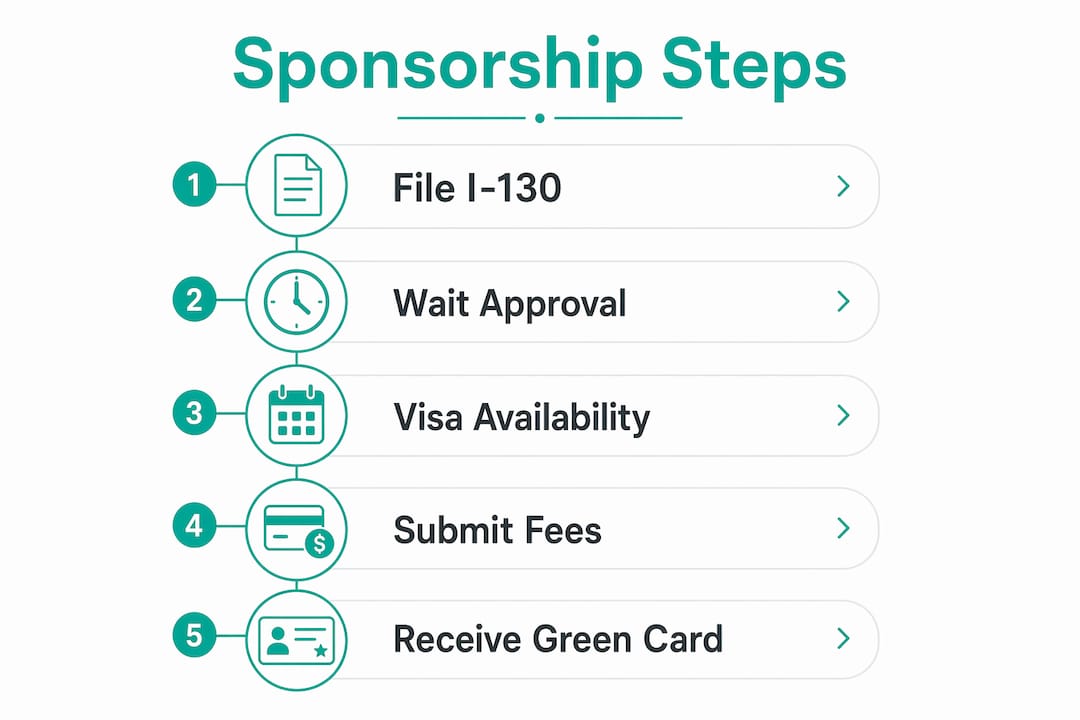
The family member immigration process moves through distinct stages. Each stage has its own forms, fees, and timelines. Missing a step or filing the wrong form is one of the most common reasons cases stall.
Step 1: File Form I-130
Form I-130, the Petition for Alien Relative, is the foundation of every family sponsorship green card case. You file it to prove your qualifying relationship to your relative. Required evidence includes proof of your U.S. citizenship or permanent residence, proof of the family relationship (birth certificates, marriage certificates), and government-issued photo identification. You can file online through your USCIS account or by mail to the appropriate USCIS lockbox.
Step 2: Wait for I-130 Approval and Visa Availability
I-130 approval does not grant your relative any immigration status or a Green Card. This is the single most misunderstood fact in family-based immigration. Approval simply confirms the relationship is valid. For immediate relatives, a visa is available immediately after approval. For preference category relatives, they must wait until their priority date becomes current on the Visa Bulletin.
Step 3: Choose the Right Pathway
Two pathways exist after a visa becomes available:
- Adjustment of Status (Form I-485): Your relative files this if they are physically present in the U.S. and eligible. Immediate relatives can file Form I-485 at the same time as Form I-130, which is called concurrent filing. This shortcut can save months of processing time. Read Hasan-legal's full guide on Adjustment of Status to understand eligibility requirements in detail.
- Consular Processing: If your relative is outside the U.S., the case transfers to the National Visa Center (NVC) after I-130 approval. The NVC collects fees, documents, and then schedules an immigrant visa interview at a U.S. embassy or consulate. Hasan-legal's guide on Consular Processing covers each step in this pathway.
Step 4: Verify Filing Fees
Filing fees change periodically. Use the USCIS Fee Calculator before submitting any packet. Submitting the wrong fee amount results in automatic rejection, which restarts your timeline.
| Form | Purpose | Filed By |
|---|---|---|
| I-130 | Establish qualifying relationship | Sponsor (petitioner) |
| I-864 | Prove financial support | Sponsor |
| I-485 | Apply for Green Card (in U.S.) | Beneficiary (relative) |
| DS-260 | Immigrant visa application (abroad) | Beneficiary (relative) |
Pro Tip: Assemble all documents into a clearly labeled bundle before filing. USCIS officers review hundreds of packets daily. A well-organized submission reduces the chance of a Request for Evidence (RFE), which can delay your case by three to six months.
What are the financial requirements for sponsoring a relative?
The Affidavit of Support, filed on Form I-864, is a legally binding contract. You agree to financially support your relative and repay any means-tested government benefits they receive. This obligation continues until your relative becomes a U.S. citizen, works 40 qualifying quarters, or permanently leaves the country.
Income Thresholds for 2026
Your household income must reach at least 125% of the HHS Poverty Guidelines for your household size. The 2026 guidelines took effect on march 1, 2026. As a practical example, a sponsor with a household of three (sponsor, spouse, and one beneficiary) must demonstrate income well above the federal poverty line for that household size. Active duty military sponsors qualify at 100% of the guidelines rather than 125%.
What Counts as Household Income
- Your own income from employment, self-employment, or other sources
- Income from any household members who sign a Form I-864A (Household Member Contract)
- Assets can substitute for income shortfalls in some cases, valued at one-fifth of their total
What to Submit with Form I-864
Practitioners at Hasan-legal compile documentation bundles that include up to three years of federal tax returns, recent pay stubs, and employer letters. USCIS requires this evidence to verify your financial capacity. Submitting only one year of returns when your income fluctuates is a common mistake that triggers RFEs.
Joint Sponsors
If your income falls short, a joint sponsor can help. A joint sponsor must be a U.S. citizen or permanent resident, at least 18 years old, and domiciled in the United States. They take on the same legal obligations as the primary sponsor. The joint sponsor does not need to be related to you or your relative.
What are the most common mistakes when sponsoring a family member?
The green card application process has predictable failure points. Knowing them in advance keeps your case on track.
Confusing I-130 Approval with a Green Card
This is the most frequent misunderstanding in family-based immigration. USCIS is explicit: I-130 approval is not a Green Card and does not grant any legal status. Sponsors who stop taking action after approval cause their relative's case to stall indefinitely.
"Filing I-130 only starts the Green Card process. Sponsors and beneficiaries must plan for additional steps such as visa availability and status applications." — USCIS
Waiting Too Long to File Downstream Applications
Once a visa becomes available, beneficiaries have a limited window to file Form I-485 or complete their consular interview. Missing this window can cause the priority date to lapse.
Documentation Errors
Common errors include:
- Submitting expired identity documents
- Failing to include certified translations for foreign-language documents
- Omitting a joint sponsor's Form I-864 when the primary sponsor's income is insufficient
- Forgetting to include derivative beneficiaries (children of the primary beneficiary) in the petition
Incorrect Fee Submission
Always verify current fees using the USCIS Fee Calculator before mailing any packet. A fee that was correct six months ago may no longer be accurate.
Derivative Beneficiaries
If your relative has children, those children may qualify as derivative beneficiaries on the same petition. Each derivative beneficiary must meet their own eligibility requirements. Overlooking this step means filing separate petitions later, which adds time and cost.
Key takeaways
Sponsoring a family member for a Green Card requires filing Form I-130 to establish the relationship, meeting the 2026 Affidavit of Support income thresholds, and completing either Adjustment of Status or Consular Processing depending on where your relative lives.
| Point | Details |
|---|---|
| I-130 is the starting point | Filing Form I-130 establishes the qualifying relationship but does not grant any immigration status. |
| Immediate relatives move faster | Spouses, parents, and unmarried children under 21 of U.S. citizens face no annual visa caps. |
| Financial proof is legally binding | Form I-864 commits you to supporting your relative at 125% of the 2026 HHS Poverty Guidelines. |
| Two pathways exist after approval | Relatives in the U.S. use Adjustment of Status; those abroad use Consular Processing through the NVC. |
| Concurrent filing saves time | Immediate relatives can file Form I-130 and Form I-485 at the same time to reduce total wait time. |
What i've learned after years of family sponsorship cases
The biggest mistake I see sponsors make is treating Form I-130 approval as the finish line. It is the starting line. Clients come to me months after approval, confused about why their relative still has no status. The answer is always the same: no one filed the next step.
The second pattern I see constantly is underprepared Affidavit of Support packages. Sponsors submit one year of tax returns when their income history is inconsistent, or they forget to include a joint sponsor when their income falls short. USCIS does not call you to ask for missing documents right away. They issue an RFE, which adds months to your timeline and creates unnecessary stress.
My honest advice: treat this process like a legal contract, because it is one. The I-864 is a binding financial commitment. The I-130 is a sworn statement. Every document you submit carries legal weight. Accuracy and completeness matter more than speed.
When should you seek legal help? If your relative falls under a preference category with a long wait, if there are any prior immigration violations in the picture, or if your income situation is complicated, consult an immigration attorney before filing. The cost of getting it right the first time is always lower than the cost of fixing a rejected or delayed case.
Patience is not optional in this process. Some preference category cases take years. But thorough preparation at every stage, from the initial I-130 through the final interview, is the single factor most within your control.
— Mahmudul
Ready to sponsor your family member? Hasan-legal can help
Navigating the family sponsorship green card process on your own is possible, but one missed document or incorrect fee can set your case back by months.
Hasan-legal's team, led by Mahmudul Hasan, Esq., handles every stage of the family-based immigration process directly. From preparing your Form I-130 and Affidavit of Support to guiding your relative through their consular interview or Adjustment of Status filing, every case receives personal attorney oversight. Explore Hasan-legal's full range of immigration services or request a free case evaluation to get a clear picture of your options before you file.
FAQ
What is form i-130 and why do you need it?
Form I-130 is the Petition for Alien Relative filed with USCIS to establish a qualifying family relationship. Approval alone does not grant immigration status; it is the required first step before any Green Card application can proceed.
How long does it take to sponsor a family member?
Processing time depends on the relationship category. Immediate relatives of U.S. citizens typically move faster because no visa cap applies, while family preference categories can involve waits of several years depending on the country of birth and category.
Can a green card holder sponsor family members?
Yes, but with limits. Permanent residents can sponsor spouses and unmarried children, but they cannot petition for parents, siblings, or married children. Only U.S. citizens hold full petitioning rights across all immediate relative and preference categories.
What happens if you do not meet the income requirement?
If your income falls below 125% of the 2026 HHS Poverty Guidelines, you can add a joint sponsor who meets the threshold independently. Assets may also substitute for income shortfalls in certain situations.
What is the difference between adjustment of status and consular processing?
Adjustment of Status applies when your relative is already in the United States and eligible to apply for a Green Card without leaving. Consular Processing applies when your relative is abroad and must attend an immigrant visa interview at a U.S. embassy or consulate before entering the country as a permanent resident.
Recommended
- Consular Processing, Explained: How to Obtain a Green Card from Outside the United States | Hasan Legal PC
- Adjustment of Status, Explained: How to Apply for a Green Card from Inside the U.S. | Hasan Legal PC
- The Follow-to-Join Process: Using Form I-824 to Bring Your Family to the United States | Hasan Legal PC
- Family of Refugees and Asylees: How to Petition for Your Spouse and Children | Hasan Legal PC