

An immigration case is denied when the evidence or information provided fails to establish eligibility or lawfulness under U.S. immigration law. This is the formal definition used by U.S. Citizenship and Immigration Services (USCIS) and consular officers worldwide. Understanding immigration case denied reasons is not just reassuring. It is the first step toward building a stronger response, whether that means filing Form I-290B, requesting a waiver, or reapplying with corrected documentation. The USCIS Policy Manual, USA.gov, and INA section 214(b) each define specific grounds that lead to denial, and knowing which applies to your case determines every option available to you.
What are the most common reasons immigration cases get denied?
Denial causes span a wide range, but most fall into five clear categories. Recognizing which category applies to your case is the fastest way to identify your next move.
Evidence problems are the leading cause of USCIS denials. Insufficient or irrelevant evidence means the record does not prove eligibility, even if documents were submitted. USCIS adjudicators evaluate the totality of the record, not just whether a document exists. A letter of support that lacks specific details, for example, carries little weight regardless of who signed it.

Incomplete or missing paperwork triggers automatic rejections and denials. Missing signatures, undated forms, or absent supporting documents give USCIS no basis to approve a petition. This is one of the most preventable denial reasons, yet it remains among the most frequent.
Inconsistent or incorrect information across forms, prior filings, or interviews raises credibility concerns. A discrepancy between a DS-160 form and a consular interview answer, for instance, signals misrepresentation under INA standards. USCIS officers and consular officers are trained to identify these inconsistencies, and they weigh them heavily.
Statutory inadmissibility covers criminal history, prior immigration violations, fraud, and certain health grounds. These are legal bars to approval that no amount of additional evidence can overcome without a separate waiver application.
Failure to respond or appear includes missing a scheduled interview, ignoring a Request for Evidence (RFE), or not responding to a Notice of Intent to Deny (NOID). Each of these is a procedural failure that typically results in denial by default.
For visa applicants specifically, INA section 214(b) creates a legal presumption of immigrant intent. Every B-1/B-2 visitor visa applicant is presumed to intend to immigrate unless they can prove otherwise through strong home-country ties, financial stability, and credible travel purpose.
Pro Tip: Review every form you submitted against your denial notice line by line. Most denial notices reference specific evidentiary or procedural deficiencies. Matching those references to your submission reveals exactly what to fix.
How does USCIS processing differ from consular visa denials?
The process, criteria, and recourse options differ significantly between a USCIS denial and a consular visa refusal. Treating them as the same leads to wasted time and missed deadlines.
| Factor | USCIS Denial | Consular Visa Refusal |
|---|---|---|
| Primary focus | Eligibility evidence and statutory compliance | Intent, admissibility, and INA legal standards |
| Denial notice | Detailed written decision with specific reasons | Often brief; includes refusal code under INA |
| Appeal option | Form I-290B to Administrative Appeals Office (AAO) | No formal appeal; reapplication or waiver |
| Waiver process | Separate waiver petition if inadmissibility applies | Waiver eligibility determined by refusal code |
| Governing body | USCIS (Department of Homeland Security) | U.S. Embassy or Consulate (Department of State) |
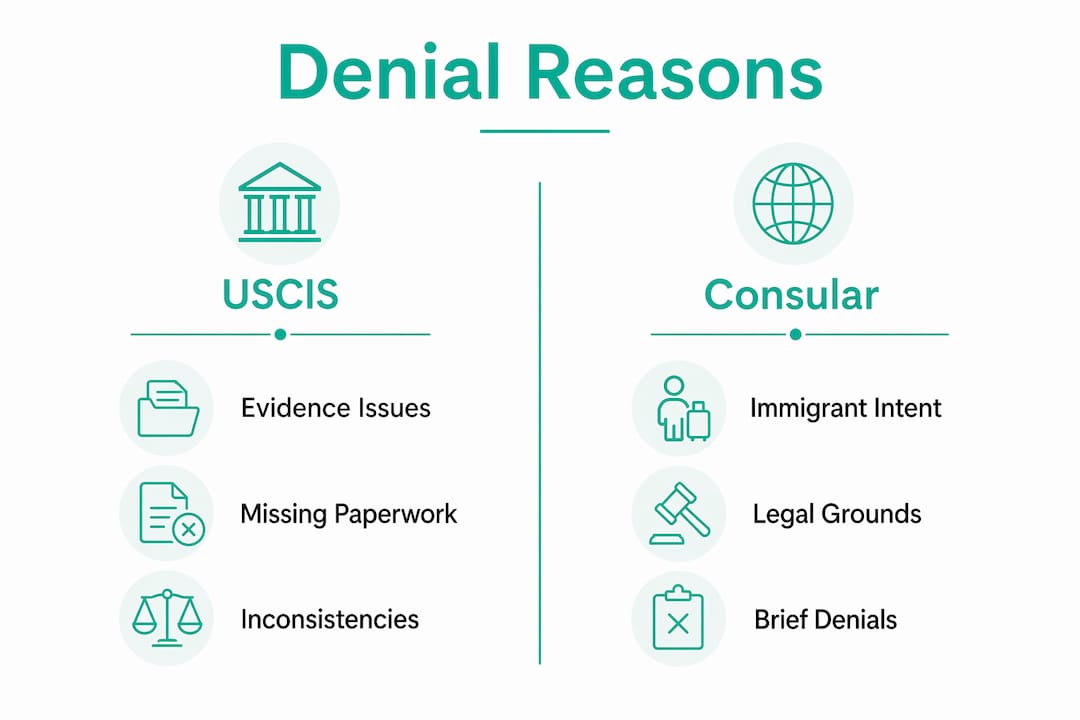
USCIS denials come with detailed written decisions. The officer must explain the legal basis for denial, which gives you a clear target for an appeal or motion. The USCIS Policy Manual requires adjudicators to weigh evidence based on credibility and legal eligibility, not just formal document labels. This means a well-documented appeal that directly addresses the officer's stated reasoning has a real path to success.
Consular refusals operate differently. The denial letter is typically brief and references an INA section rather than a detailed factual analysis. Visa refusal codes determine whether a waiver is even possible, making those codes the first thing to decode after any consular refusal. An INA 214(b) refusal, for example, does not require a waiver. It requires a stronger showing of non-immigrant intent on reapplication.
The Administrative Appeals Office (AAO) handles appeals for most USCIS petition denials. The Board of Immigration Appeals (BIA) handles certain other immigration court matters. Consular decisions, by contrast, fall under the Department of State's jurisdiction and are not subject to AAO review. Understanding which agency controls your case determines which procedural path is even available to you.
What are the critical deadlines and options after a denial?
Time is the most unforgiving factor in the immigration denial appeal process. Missing a deadline does not just delay your case. It can eliminate your right to appeal entirely.
-
File Form I-290B within 30 calendar days. USCIS requires appeals or motions to be filed within 30 days of the denial decision, or 33 days if the decision was mailed. Special revocations carry shorter windows. Late filings are rejected under most circumstances.
-
Respond to RFEs and NOIDs within the stated deadline. USCIS sets specific response windows in each notice, typically 87 days for RFEs. Missing these deadlines results in denial based on the existing record, with no opportunity to supplement.
-
Assess waiver eligibility before reapplying after a visa refusal. USA.gov recommends that applicants first determine whether a waiver of inadmissibility applies before assuming reapplication alone will resolve the issue. Skipping this step leads to repeated denials on the same grounds.
-
Choose between a motion to reopen and a motion to reconsider. A motion to reopen introduces new facts or evidence. A motion to reconsider argues that the law was applied incorrectly. These are distinct legal tools, and selecting the wrong one wastes both time and filing fees.
-
Monitor your case status through the USCIS online portal. Case status updates, RFE notices, and denial decisions are posted online. Checking regularly prevents missed deadlines caused by mail delays or address errors.
Pro Tip: Set a calendar alert the day you receive any USCIS notice. Count the deadline from the date on the notice, not the date you received it. Those extra days matter.
How can applicants effectively address and overcome denial reasons?
Overcoming a denial requires targeting the specific reason the officer cited, not submitting more of the same documentation. Reapplying without addressing the denial reason rarely succeeds. Officers review prior denials, and an identical submission signals that the applicant did not understand or take the denial seriously.
Here is what actually moves the needle:
-
Address evidentiary shortcomings precisely. If USCIS found your evidence lacked probative value, submit documentation that directly answers the officer's stated concern. Quality and relevance matter far more than volume. A single well-drafted expert letter that speaks to the specific legal standard outweighs ten generic support letters. You can review documentation requirements for adjustment of status cases to understand what USCIS considers sufficient.
-
Correct all inconsistencies before reapplying. Review every prior filing, interview transcript, and supporting document for conflicting statements. Even minor discrepancies in dates, addresses, or employment history can trigger credibility concerns that override otherwise strong evidence.
-
Demonstrate concrete ties for visa cases. For B-1/B-2 and similar non-immigrant visas, abstract claims of intent to return are not enough. Bank statements, property records, employment contracts, and family documentation in your home country provide the concrete proof consular officers require under INA 214(b).
-
Respond comprehensively to RFEs and NOIDs. A partial response is treated as a weak response. Address every point raised in the notice, provide supporting evidence for each, and organize your response to mirror the structure of the officer's questions. Learn more about how USCIS handles NOIDs and what procedural steps follow.
-
Seek legal counsel for inadmissibility issues. Criminal history, prior deportations, and fraud findings require waiver applications that involve separate legal standards. Attempting these without professional guidance significantly reduces approval odds.
-
Understand that material change matters. If your circumstances have genuinely changed since the denial, document that change thoroughly. A new job offer, a resolved legal matter, or updated financial records can constitute the material change needed to support a successful reapplication.
Key takeaways
Immigration cases are denied primarily because submitted evidence fails to meet USCIS evidentiary standards or because applicants fail to address statutory inadmissibility, procedural requirements, or consistency across filings.
| Point | Details |
|---|---|
| Evidence quality over quantity | USCIS weighs relevance and probative value, not document count. |
| Deadlines are absolute | Form I-290B must be filed within 30 days; missing this window typically ends appeal rights. |
| USCIS and consular denials differ | Each has distinct recourse options, governing agencies, and procedural paths. |
| Reapplication requires material change | Submitting the same application after denial almost always produces the same result. |
| Waiver eligibility must be checked first | Visa refusal codes determine whether a waiver is required before any reapplication strategy works. |
What I've learned from handling denial cases firsthand
After working through hundreds of denial cases, the pattern I see most often is not missing documents. It is mismatched evidence. An applicant submits a strong-looking file, but the documents answer a different question than the one the officer was asking. USCIS adjudicators decide cases based on what the record actually proves, not what the applicant intended to show. That distinction matters enormously when building an appeal.
The second thing I see consistently is applicants underestimating how much a single inconsistency can damage an otherwise solid case. A date that differs by one year between a prior filing and a current form can shift an officer's entire credibility assessment. I always tell clients: before you submit anything, read every document as if you are looking for a reason to deny it.
On the procedural side, I cannot overstate how often the 30-day appeal window catches people off guard. Applicants receive a denial, spend two weeks processing it emotionally and logistically, and then discover they have less than two weeks to file Form I-290B. Treat that deadline as a hard stop from the moment the notice arrives. Common EB-1A denial patterns show that procedural missteps, not just weak evidence, account for a significant share of preventable losses.
Finally, do not assume that a consular refusal is the end of the road. Understanding the refusal code, checking waiver eligibility, and building a materially stronger application for the next submission has produced successful outcomes for many clients who initially believed their case was closed.
— Mahmudul
How Hasan Legal PC can help after an immigration denial
Receiving a denial does not mean your case is over. It means you need a clear-eyed assessment of what went wrong and a precise plan to address it.
At Hasan Legal PC, attorney Mahmudul Hasan, Esq. personally reviews every denial case to identify the specific evidentiary, procedural, or legal issues that led to the outcome. Whether you are facing a USCIS petition denial, a consular visa refusal, or an RFE you are unsure how to answer, the team provides direct, personalized guidance on your strongest available options. Explore the full range of immigration legal services available, or request a free case evaluation to get a clear picture of your next steps before any deadlines pass.
FAQ
What is the most common reason an immigration case gets denied?
Insufficient or irrelevant evidence is the most frequently cited reason for USCIS denials. Incomplete documentation and inconsistent information across forms are close behind.
How long do I have to appeal a USCIS denial?
Form I-290B must generally be filed within 30 calendar days of the denial decision, or 33 days if the decision was mailed to you.
Can I reapply after a visa denial?
Yes, but reapplying without addressing the specific denial reason rarely succeeds. You should first check whether a waiver applies, then build a materially stronger application before resubmitting.
What is INA section 214(b) and why does it cause so many visa denials?
INA 214(b) presumes that every non-immigrant visa applicant intends to immigrate permanently. Applicants must affirmatively prove strong ties to their home country, financial stability, and credible travel intent to overcome this presumption.
What is the difference between a motion to reopen and a motion to reconsider?
A motion to reopen introduces new facts or evidence not previously in the record. A motion to reconsider argues that USCIS applied the law incorrectly to the existing facts. Choosing the right one depends entirely on the nature of the denial.
Recommended
- Types of Affirmative Asylum Decisions: Grant, Referral, NOID, Denial, and What Each Means | Hasan Legal PC
- Questions and Answers: Affirmative Asylum Eligibility and Applications | Hasan Legal PC
- U.S. Visa Types & Green Card Categories | Hasan Legal PC
- Affirmative Asylum Frequently Asked Questions: Background Checks, Interviews, Decisions, and More | Hasan Legal PC