

The marriage green card process allows a foreign spouse to become a lawful permanent resident of the United States based on marriage to a U.S. citizen or permanent resident. Formally called adjustment of status or consular processing depending on where you live, this path falls under the immediate relative category for spouses of U.S. citizens. That category has no annual visa cap, which means no waiting in a backlog queue. The two core USCIS forms driving this process are Form I-130, Petition for Alien Relative, and Form I-485, Application to Register Permanent Residence. Knowing how these forms connect, and what comes after, is the foundation of a successful application.
What are the eligibility requirements for a marriage green card?
A marriage green card requires two conditions to be met at the same time. First, the marriage must be bona fide, meaning it was entered into genuinely and not solely to obtain immigration benefits. Second, the foreign spouse must have been lawfully admitted or paroled into the United States if applying from inside the country. These two requirements are non-negotiable and apply regardless of how long the couple has been married.
Who qualifies as an immediate relative?
Spouses of U.S. citizens qualify as immediate relatives under federal immigration law. This is the most favorable category because it carries no annual numerical limit. Spouses of lawful permanent residents, by contrast, fall under the family preference system and face longer waits due to visa caps.

Documents you need to gather
Collecting the right paperwork before you file saves weeks of back-and-forth with USCIS. A complete document checklist for adjustment of status includes:
- Marriage certificate (government issued, with certified translation if not in English)
- Proof of U.S. citizenship or permanent residency of the petitioning spouse (passport, naturalization certificate, or green card)
- Evidence of bona fide marriage: joint bank account statements, lease agreements, insurance policies, photos together, and correspondence
- Valid passport for the foreign spouse
- Birth certificates for both spouses
- Form I-864, Affidavit of Support, showing the U.S. spouse meets income requirements
- Medical examination results on Form I-693, completed by a USCIS-designated civil surgeon
Incomplete applications are one of the most common causes of extended processing times. Every missing document creates an opportunity for a Request for Evidence, which can add months to your case.
Pro Tip: Organize your bona fide marriage evidence chronologically. USCIS officers respond well to a clear timeline that shows the relationship developing naturally over time.
How do you file the marriage green card application?
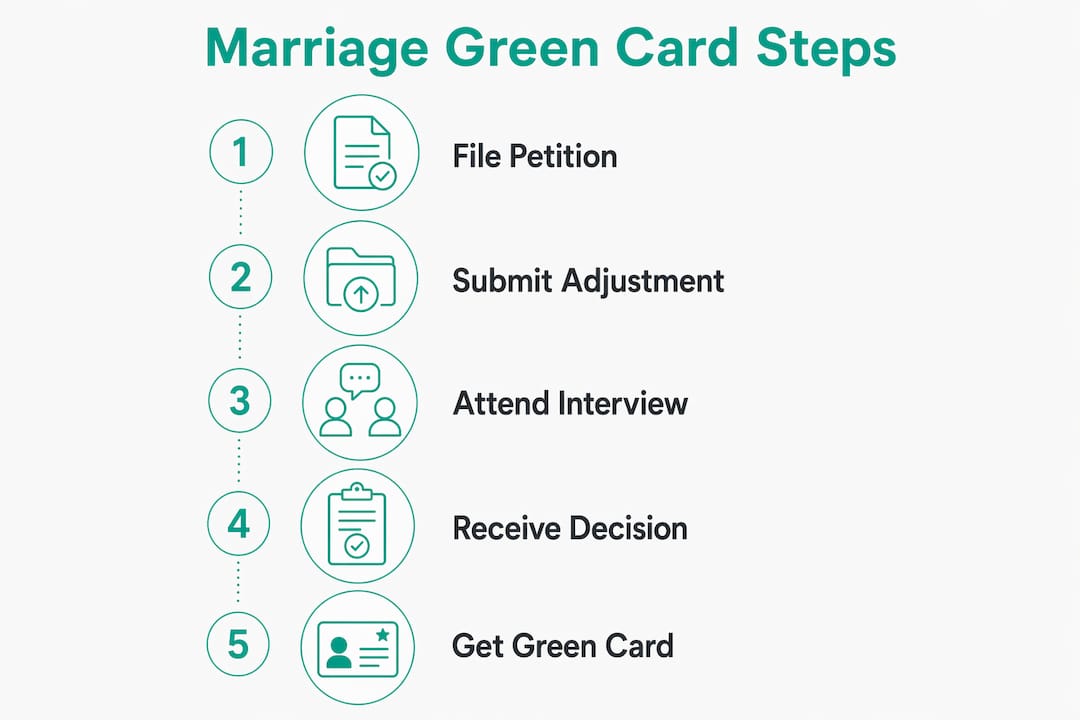
The spousal immigration process follows a defined sequence of steps. Each step has its own form, fee, and timeline. Missing a step or filing out of order can delay your case significantly.
-
File Form I-130 — The U.S. citizen or permanent resident spouse files this petition with USCIS to establish the qualifying family relationship. This is the starting point for every marriage-based petition.
-
File Form I-485 concurrently (if eligible) — Spouses of U.S. citizens living inside the United States can file Form I-485 at the same time as Form I-130. This concurrent filing option shortens the overall timeline considerably. Spouses of permanent residents must wait for I-130 approval before filing I-485.
-
Consular processing (if abroad) — If the foreign spouse lives outside the United States, the case transfers to the National Visa Center after I-130 approval, then to a U.S. embassy or consulate for an immigrant visa interview.
-
Receive biometrics appointment — USCIS schedules a biometrics appointment to collect fingerprints and photos. This typically happens within a few weeks of filing.
-
Apply for work and travel authorization — While Form I-485 is pending, applicants can apply for employment authorization and advance parole travel documents simultaneously. These documents allow you to work legally and travel outside the U.S. without abandoning your pending application.
-
Attend the green card interview — USCIS schedules an interview at a local field office. Both spouses typically attend. Officers verify the marriage is genuine and that all application information is accurate.
-
Receive the final decision — After the interview, USCIS approves or denies the application. Approved applicants receive their green card by mail within a few weeks.
| Stage | Form or Action | Typical Timing |
|---|---|---|
| Petition filing | Form I-130 | Day 1 |
| Adjustment filing | Form I-485 (concurrent) | Day 1 (with I-130) |
| Biometrics | USCIS appointment | 4–8 weeks after filing |
| Work/travel permits | Form I-765 / I-131 | 3–5 months after filing |
| Interview | USCIS field office | 8–14 months after filing |
| Green card issued | USCIS decision | Weeks after interview |
Pro Tip: Use the USCIS online tools to check your case status after each stage. Knowing where your case stands helps you respond quickly if USCIS sends a notice.
What is the typical timeline for a marriage green card?
Processing times vary based on where you file, USCIS workload, and whether your case requires extra review. As of june 2026, concurrent filing cases for spouses of U.S. citizens typically take 14–20 months from start to finish. That is a meaningful difference from non-concurrent filing, which can stretch to 24–28 months.
The I-485 stage alone generally takes 8–14 months after filing. That window covers biometrics, work authorization, and the interview. USCIS workload at your local field office is the single biggest variable in that range.
Factors that affect your timeline
- USCIS field office volume: Some offices process cases faster than others.
- Requests for Evidence (RFEs): An RFE pauses your case clock until you respond. Thorough initial filing prevents most RFEs.
- Background check delays: Security clearances occasionally take longer for certain nationalities or travel histories.
- Interview waiver: USCIS may waive the interview for low-risk cases with strong documentation and long-term marriages. This is an exception, not the rule, but it can shorten the process when it applies.
Setting realistic expectations matters. A 14-month timeline is not a sign that something is wrong. It is the normal pace of the green card application timeline for most applicants.
What mistakes should you avoid during the marriage green card process?
Most delays and denials trace back to a small set of avoidable errors. Knowing them in advance puts you ahead of the majority of applicants.
- Submitting incomplete forms: Every blank field that should have an answer is a red flag. Review each form twice before filing.
- Weak bona fide marriage evidence: A marriage certificate alone is not enough. USCIS expects to see financial ties, shared living arrangements, and a documented relationship history.
- Misrepresenting information: Inconsistencies between your forms, your interview answers, and your supporting documents raise fraud concerns. Honest, consistent information is the strongest protection you have.
- Ignoring the 90-day rule: The 90-day rule applies when a foreign national marries a U.S. citizen within 90 days of entering the U.S. on a nonimmigrant visa. USCIS may presume the original visa entry was fraudulent. Applicants in this situation need strong evidence that the marriage is genuine.
- Missing deadlines or notices: USCIS sends notices by mail. A missed biometrics appointment or RFE deadline can result in automatic denial.
Preparation is the most underrated part of the marriage green card interview. Officers are trained to spot inconsistencies. Couples who review their application together before the interview perform significantly better.
Pro Tip: If you receive an RFE, read it carefully and respond to every point it raises. A partial response is treated the same as no response.
Key takeaways
The marriage green card process is most efficient when you file concurrently, document your marriage thoroughly, and respond to USCIS notices without delay.
| Point | Details |
|---|---|
| Concurrent filing saves time | Spouses of U.S. citizens can file I-130 and I-485 together, cutting months off the timeline. |
| Bona fide marriage evidence is critical | Joint financials, photos, and shared records carry more weight than the marriage certificate alone. |
| Timeline runs 14–20 months | Concurrent filing cases for U.S. citizen spouses average 14–20 months as of 2026. |
| Work and travel permits are available | Applicants can work and travel legally while I-485 is pending with the right filings. |
| RFEs are preventable | Complete, accurate documentation at filing reduces the risk of evidence requests significantly. |
What I have learned from years of marriage green card cases
After handling hundreds of marriage-based immigration cases, the pattern I see most often is this: applicants who treat the process as a paperwork exercise struggle, and applicants who treat it as a legal case succeed. Those are two very different mindsets.
The couples who do best are the ones who document their relationship the way a journalist would document a story. They save emails, keep joint accounts, and photograph their life together. When USCIS asks for proof, they have it. The couples who struggle are the ones who assume love is self-evident. It is not, at least not to a federal agency reviewing a file.
I also want to be direct about timelines. Fourteen months feels long when you are living it. But rushing the process by filing incomplete documents to save a few weeks almost always backfires. An RFE adds months. A denial adds years. Filing correctly the first time is always the faster path.
For complex cases, particularly those involving the 90-day rule, prior visa violations, or prior immigration history, consulting an immigration attorney before filing is not optional. It is the most cost-effective decision you can make.
— Mahmudul
How Hasan-legal supports your marriage green card application
Hasan-legal works with couples at every stage of the spousal immigration process, from the initial petition through the green card interview. Attorney Mahmudul Hasan, Esq. personally oversees each case, which means you get direct legal guidance rather than a paralegal working from a checklist.

Hasan-legal's services cover case evaluation, document preparation, RFE responses, and interview coaching. Whether you are filing from inside the United States or abroad, the team builds a case file designed to minimize delays and present your marriage clearly. Schedule a free case evaluation to get a clear picture of where your case stands and what steps come next. You can also review the full range of immigration legal services Hasan-legal offers for family-based applicants.
FAQ
What is the marriage green card process?
The marriage green card process is the legal path by which a foreign spouse of a U.S. citizen or permanent resident applies for lawful permanent residency. It involves filing Form I-130 and, if eligible, Form I-485 for adjustment of status inside the United States.
How long does a marriage green card take in 2026?
Concurrent filing cases for spouses of U.S. citizens typically take 14–20 months as of june 2026. Non-concurrent cases can take 24–28 months depending on USCIS workload and case complexity.
What documents are required for a marriage green card?
Required documents include a government-issued marriage certificate, proof of the U.S. spouse's citizenship or residency, evidence of a bona fide marriage, valid passports, Form I-864 Affidavit of Support, and a medical examination on Form I-693.
Can I work while my marriage green card is pending?
Yes. Applicants can apply for employment authorization while Form I-485 is pending by filing Form I-765. This work permit is typically issued within a few months of the I-485 filing date.
Do I have to attend an interview for a marriage green card?
Most applicants attend an interview at a USCIS field office. USCIS may waive the interview for low-risk cases with strong documentation, but this is an exception. Preparation for the interview remains important regardless of whether a waiver is possible.
Recommended
- Removal of Conditions on Permanent Residence: The I-751 Guide | Hasan Legal PC
- Consular Processing, Explained: How to Obtain a Green Card from Outside the United States | Hasan Legal PC
- Adjustment of Status, Explained: How to Apply for a Green Card from Inside the U.S. | Hasan Legal PC
- Step-by-Step Guide to the K-1 Visa Process | Hasan Legal PC