

PhD holders in the United States have two primary Green Card pathways: the EB-1A Extraordinary Ability category and the EB-2 National Interest Waiver (NIW). Both routes allow self-petition without employer sponsorship, making them the most practical phd holder green card options for academics and researchers. Your doctoral credentials, publications, and research impact are not just resume items. They are the raw material for a compelling immigration petition. Understanding how USCIS evaluates these credentials is what separates a successful application from a rejected one.
What PhD holder green card options are available in 2026?
The two strongest green card pathways for PhD holders are EB-1A and EB-2 NIW. A third option, EB-1B Outstanding Researcher, is also available but requires employer sponsorship. Each category sits within the employment-based preference system and targets individuals with advanced expertise. Your choice depends on your career stage, evidence strength, and how quickly you need permanent residency.
EB-1A targets individuals with extraordinary ability in sciences, arts, education, business, or athletics. EB-2 NIW targets professionals whose work serves U.S. national interests. Both categories bypass the PERM labor certification process, which is the time-consuming step that requires employers to prove no qualified American worker is available for the position.

How does the eb-1a green card work for PhD holders?
The EB-1A category does not require an employer sponsor, a job offer, or labor certification, making it one of the most flexible green card pathways for PhD graduates. You file the petition yourself, pay the filing fees, and present your evidence directly to USCIS. Premium processing is available, which means USCIS will adjudicate your case within 15 business days for an additional fee.
To qualify, you must satisfy at least 3 of 10 regulatory criteria established by USCIS. PhD holders frequently meet these criteria through academic byproducts such as peer-reviewed publications, citation counts, and editorial review roles. Other qualifying criteria include nationally or internationally recognized awards, membership in associations requiring outstanding achievement, and media coverage of your work.
Here are the most common EB-1A criteria PhD holders use:
- Published scholarly articles in peer-reviewed journals with measurable citation impact
- Peer review invitations from journals or conference committees in your field
- Original contributions of major significance, supported by letters from independent experts
- Awards and prizes recognized at the national or international level
- High citation counts and evidence of clinical, policy, or commercial impact from your research
- Media coverage of your work in professional or major trade publications
USCIS applies a preponderance of evidence standard, meaning you must show it is more likely than not that you meet each claimed criterion. Simply holding a PhD does not satisfy this standard. A curated petition with strong, specific evidence across at least 3 criteria is required.
Pro Tip: Do not list every publication you have ever written. Select the 5–10 most cited works and build a citation impact narrative around them. USCIS officers respond to clear, focused arguments, not volume.
How does the eb-2 NIW pathway work for PhD holders?
The EB-2 National Interest Waiver allows PhD holders to self-petition if they can prove their work benefits U.S. national interests, bypassing the labor certification requirement entirely. NIW is popular among academics because the eligibility bar is more accessible than EB-1A, even though processing is generally slower.
USCIS evaluates NIW petitions under the three-prong Dhanasar framework, established in 2016. To qualify, you must show:
- Your proposed work has substantial merit and national importance
- You are well-positioned to advance that work
- Waiving the job offer and labor certification requirement benefits the United States on balance
PhD holders in STEM fields, public health, national security research, and clean energy consistently build strong NIW cases. A researcher developing new cancer diagnostics, for example, can link their work directly to U.S. public health priorities. That direct connection is what makes an NIW petition succeed.
The EB-2 category also includes a traditional route with PERM labor certification. The EB-2 PERM route requires employer sponsorship and a full labor market test. Most PhD holders prefer NIW because it removes that dependency entirely.
Pro Tip: Frame your NIW petition around a specific, defined field of endeavor rather than your entire research career. USCIS evaluates whether your work in a particular area serves national interests. Broad claims weaken your case.
Eb-1a vs. eb-2 NIW: which path fits your profile?
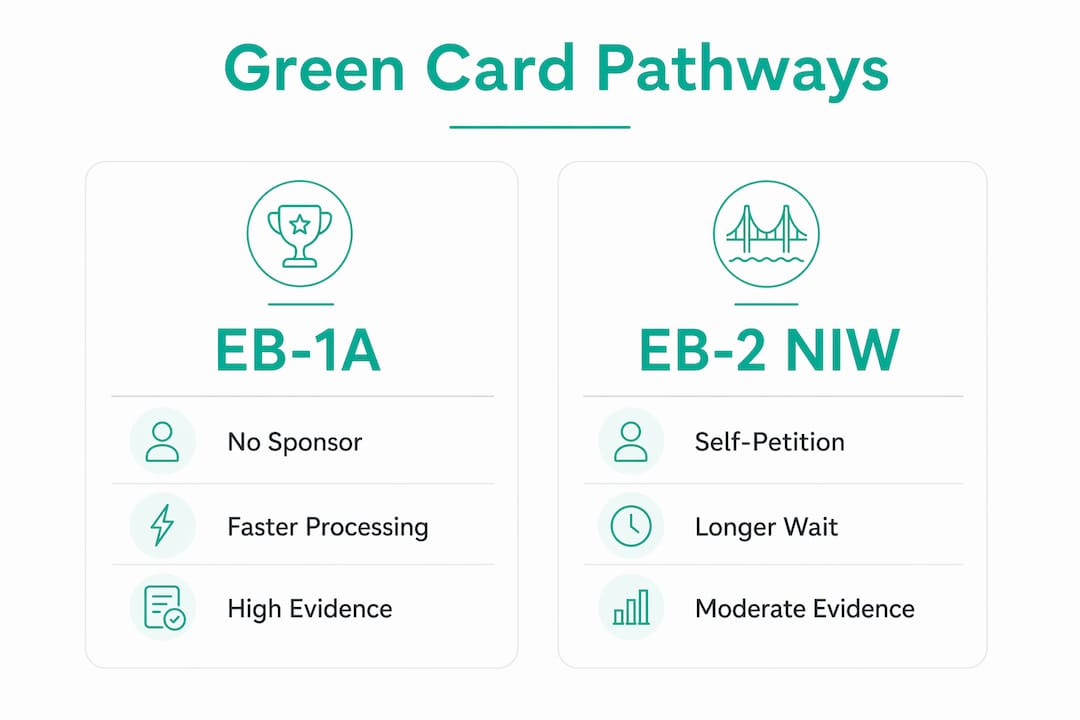
Choosing between EB-1A and EB-2 NIW is the most consequential decision in your green card strategy. The table below compares the two categories across the factors that matter most to PhD applicants.
| Factor | EB-1A Extraordinary Ability | EB-2 National Interest Waiver |
|---|---|---|
| Employer sponsorship required | No | No |
| Labor certification required | No | No |
| Evidence standard | Extraordinary ability (3 of 10 criteria) | Substantial merit + national interest |
| Premium processing available | Yes | No (as of 2026) |
| Typical processing time | Faster with premium processing | Slower, subject to priority dates |
| Best for | Senior researchers with strong citation records | Early-career PhDs with impactful research |
| Prestige level | Higher | Moderate |
EB-1A is faster and more prestigious but requires more stringent evidence. EB-2 NIW is somewhat more accessible but slower and subject to visa bulletin priority dates for applicants from high-demand countries like India and China. If your citation record is strong and your field recognizes you as a leader, EB-1A is the right target. If you are earlier in your career but your research addresses a clear U.S. national priority, NIW is the more realistic path.
What other green card pathways exist for PhD holders?
Beyond EB-1A and EB-2 NIW, PhD holders have additional options worth understanding. The EB-1B Outstanding Researcher category is the most relevant alternative. It requires employer sponsorship but exempts you from labor certification. EB-1B is a strong option if you already have a university or research institution willing to sponsor your petition.
Other pathways and considerations include:
- Family-based sponsorship: If you have a U.S. citizen or permanent resident spouse or parent, family-based categories may offer a parallel or faster route depending on your country of birth and priority date.
- O-1A visa as a bridge: The O-1A nonimmigrant visa for extraordinary ability can keep you in legal status while your Green Card petition is pending. It uses similar evidence criteria to EB-1A.
- EB-2 NIW without a PhD: The NIW category is not exclusive to doctoral graduates. Professionals with exceptional ability can also qualify, which means NIW eligibility extends beyond PhD holders in certain circumstances.
The most common misconception is that a PhD alone guarantees EB-1A approval. USCIS requires a clear, strategic demonstration of extraordinary ability, not just the existence of a doctorate. Many PhD holders have strong credentials but weak petitions because they fail to frame their evidence correctly. Working with an immigration attorney who specializes in academic cases is not optional for most applicants. It is the difference between a well-built case and a denial.
How to build a strong green card petition as a PhD holder
A strong petition is built before you file, not during the process. The preparation phase determines your outcome more than any other factor. Follow these steps to position your case effectively:
- Audit your academic record. List every publication, citation, award, peer review invitation, media mention, and grant. Identify which EB-1A criteria or NIW prongs each item supports.
- Quantify your impact. Pull your Google Scholar or Web of Science citation metrics. High citation counts and impactful publications weigh heavily in USCIS adjudications. A paper cited 200 times tells a stronger story than 20 papers cited once each.
- Secure expert recommendation letters. Letters from independent experts who do not know you personally carry more weight than letters from your dissertation advisor. Aim for 5–8 letters from recognized leaders in your specific field.
- Define your field of endeavor narrowly. A petition focused on "machine learning applications in early Alzheimer's detection" is stronger than one covering "artificial intelligence research."
- Monitor the visa bulletin. If you are from India or China and filing EB-2 NIW, your priority date determines when you can complete the process. Check the USCIS Visa Bulletin monthly.
- Engage specialized legal counsel early. An attorney experienced in PhD immigration cases will identify your strongest criteria, draft a compelling cover letter, and anticipate USCIS requests for evidence.
Pro Tip: Start building your petition file at least 12 months before you plan to file. Gathering independent expert letters, compiling citation evidence, and drafting the petition narrative takes longer than most applicants expect.
Key takeaways
PhD holders who strategically frame their academic credentials under EB-1A or EB-2 NIW have the strongest green card pathways available in the U.S. employment-based system.
| Point | Details |
|---|---|
| EB-1A requires no sponsor | PhD holders can self-petition without an employer, job offer, or labor certification. |
| Meet 3 of 10 EB-1A criteria | Publications, citations, peer review roles, and awards are the most common qualifying evidence. |
| NIW uses the Dhanasar framework | Prove substantial merit, national importance, and that a waiver benefits the U.S. |
| EB-1A processes faster | Premium processing is available for EB-1A but not for EB-2 NIW as of 2026. |
| PhD alone is not enough | USCIS requires strategic, curated evidence of extraordinary ability or national interest impact. |
What i have learned working with PhD applicants
After handling dozens of academic immigration cases, the pattern I see most often is this: brilliant researchers with genuinely impressive credentials submit weak petitions because they assume the credentials speak for themselves.
A 500-citation paper is powerful evidence. But only if you tell USCIS exactly why those citations matter, who cited your work, and what real-world impact followed. I have seen EB-1A petitions denied for applicants with strong publication records simply because the petition narrative failed to connect the evidence to the regulatory criteria.
The other mistake I see regularly is applicants choosing EB-1A when EB-2 NIW is the smarter fit for their career stage. EB-1A is not a higher goal to aspire to. It is a different standard. If your research has clear national importance but your citation record is still building, NIW is the right vehicle. Chasing EB-1A prematurely wastes time and risks a denial that complicates future filings.
Early preparation and honest self-assessment of your evidence are the two factors that most consistently predict success. Start the process earlier than you think you need to. The applicants who come to me 18 months before they want to file almost always build stronger cases than those who arrive 3 months out.
— Mahmudul
How Hasan-legal helps PhD holders secure their green card
PhD holders working through the EB-1A or EB-2 NIW process need more than general immigration advice. They need an attorney who understands how USCIS evaluates academic credentials, citation evidence, and research impact.
Hasan-legal provides personalized case evaluations for PhD holders, identifying the strongest pathway based on your specific academic record. Attorney Mahmudul Hasan, Esq. directly oversees every petition, from evidence strategy to recommendation letter preparation. The firm also guides clients through premium processing decisions for EB-1A cases. If you are ready to take the next step, explore Hasan-legal's full range of immigration legal services and schedule a consultation today.
FAQ
Does a PhD automatically qualify me for eb-1a?
No. USCIS requires a strategic demonstration of extraordinary ability across at least 3 of 10 regulatory criteria. A doctorate alone does not satisfy this standard.
Can i file eb-1a or eb-2 NIW without an employer?
Yes. Both EB-1A and EB-2 NIW are self-petition categories. You do not need a job offer or employer sponsor to file either petition.
How long does eb-2 NIW take compared to eb-1a?
EB-1A is generally faster because premium processing is available. EB-2 NIW does not currently offer premium processing and is subject to visa bulletin priority dates for certain countries.
What evidence matters most in an NIW petition?
The strongest NIW petitions clearly link your research to a specific U.S. national priority, supported by expert letters and documented evidence of impact in your field.
Can i switch from an f-1 or j-1 visa to a green card through eb-1a?
Yes. PhD students and postdoctoral researchers on F-1 or J-1 status can file EB-1A or EB-2 NIW petitions. J-1 holders subject to the two-year home residency requirement may need a waiver before adjusting status.
Recommended
- EB-2 NIW for International Doctors: From Medical Practice to Green Card | Hasan Legal PC
- Employment-Based Adjustment of Status: A Strategic Deep Dive | Hasan Legal PC
- EB-1 Visa for PhD Holders: Eligibility and Process | Hasan Legal PC
- Adjustment of Status, Explained: How to Apply for a Green Card from Inside the U.S. | Hasan Legal PC