

Professor immigration visa options are the specific U.S. visa pathways that allow foreign academics to live and work in teaching or research roles at American institutions. The two main tracks are immigrant visas, which lead to a green card, and non-immigrant visas, which authorize temporary work. Key categories include the EB-1B outstanding professor or researcher visa, the National Interest Waiver (NIW) under EB-2, the O-1 extraordinary ability visa, and the J-1 exchange visitor visa. USCIS administers all of these pathways, and each carries distinct eligibility standards, employer obligations, and processing timelines that academics must understand before applying.
What are the primary immigrant visa options available to professors?
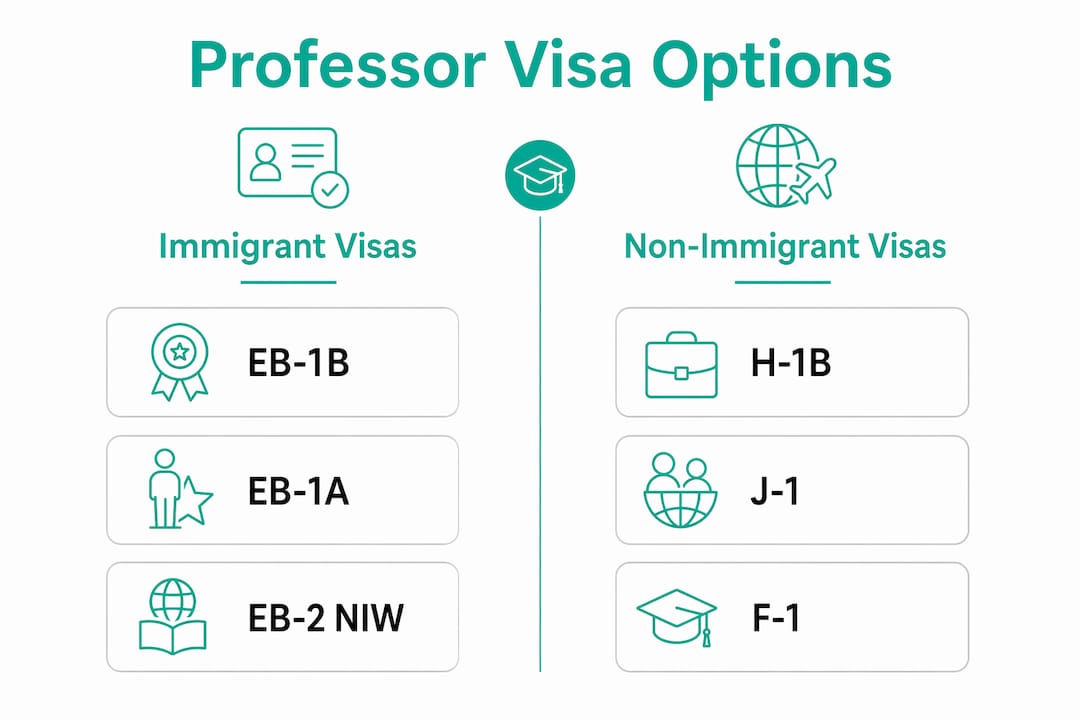
Immigrant visas for professors lead directly to a green card and permanent U.S. residency. Three categories stand out as the most practical for academics: EB-1B, EB-1A, and EB-2 with a National Interest Waiver.
EB-1B: Outstanding professor or researcher
The EB-1B is the most direct green card route for professors with established international reputations. USCIS requires international recognition, at least 3 years of teaching or research experience, and a permanent, tenured or tenure-track job offer from a qualifying U.S. institution. That last requirement catches many applicants off guard. Temporary, adjunct, or visiting positions do not qualify, regardless of how strong the candidate's academic record is.

The employer side of the petition matters as much as the professor's credentials. Universities meet EB-1B employer criteria more easily than private employers, who must demonstrate at least three full-time researchers and documented institutional accomplishments. This distinction makes university sponsorship the most reliable path for most professors. One major advantage of EB-1B is that it is exempt from PERM labor certification, which removes a lengthy and expensive step from the process.
Pro Tip: Request a formal letter from your department chair that explicitly states the position is permanent and tenure-track. USCIS scrutinizes employer documentation closely, and a vague offer letter is one of the most common reasons for a Request for Evidence.
EB-1A: Extraordinary ability, self-petition option
The EB-1A extraordinary ability category allows professors to self-petition without an employer sponsor. This is a significant advantage for academics who have not yet secured a permanent U.S. position. However, the evidentiary bar is high. USCIS expects proof of sustained national or international acclaim, typically demonstrated through major awards, high citation counts, peer review roles, or media coverage of the professor's work.
EB-2 with National Interest Waiver
The NIW under EB-2 lets professors bypass the PERM labor certification requirement by arguing their work benefits the United States. Professors in STEM fields, public health, or national security research are strong candidates. The EB-2 NIW pathway also allows self-petition, making it a practical option for academics who cannot secure employer sponsorship at the time of filing.
| Visa Category | Employer Sponsor Required | PERM Labor Certification | Key Requirement |
|---|---|---|---|
| EB-1B | Yes | No | Permanent job offer, international recognition |
| EB-1A | No | No | Sustained extraordinary ability |
| EB-2 NIW | No | No (waived) | National interest argument |
The U.S. allocates approximately 140,000 employment-based immigrant visas annually across five preference categories. EB-1 visas, which include both EB-1A and EB-1B, sit at the top of that priority order. That priority status means shorter wait times for most nationalities compared to EB-2 or EB-3 categories.
Which non-immigrant visas do professors commonly use?
Non-immigrant visas authorize temporary work in the United States. They are the standard entry point for visiting scholars, newly hired faculty, and professors who are still building the record needed for a green card petition.
The most common options for academics include:
- J-1 Exchange Visitor Visa. The J-1 is the most common classification for visiting professors and scholars in approved educational exchange programs. Employment is restricted to program-related activities, and J-1 holders must work with their program officer before accepting any outside work.
- H-1B Specialty Occupation Visa. The H-1B covers professors in specialty occupations at accredited universities. It allows multi-year authorized work and can serve as a bridge to a green card. The 2025 introduction of a $100,000 H-1B fee for new overseas hires has significantly changed how universities approach this option.
- O-1 Extraordinary Ability Visa. The O-1 visa suits professors who can document extraordinary ability through awards, publications, peer review roles, or significant contributions to their field. It does not require a permanent job offer and can be renewed in one-year increments.
- TN, E-3, and H-1B1 Visas. These nationality-specific options apply to Canadian and Mexican professors (TN), Australian nationals (E-3), and Singapore or Chile nationals (H-1B1). Each carries its own eligibility rules and annual caps.
Pro Tip: If your university is hesitant to sponsor an H-1B because of the new fee, ask your international office whether you qualify for an O-1 or a TN. Both can be processed faster and at lower cost in many cases.
J-1 holders and F-1 students face strict work restrictions, limited to on-campus or program-related employment. Accepting outside consulting or teaching without authorization can jeopardize visa status entirely.
What eligibility pitfalls should professors know before applying?
The most common reason EB-1B petitions fail is treating the employer's documentation as secondary. USCIS expects proof of a permanent, qualifying position alongside the professor's academic achievements. Both sides of the petition must be equally strong.
The following are the most critical eligibility requirements and pitfalls to address before filing:
- Confirm the position qualifies. USCIS requires a permanent, tenured or tenure-track role. Fixed-term contracts, visiting appointments, and adjunct positions do not meet this standard, even if they are renewable.
- Document international recognition specifically. General academic success is not enough. USCIS looks for evidence that peers outside the professor's home institution recognize the work, such as citation records, invitations to peer review, or named awards from international bodies.
- Verify the employer's institutional standing. Universities typically qualify without additional proof. Private research organizations must show at least three full-time researchers and a record of documented research activity.
- Prepare the offer letter carefully. The letter must state the position title, confirm it is permanent, and describe the research or teaching responsibilities. Vague language creates grounds for a Request for Evidence.
- Align the petition narrative. The I-140 petition should connect the professor's specific expertise to the employer's research mission. A generic summary of publications does not satisfy USCIS reviewers.
Pro Tip: Start gathering peer review invitations, citation reports, and international award documentation at least six months before you plan to file. Assembling this evidence retroactively under deadline pressure leads to weaker petitions.
Successful EB-1B petitions require a balanced presentation of both the professor's recognition and the employer's position eligibility. Treating either element as a formality is the fastest path to a denial.
How have 2025 and 2026 regulatory changes affected academic hiring?
The $100,000 H-1B fee introduced in 2025 has reshaped how universities recruit international faculty. The fee applies to new overseas hires but does not apply to professors who already held H-1B status as of the proclamation's effective date, even when extensions are filed. That exemption matters for retention but does little to reduce costs for new international recruits.
Universities have responded by diversifying their visa sponsorship strategies. Institutions are increasingly emphasizing O-1 visas and nationality-based work visas like TN, E-3, and H-1B1 to recruit international faculty without incurring the new H-1B fee. This shift has practical consequences for professors: your nationality and your current visa status now play a larger role in which pathway your university will sponsor.
"The current immigration environment requires academic institutions to think strategically about visa sponsorship in ways they never had to before." — Mayer Brown, 2026 Academic Institutions Immigration Report
State-level policies have added another layer of complexity. Some states have introduced restrictions that affect H-1B sponsorship decisions at public universities, creating uneven hiring conditions across the country. Professors evaluating offers from multiple institutions should ask directly about each school's current visa sponsorship policies before accepting a position.
The practical response for professors is to understand which visa categories your institution can sponsor and to raise the conversation early in the hiring process. Waiting until after an offer is accepted to discuss visa strategy wastes time and can delay your start date by months.
Key Takeaways
The most effective approach to professor immigration is combining strong academic credentials with equally strong employer documentation, then selecting the visa category that matches your career stage and your institution's sponsorship capacity.
| Point | Details |
|---|---|
| EB-1B is the top green card route | Requires international recognition, 3 years of experience, and a permanent job offer from a qualifying employer. |
| Employer documentation is non-negotiable | USCIS denies EB-1B petitions that lack proof of a permanent, qualifying position alongside academic achievements. |
| NIW and EB-1A allow self-petition | Professors without a permanent U.S. offer can file independently under these categories if they meet the evidentiary standards. |
| The $100,000 H-1B fee changes strategy | New overseas hires now trigger this fee, pushing universities toward O-1, TN, E-3, and H-1B1 alternatives. |
| Start visa planning early | Gathering international recognition evidence and coordinating with your employer at least six months before filing produces stronger petitions. |
What I have learned from years of academic immigration cases
Working with professors across career stages has taught me one consistent lesson: the academics who succeed in their visa petitions are the ones who treat immigration as a professional project, not an administrative task.
Most professors I work with are meticulous researchers. They document everything in their academic work. But when it comes to their own visa petition, they often assume that a strong CV speaks for itself. It does not. USCIS reviewers are not academics. They follow a checklist, and if the employer's documentation does not match the checklist, the petition fails regardless of how impressive the publication record is.
The other pattern I see repeatedly is professors who wait too long to engage with immigration counsel. They accept a position, assume the university's HR department will handle everything, and then discover six months later that the institution cannot sponsor the visa category they need. By that point, options are limited and timelines are compressed.
My honest recommendation is to evaluate your visa options before you accept a job offer, not after. Know whether the position qualifies for EB-1B. Know whether your nationality opens a faster path through TN or E-3. Know whether your research record supports an NIW self-petition as a backup. That preparation gives you real negotiating clarity and protects you from surprises.
The regulatory environment in 2026 is more complex than it was three years ago. Fee changes, state-level policy shifts, and evolving USCIS standards mean that what worked for a colleague two years ago may not work for you today. Staying current and working with counsel who tracks these changes is not optional. It is the difference between a smooth process and a costly delay.
— Mahmudul
How Hasan-legal supports professors through the visa process
Hasan-legal works directly with academics and their sponsoring institutions to build petitions that hold up under USCIS scrutiny. Attorney Mahmudul Hasan, Esq., personally oversees every case, which means you are not handed off to a paralegal after your initial consultation.
Hasan-legal handles EB-1B, EB-1A, NIW, O-1, and employment-based visas for professors at all career stages, from early-career researchers pursuing NIW petitions to senior faculty seeking EB-1B green cards. The firm also advises universities on institutional compliance and sponsorship strategy in light of the 2025 H-1B fee changes. Schedule a consultation through Hasan-legal's immigration services page to discuss your specific situation and identify the pathway that fits your credentials and timeline.
FAQ
What is the best green card option for a professor?
The EB-1B outstanding professor or researcher visa is the most direct green card route for academics with international recognition and a permanent U.S. job offer. Professors without a qualifying offer can pursue the EB-1A or EB-2 NIW through self-petition.
Does the EB-1B require PERM labor certification?
No. The EB-1B is exempt from PERM labor certification, which removes a significant time and cost burden from the process compared to standard EB-2 or EB-3 petitions.
What visa do visiting professors typically use?
The J-1 exchange visitor visa is the most common classification for visiting professors and scholars in approved educational exchange programs, though employment is restricted to program-related activities.
How does the $100,000 H-1B fee affect professors?
The fee applies to new overseas hires and does not apply to professors who already held H-1B status as of the proclamation's effective date. Universities are responding by sponsoring O-1, TN, E-3, and H-1B1 visas as lower-cost alternatives.
Can a professor self-petition for a green card without an employer sponsor?
Yes. Both the EB-1A extraordinary ability category and the EB-2 National Interest Waiver allow professors to self-petition without an employer sponsor, provided they meet the respective evidentiary standards set by USCIS.
Recommended
- Visa Bulletin April 2026 | Hasan Legal PC
- The H-1B Visa: Specialty Occupations, Eligibility, Cap, and the 2025–2026 Policy Landscape | Hasan Legal PC
- STEM Employment Pathways: Temporary and Permanent Options at a Glance | Hasan Legal PC
- Visa Bulletin April 2026 – Final Action & Filing Dates | Hasan Legal PC