

Traveling abroad with a pending green card application is possible, but it requires specific legal authorization to avoid losing your place in the immigration process. The formal term for this authorization is Advance Parole, and it is the document most adjustment of status applicants must carry before leaving the United States. Without it, a single international trip can cause U.S. Citizenship and Immigration Services (USCIS) to treat your Form I-485 as abandoned. This guide covers what you need, what to avoid, and how to protect your application when travel abroad with a pending green card becomes necessary.
What is Advance Parole and who needs it before traveling abroad?
Advance Parole is the required travel document for most people who have filed Form I-485, the application to adjust status to lawful permanent resident. It allows you to leave the United States and return legally while your green card case is still open. Traveling without it results in automatic abandonment of your I-485, with very limited exceptions.

You apply for Advance Parole by filing Form I-131 with USCIS. Many applicants file Form I-131 together with their I-485 at the same time, which saves time and reduces costs. If you file separately, the current filing fee is $630. Processing times vary, but USCIS typically takes several months to approve Form I-131, so you should apply well before any planned trip.
Key facts about Advance Parole every applicant should know:
- You must receive written approval before you depart. A pending I-131 does not authorize travel.
- Attending biometrics before you leave is required. If you depart before your biometrics appointment, USCIS considers the I-131 abandoned.
- Advance Parole is not a visa. It is a travel document that allows reentry, but a Customs and Border Protection (CBP) officer still has discretion at the port of entry.
- Advance Parole covers a specific validity period. Travel after that period expires is not authorized.
Pro Tip: File Form I-131 at the same time as your I-485 to reduce wait time and avoid gaps in travel authorization. Never book international travel until you hold the physical approved document in your hands.
Who does not need Advance Parole?
Certain visa holders are exempt from the Advance Parole requirement. If you hold a valid, unexpired H-1B or L-1 visa and maintain that nonimmigrant status, you can travel and reenter the U.S. on your existing visa while your I-485 is pending. K-3 and K-4 visa holders also fall under this exception. The key condition is that your nonimmigrant status must remain valid throughout the trip. If your H-1B or L-1 status expires while you are abroad, you lose this exception. Review the adjustment of status rules carefully before relying on a visa exception.
What are the travel restrictions and risks for green card applicants?
The biggest risk is application abandonment. Traveling abroad without approved Advance Parole while your I-485 is pending causes USCIS to treat your case as abandoned. That means you lose all filing fees paid, all time invested, and your priority date may not be preserved depending on your category.
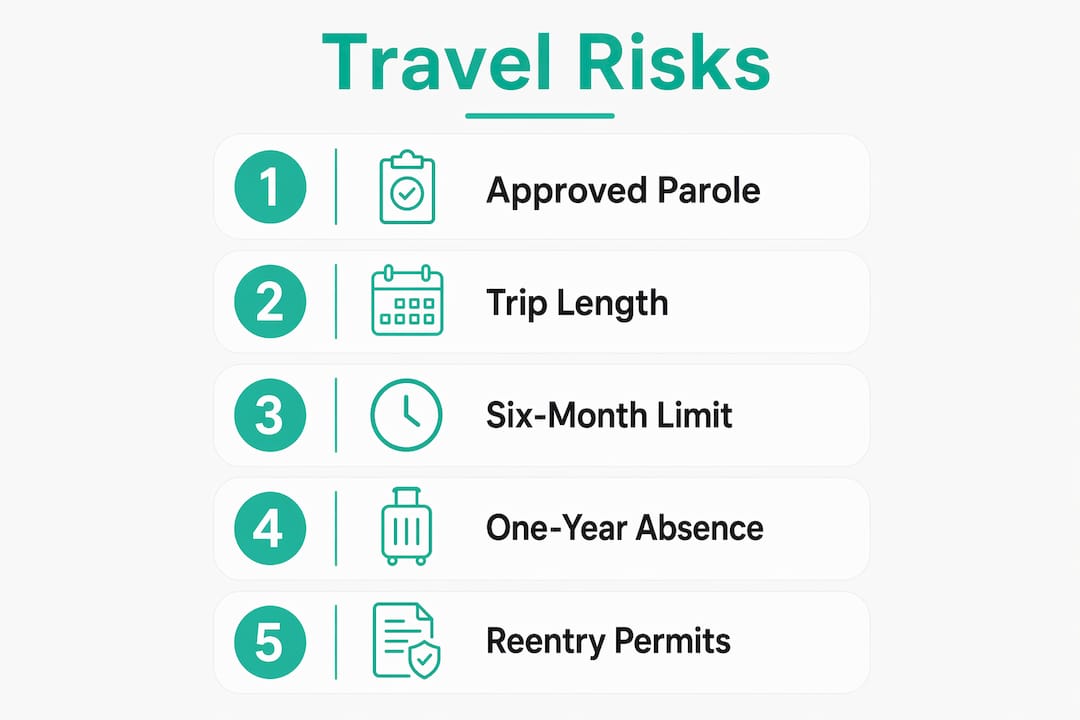
Trip length creates a second layer of risk, even for those with proper authorization. A single absence longer than six months can trigger a presumption of abandonment of permanent residency. This means CBP officers may question whether you truly intend to make the United States your permanent home. The burden falls on you to prove otherwise with documentation.
Absences that reach one year are even more serious. Leaving for a year or more without a reentry permit can render your green card invalid for reentry purposes. A reentry permit, also filed on Form I-131, must be applied for before you depart. It is designed for green card holders who already have their card but anticipate extended international stays.
In 2026, immigration enforcement screening has grown stricter. Green card holders and visa holders who traveled in the Democratic Republic of the Congo, Uganda, or South Sudan within 21 days before attempting U.S. entry now face Ebola-related entry restrictions. This applies regardless of your travel document status. The restriction reflects a broader pattern of health-based and security-based entry controls that can affect applicants at any stage.
Additional risks to keep in mind:
- CBP officers conduct secondary inspections at ports of entry. You may face detailed questioning about your ties to the United States.
- Changes in immigration policy can affect pending applications mid-process. The USCIS adjustment of status memo from 2026 reflects ongoing policy shifts that applicants must monitor.
- Travel to certain countries may raise national security flags that complicate reentry, independent of your travel documents.
How to prepare and document your travel with a pending application
Preparation is the difference between a smooth reentry and a nightmare at the border. Follow these steps before any international trip while your I-485 is pending.
- File Form I-131 early. Submit your Advance Parole application as soon as your I-485 is filed. Check I-485 processing times to understand how long your overall case may take and plan travel windows accordingly.
- Complete biometrics before departure. USCIS schedules a biometrics appointment after you file Form I-131. Attend this appointment before you leave the country. Missing it abandons your travel document application.
- Wait for written approval. Do not book flights until you hold the approved Advance Parole document. A receipt notice is not approval.
- Gather your travel document packet. Carry all of the following every time you travel:
| Document | Purpose |
|---|---|
| Approved Advance Parole (Form I-512L) | Authorizes reentry to the U.S. |
| Valid passport | Required for international travel |
| I-485 receipt notice | Proves your application is pending |
| Biometrics appointment notice | Confirms USCIS processing |
| Evidence of U.S. ties | Supports your intent to return |
- Compile proof of U.S. ties. Carrying evidence such as a lease agreement, employer letter, recent tax returns, and bank statements demonstrates that you maintain a permanent home in the United States. CBP officers look for this during reentry screening.
- Plan for emergencies. If a family emergency forces you to travel before your Advance Parole is approved, contact an immigration attorney immediately. Emergency Advance Parole is available in limited circumstances, but it requires documentation of the emergency and fast action.
Pro Tip: Make digital and physical copies of every document in your travel packet. Store copies in a secure cloud folder you can access from abroad. If documents are lost or stolen overseas, you will need them to work with the U.S. embassy.
What exceptions and special situations exist for pending green card travelers?
Not every applicant faces the same rules. Your specific visa category and circumstances determine which travel rules apply to you.
Nonimmigrant visa holders with a pending I-485
H-1B and L-1 visa holders can travel and reenter on their existing visas without Advance Parole, provided their status remains valid. This is a meaningful exception because H-1B and L-1 holders often have employer-sponsored travel obligations. However, the exception disappears the moment your nonimmigrant status lapses. If your H-1B is expiring soon, apply for Advance Parole as a backup before your status ends. Learn more about nonimmigrant visa pathways and how they interact with adjustment of status.
Reentry permits for green card holders
A reentry permit is different from Advance Parole. It applies to people who already hold a green card and need to stay outside the United States for an extended period. The permit is valid for up to two years and must be filed before departure. It does not guarantee reentry, but it significantly strengthens your case at the border.
| Document | Who needs it | When to file |
|---|---|---|
| Advance Parole (Form I-131) | I-485 applicants without valid H-1B/L-1 | Before any international travel |
| Reentry Permit (Form I-131) | Green card holders planning long absences | Before departure from the U.S. |
| Valid H-1B or L-1 Visa | Nonimmigrant visa holders with pending I-485 | Maintain valid status throughout trip |
Conditional residents and Form I-751
If you hold a two-year conditional green card and have filed Form I-751 to remove conditions, travel rules still apply. You must carry your expired conditional green card, your I-751 receipt notice, and any valid travel document. CBP officers will review all of these at reentry.
When to consult an immigration attorney
Complex situations require professional guidance. If your case involves prior immigration violations, travel to restricted countries, a pending I-751, or an upcoming USCIS interview, consult an attorney before booking any travel. The USCIS discretion factors that affect adjustment of status decisions can be influenced by how your travel history is documented and presented.
Key takeaways
Traveling abroad while your I-485 is pending requires approved Advance Parole in hand before departure, or a valid H-1B or L-1 visa that maintains your nonimmigrant status throughout the trip.
| Point | Details |
|---|---|
| Advance Parole is mandatory | Most I-485 applicants must have written approval before leaving the U.S. |
| Biometrics must come first | Departing before your biometrics appointment abandons your Form I-131. |
| Trip length matters | Absences over six months trigger scrutiny; one year can invalidate reentry rights. |
| Visa exceptions exist | Valid H-1B and L-1 holders can travel without Advance Parole if status remains active. |
| Documentation protects you | Carry your approval notice, passport, receipt notices, and proof of U.S. ties every time. |
My honest assessment of travel planning with a pending green card
I have worked with hundreds of clients who underestimated the complexity of traveling while their I-485 was pending. The most common mistake I see is not the absence of Advance Parole. It is the assumption that a pending I-131 is good enough to travel on. It is not. I have seen clients board flights with a receipt notice in hand, believing they were covered, only to face serious complications at reentry.
The second pattern I see regularly is clients who wait until a family emergency forces them to travel. At that point, options are limited and stress is high. Early filing of Form I-131 alongside the I-485 is the single most protective step you can take. It costs nothing extra if filed concurrently, and it gives you a legal safety net.
In 2026, enforcement at ports of entry has become more unpredictable. CBP officers have broader discretion, and the Ebola-related restrictions affecting travelers from parts of Central Africa are a clear signal that health-based entry controls can appear quickly and apply broadly. My advice is to treat every international trip as a legal event, not just a personal one. Document everything, carry everything, and never assume your situation is straightforward without confirming it with an attorney first.
The applicants who navigate this process well are the ones who plan months ahead, not days ahead.
— Mahmudul
How Hasan-legal can help you travel safely and protect your application
Protecting your green card application while managing international travel obligations requires precise legal guidance. At Hasan-legal, attorney Mahmudul Hasan, Esq. personally reviews every case to identify travel risks, prepare Form I-131 filings, and advise on the documentation you need at the border.
Whether you need help filing for Advance Parole, understanding your visa exception, or preparing for a CBP secondary inspection, Hasan-legal provides the personalized attention your case deserves. Start with a free case evaluation to discuss your travel situation and pending application. You can also explore the full range of immigration services Hasan-legal offers to green card applicants at every stage of the process.
FAQ
Can I travel abroad while my green card application is pending?
Yes, but only with approved Advance Parole or a valid H-1B or L-1 visa. Traveling without authorization causes USCIS to treat your I-485 as abandoned.
How long does it take to get Advance Parole approved?
USCIS processing times for Form I-131 vary and can take several months. File as early as possible, and never travel until you hold the written approval document.
What happens if I leave the U.S. for more than six months?
An absence longer than six months triggers a presumption that you have abandoned your permanent residency. You will need strong evidence of U.S. ties to overcome that presumption at reentry.
Do H-1B visa holders need Advance Parole to travel?
No. H-1B and L-1 visa holders with valid, unexpired status can reenter the U.S. on their existing visas while their I-485 is pending. The exception applies only as long as that nonimmigrant status remains active.
What documents should I carry when reentering the U.S. with a pending green card?
Carry your approved Advance Parole document, valid passport, I-485 receipt notice, and evidence of U.S. ties such as a lease, employer letter, and tax returns. These documents demonstrate your intent to maintain permanent residence.
Recommended
- Consular Processing, Explained: How to Obtain a Green Card from Outside the United States | Hasan Legal PC
- Adjustment of Status, Explained: How to Apply for a Green Card from Inside the U.S. | Hasan Legal PC
- How to Build an EB-2 NIW Case That Stands Out | Hasan Legal PC
- U.S. Immigration, Explained | Hasan Legal PC