

The vaccination requirement for immigration is defined as a federal mandate requiring all applicants for U.S. lawful permanent residency to show proof of specific vaccines or receive them before their case can be approved. Under INA section 212(a)(1)(A)(ii), failing to meet this standard classifies an applicant as having a Class A medical condition, which makes them inadmissible. USCIS enforces this requirement through a medical exam conducted by a designated civil surgeon, documented on Form I-693. The CDC sets the list of required vaccines based on public health criteria, not personal preference or country of origin. Understanding this process protects your application from preventable delays.
What is vaccination requirement immigration: the required vaccines
U.S. immigration law requires proof of vaccination for 15 specific vaccine-preventable diseases. That number matters because missing even one age-appropriate vaccine can result in a Class A inadmissibility finding, which stops your green card application in its tracks.
The 15 required vaccines cover the following diseases:
- Mumps
- Measles
- Rubella
- Polio
- Tetanus and diphtheria toxoids
- Pertussis (whooping cough)
- Haemophilus influenzae type b (Hib)
- Hepatitis A
- Hepatitis B
- Varicella (chickenpox)
- Influenza
- Pneumococcal pneumonia
- Rotavirus
- Meningococcal disease
- COVID-19 (added per current ACIP recommendations)
The CDC's immigration vaccine list differs from the full Advisory Committee on Immunization Practices (ACIP) schedule. The CDC selects vaccines for immigration based on two criteria: whether the disease has been eliminated or is in the process of elimination in the U.S., and whether the disease has outbreak potential. That means not every vaccine on the routine childhood schedule appears here, and not every vaccine on this list appears on the routine schedule.
Age-appropriateness governs which vaccines apply to you. A 45-year-old applicant is not required to receive rotavirus vaccine, for example, because it is only recommended for infants. Civil surgeons apply the ACIP age guidelines to determine which vaccines each applicant actually needs.

Pro Tip: Bring your complete vaccination history to the civil surgeon appointment, even if records are from another country. Documented prior vaccination can satisfy the requirement without you needing a new shot.
| Vaccine | Age group typically required |
|---|---|
| MMR (measles, mumps, rubella) | 12 months and older |
| Varicella | 12 months and older |
| Hepatitis B | All ages |
| Influenza | 6 months and older (flu season only) |
| Rotavirus | Infants only |
| Hib | Children under 5 |
| Pneumococcal | Infants and adults 65+ |
| Meningococcal | 11 years and older |
How does the immigration medical exam and Form I-693 work?
The immigration medical examination is conducted exclusively by a designated civil surgeon, a physician authorized by USCIS to perform these exams. You cannot use your personal doctor, a hospital, or a walk-in clinic. Only civil surgeons can complete Form I-693, which is the official record of your medical exam and vaccination assessment.
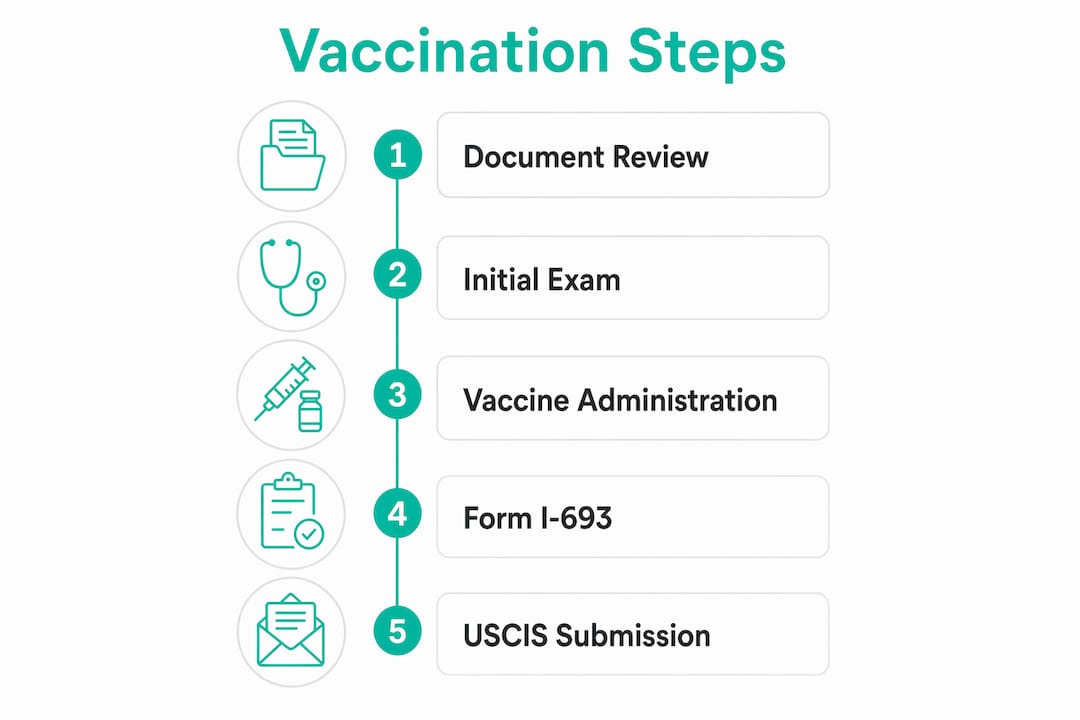
Since december 2, 2024, applicants adjusting status inside the U.S. must submit Form I-693 concurrently with Form I-485. Submitting the form late or separately now results in rejection. This is one of the most significant recent procedural changes in the adjustment of status process, and many applicants are still unaware of it.
During the exam, the civil surgeon reviews your vaccination records and determines which vaccines you have already received. Here is what the vaccination assessment covers:
- Review of all existing vaccination documentation
- Identification of any missing age-appropriate vaccines
- Administration of at least one dose of each missing required vaccine
- Counseling on completing any multi-dose series after the exam
- Notation of any vaccines that are not medically appropriate
A critical point that surprises many applicants: full vaccine series completion is not required before the medical exam. You only need at least one dose of each required vaccine at the time of the exam. The civil surgeon will counsel you on completing the remaining doses after your appointment. This means you do not need to delay your exam waiting for a full series to finish.
Form I-693 is submitted in a sealed envelope signed by the civil surgeon. You must not open this envelope. USCIS will reject an unsealed form. Refugees who completed overseas medical exams submit only a partial Form I-693 upon adjustment of status, since some components were already addressed abroad.
Pro Tip: Call the civil surgeon's office before booking to confirm their current fee. Medical exam fees are not fixed by USCIS and vary significantly between providers. Costs can range from under $200 to over $500 depending on location and the number of vaccines needed.
What exceptions and waivers apply to vaccination rules for immigration?
Not every applicant can receive every vaccine. Medical contraindications are real, and U.S. immigration law accounts for them. The waiver process is simpler than most applicants expect.
When a civil surgeon determines that a vaccine is not medically appropriate for you, they mark it as such directly on Form I-693. USCIS then grants an administrative waiver automatically during form processing. You do not file a separate waiver application. You do not pay an additional fee. The civil surgeon's notation is all that is required.
Common reasons a vaccine may be marked as not medically appropriate include:
- A documented allergy to a vaccine component (such as gelatin or neomycin)
- A history of a severe adverse reaction to a prior dose
- A medical condition that makes the vaccine contraindicated (such as immunodeficiency for live vaccines)
- Age-based inapplicability, where the vaccine is not recommended for your age group
Temporary contraindications also apply. If you are pregnant, for example, live vaccines such as MMR and varicella are contraindicated during pregnancy. The civil surgeon will note this, and USCIS will handle it accordingly. You may need a follow-up exam after delivery to complete the vaccination record.
The key distinction is between a medical exemption and a religious or personal belief exemption. U.S. immigration law does not recognize religious or personal belief exemptions for the vaccination requirement. Only documented medical contraindications qualify for the administrative waiver. Applicants who refuse vaccines without a medical basis will receive a Class A inadmissibility finding.
How does influenza vaccine timing affect your immigration medical exam?
The influenza vaccine requirement operates on a fixed annual window that catches many applicants off guard. Flu season for immigration purposes runs from october 1 through march 31 each year. If your medical exam falls within that window, you must receive the influenza vaccine at the exam, regardless of whether you received one earlier in the year.
Applicants aged 6 months and older must receive the influenza vaccine if their exam occurs during flu season. Missing this vaccine during the october 1 through march 31 window results in an incomplete vaccination assessment, which triggers a Class A medical condition finding. That finding makes you inadmissible until the deficiency is corrected.
The practical implications for applicants and their legal representatives are significant:
- Scheduling your exam in april through september avoids the flu vaccine window entirely
- If you schedule during flu season, confirm the civil surgeon has the current season's influenza vaccine in stock
- A medical contraindication to the flu vaccine (such as a severe egg allergy) still qualifies for the administrative waiver
- Exam timing during flu season without the influenza vaccine creates a Class A condition that requires a follow-up exam to resolve
The influenza vaccine requirement is the one vaccination rule most likely to create an unexpected delay. A healthy applicant who schedules their exam in january without thinking about the flu vaccine can face a Class A finding that pushes their green card timeline back by months. Careful scheduling prevents this entirely.
Practical guidance for applicants and legal representatives
Gathering your vaccination records before the civil surgeon appointment is the single most effective step you can take. Records from other countries are acceptable as long as they identify the vaccine, the date administered, and the provider. If records are lost or unavailable, the civil surgeon will administer the required vaccines at the exam.
Here is a clear list of dos and don'ts for navigating vaccination rules for immigration:
Do:
- Collect all vaccination records before your appointment
- Verify the civil surgeon's fee and vaccine availability before booking
- Schedule outside the october 1 through march 31 window if you want to avoid the flu vaccine requirement
- Submit Form I-693 concurrently with Form I-485 as required since december 2024
- Disclose all medical conditions and allergies to your civil surgeon
Don't:
- Assume you need a complete vaccine series before the exam
- Open the sealed Form I-693 envelope
- Use a provider who is not a USCIS-designated civil surgeon
- Delay your exam waiting for a multi-dose series to finish
- Ignore the flu season window when scheduling
Common issues in I-485 adjustment applications often trace back to vaccination documentation errors or missed procedural deadlines. Reviewing USCIS and CDC resources for current updates before your exam is a sound practice. Requirements can change, and the december 2024 Form I-693 submission rule is proof of that.
Pro Tip: If you are a legal representative, confirm your client's exam date relative to the flu season window before scheduling. A simple calendar check can prevent a Class A finding that delays the entire case.
Key Takeaways
The vaccination requirement for U.S. immigration mandates proof of 15 age-appropriate vaccines, verified through Form I-693 by a designated civil surgeon, with automatic waivers available for documented medical contraindications.
| Point | Details |
|---|---|
| 15 vaccines required | Missing any age-appropriate vaccine triggers a Class A inadmissibility finding. |
| Form I-693 submission | Since december 2024, Form I-693 must be submitted concurrently with Form I-485. |
| One dose is enough | Full vaccine series completion is not required before the medical exam. |
| Flu season window | Applicants examined between october 1 and march 31 must receive the influenza vaccine. |
| Automatic waivers | Civil surgeons mark contraindicated vaccines on Form I-693; no separate waiver application is needed. |
What I have learned from handling vaccination cases in immigration practice
The vaccination requirement is one of the most misunderstood parts of the green card process. Clients come to me convinced they need to restart their entire childhood vaccine series before they can even schedule a civil surgeon appointment. That belief is wrong, and it costs people months of unnecessary waiting.
The rule is straightforward once you understand it: one dose of each required vaccine at the time of the exam is enough. The civil surgeon handles the rest. What actually causes delays is poor scheduling, missing documentation, and the flu season window. Those are preventable problems.
Cost is a real barrier for some applicants. Because USCIS does not regulate civil surgeon fees, prices vary widely. I have seen clients pay dramatically different amounts for the same exam in the same city. Calling ahead and comparing fees is not optional. It is a practical step that protects your budget.
The waiver process for contraindicated vaccines is far less intimidating than it sounds. In practice, the civil surgeon marks the form, USCIS processes it, and the case moves forward. I have handled many cases where clients had legitimate medical contraindications, and the administrative waiver resolved the issue without any additional filing.
My strongest advice: start gathering vaccination records the moment you decide to pursue a green card. Do not wait until you are scheduling the civil surgeon appointment. Early preparation removes the single biggest source of confusion and delay in this part of the process.
— Mahmudul
How Hasan-legal can help with your immigration medical requirements
Navigating vaccination rules, civil surgeon appointments, and Form I-693 deadlines is manageable with the right guidance. Hasan-legal specializes in U.S. immigration services that cover every stage of the green card process, including medical exam compliance and documentation review.

Attorney Mahmudul Hasan, Esq. directly oversees each case, which means you get expert attention on the details that matter, including the december 2024 Form I-693 submission change and flu season scheduling. Whether you are an applicant or a legal representative, a free case evaluation with Hasan-legal gives you a clear picture of where your vaccination compliance stands and what steps to take next.
FAQ
What vaccines are required for U.S. immigration?
U.S. immigration law requires proof of vaccination for 15 diseases, including measles, mumps, rubella, polio, hepatitis A and B, varicella, influenza, and others. The specific vaccines that apply to you depend on your age and medical history.
Do I need all vaccine doses before my civil surgeon exam?
No. You only need at least one dose of each required vaccine at the time of the exam. The civil surgeon will counsel you on completing any multi-dose series after your appointment.
What happens if I cannot receive a required vaccine?
If a vaccine is medically contraindicated, the civil surgeon marks it as "not medically appropriate" on Form I-693. USCIS grants an administrative waiver automatically. No separate waiver application is required.
When must I submit Form I-693?
Since december 2, 2024, applicants adjusting status inside the U.S. must submit Form I-693 at the same time as Form I-485. Submitting it separately results in rejection.
Does the flu vaccine apply to all immigration applicants?
The influenza vaccine is required for applicants aged 6 months and older whose medical exam falls between october 1 and march 31. Applicants examined outside that window are not required to receive it.