

A conditional green card is lawful permanent residence valid for exactly two years, issued to spouses in marriages under two years old at the time of approval and to certain immigrant investors. Unlike a standard 10-year green card, it cannot be renewed. You must file a petition to remove the conditions before the card expires, or you risk losing your status entirely. Understanding the conditional green card process from day one is the difference between a clear path to permanent residency and an avoidable legal crisis.
What is a conditional green card and why does USCIS issue it?
A conditional green card, formally called conditional permanent residence, exists because USCIS uses it to verify that the underlying basis for residency is genuine. The agency issues it primarily in two situations: when a marriage-based green card applicant's marriage was less than two years old at the time of approval, and when an immigrant investor or entrepreneur obtains residency through the EB-5 program.
The rationale is straightforward. USCIS needs time to confirm that a marriage is bona fide and not entered into solely for immigration purposes. Conditional status gives the agency a two-year window to revisit the case before granting full permanent residence. For investors, the same logic applies: USCIS wants to confirm that the qualifying investment was sustained and that the required jobs were created.

This mechanism is not punitive. It is a statutory safeguard built into U.S. immigration law to prevent fraud. Conditional status allows USCIS to closely review recent marriages and investor cases without denying residency outright. You receive full resident rights during that two-year period while USCIS reserves the right to evaluate your case again.
Who qualifies for conditional permanent residence:
- Spouses of U.S. citizens or lawful permanent residents whose marriage was under two years old at the time of the green card approval
- Children who obtained residency through a qualifying parent in that same marriage
- Immigrant investors who received residency through the EB-5 visa program
- Entrepreneurs and their qualifying family members admitted under investor-based categories
Pro Tip: If your marriage was just a few weeks shy of the two-year mark when your green card was approved, you will still receive a conditional card. The two-year threshold is measured at the moment of approval, not at the time you applied.
What rights and limitations come with conditional residence?
Conditional green card holders have the same rights as any other lawful permanent resident during the two-year validity period. You can live anywhere in the United States, work for any employer without restriction, travel internationally and re-enter the country, and petition for certain family members. The word "conditional" does not reduce your day-to-day rights as a resident.
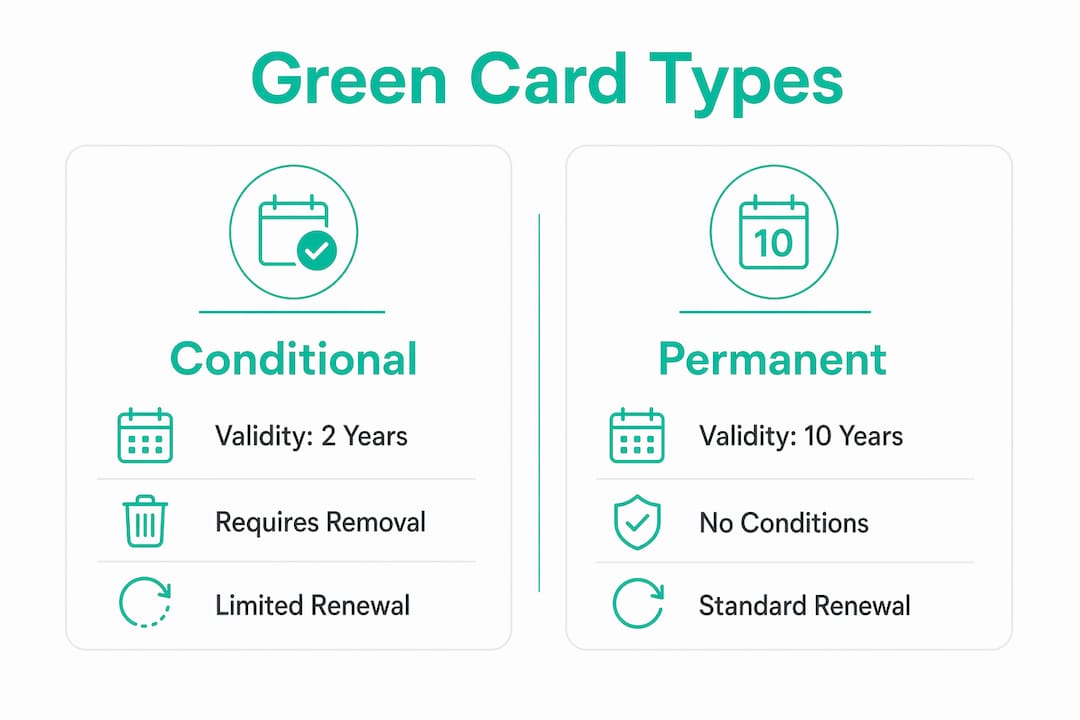
The critical limitation is the expiration date and what happens around it. A conditional green card cannot be renewed. There is no extension option. Your only path to continued lawful status is to file a petition to remove the conditions before the card expires. Missing that window does not simply mean your card is invalid. It means your status is terminated.
Here is the sequence of events if you fail to act in time:
- Your conditional permanent residence is automatically terminated when the card expires without a timely petition on file.
- USCIS issues a Notice to Appear (NTA), which initiates removal proceedings against you.
- You must then appear before an immigration judge to defend your right to remain in the United States.
- Even if you have a strong case, defending removal proceedings is far more costly and stressful than filing on time.
- A removal order can bar you from re-entering the United States for years or permanently.
One more limitation worth knowing: naturalization applications generally require an approved removal of conditions petition before USCIS will process them. You cannot simply apply for citizenship while still holding conditional status. The removal of conditions is a prerequisite step on the path to becoming a U.S. citizen.
How to remove conditions on your green card and avoid losing status
Removing conditions is the most consequential step in the conditional green card process, and timing is everything. You must file Form I-751 (for marriage-based cases) or Form I-829 (for investor-based cases) during the 90-day window immediately before your conditional green card expires. Filing too early or failing to file at all carries serious consequences.
One detail that surprises many applicants: the 90-day window is tied to your initial conditional permanent resident admission date, not the physical card issuance date. The filing window begins 90 days before the second anniversary of when you were admitted as a conditional resident. Mark that date carefully and work backward.
What you need to file Form I-751:
- A completed and signed Form I-751 petition
- Joint filing with your petitioning spouse (required unless a waiver applies)
- Filing fee as specified by USCIS at the time of submission
- Evidence that your marriage is bona fide: joint bank account statements, lease or mortgage documents, utility bills in both names, photographs together over time, birth certificates of children born to the marriage, and affidavits from people who know you as a couple
USCIS requires evidence of a genuine marriage because the entire purpose of the petition is to prove the marriage was not entered into for immigration purposes. The more documentation you provide, the stronger your case. Thin evidence files are a leading cause of Requests for Evidence (RFEs) and delays.
Joint filing is the default requirement. However, USCIS allows waivers of the joint filing requirement in specific situations: if the marriage ended in divorce or annulment, if your spouse died, if you were subjected to battery or extreme cruelty, or if deportation would cause extreme hardship. Waiver cases require additional documentation and are more complex to prepare.
After you file, USCIS will mail you a receipt notice. That receipt notice, combined with your expired conditional green card, serves as proof of continued lawful status while your petition is pending. Processing times for Form I-751 have historically ranged from 12 to 24 months. You can check current I-751 processing times at Hasan Legal PC for up-to-date estimates.
| Filing form | Who uses it | Filing window | Joint filing required |
|---|---|---|---|
| Form I-751 | Marriage-based conditional residents | 90 days before 2-year anniversary | Yes, unless waiver applies |
| Form I-829 | Investor-based conditional residents | 90 days before 2-year anniversary | No (individual petition) |
Pro Tip: Start gathering your evidence at least six months before your filing window opens. Joint financial records, lease renewals, and photos take time to compile. Waiting until the 90-day window begins puts you under unnecessary pressure.
Conditional green card vs. permanent 10-year green card: key differences
Understanding how a conditional green card differs from a standard permanent green card helps you plan your next steps with clarity. The two cards look similar and grant similar rights, but they operate very differently in terms of validity, renewal, and what you must do to maintain your status.
| Feature | Conditional green card | Permanent green card |
|---|---|---|
| Validity period | 2 years | 10 years |
| Renewable | No | Yes |
| Petition required | Yes (I-751 or I-829) | No (renewal only) |
| Naturalization eligibility | After conditions removed | After 3 or 5 years of residence |
| Risk of termination | Yes, if petition not filed | No, unless status abandoned |
The naturalization implication is particularly important. If you obtained your conditional green card through marriage to a U.S. citizen, you may be eligible to apply for naturalization after three years of continuous residence. However, you must have your conditions removed before USCIS will approve that naturalization application. A conditional green card that expires without a filed petition does not count toward your residency timeline in any useful way.
For immigrant investors using the EB-5 program, the path is slightly different. Form I-829 removes conditions based on proof that the investment was sustained and that the required number of jobs were created or preserved. The standard of evidence is different from marriage cases, but the 90-day filing window and the consequences of missing it are identical.
Key takeaways
A conditional green card grants two-year lawful permanent residence that requires a timely petition to remove conditions, or status is automatically terminated and removal proceedings begin.
| Point | Details |
|---|---|
| Two-year validity, no renewal | A conditional green card expires after two years and cannot be extended or renewed under any circumstances. |
| 90-day filing window | File Form I-751 or I-829 within 90 days before expiration, calculated from your admission date, not card issuance. |
| Same rights as permanent residents | Conditional residents can live, work, and travel freely during the two-year period, with full resident privileges. |
| Missing the deadline triggers removal | Failure to file on time results in automatic termination of status and a Notice to Appear for removal proceedings. |
| Conditions must be removed before naturalization | USCIS requires an approved removal petition before processing any naturalization application. |
What I've learned from handling conditional green card cases
After working through hundreds of conditional green card cases at Hasan Legal PC, the pattern I see most often is not legal complexity. It is timing and preparation failures that could have been avoided entirely.
The 90-day window sounds generous until you realize that gathering strong evidence takes months. Couples who wait until the window opens to start collecting joint financial records, lease agreements, and photos often find themselves filing thin petitions. USCIS responds with Requests for Evidence, which adds months to an already long processing timeline and creates unnecessary anxiety.
The joint filing requirement also catches people off guard. Some couples have drifted apart by the two-year mark, or one spouse is uncooperative. If your spouse refuses to sign the I-751, you are not automatically out of options. Waiver categories exist for exactly these situations, but they require a different evidentiary strategy and more careful preparation. Trying to navigate a waiver case without legal guidance is one of the riskiest moves I see clients attempt on their own.
One thing I tell every client: the receipt notice you get after filing is not just paperwork. It is your proof of continued lawful status. Keep it with your expired conditional green card at all times. Employers, landlords, and border officers may ask for it, and not having it on hand creates problems that are entirely avoidable.
The interaction between conditional residence and naturalization also confuses many people. If you are married to a U.S. citizen and have lived in the U.S. for three years, you may feel ready to apply for citizenship. But if your I-751 is still pending, USCIS will not approve your naturalization application. Get the removal of conditions resolved first. It is a sequential process, not a parallel one.
— Mahmudul
How Hasan Legal PC can help with your conditional green card
Removing conditions on your green card is a process where preparation and precision matter more than most people expect. At Hasan Legal PC, attorney Mahmudul Hasan, Esq., personally oversees every Form I-751 and Form I-829 petition, from evidence strategy to filing and follow-up. Whether you are filing jointly, pursuing a waiver, or facing a missed deadline, the firm provides direct legal guidance tailored to your specific situation.

If your conditional green card is approaching expiration or you have questions about your filing window, do not wait. Schedule a free case evaluation with Hasan Legal PC today, or explore the full range of immigration services the firm offers to conditional residents and their families.
FAQ
What is a conditional green card in simple terms?
A conditional green card is a two-year lawful permanent resident card issued mainly to spouses in new marriages and immigrant investors. It grants full resident rights but requires a petition to remove conditions before it expires.
How do I remove conditions on my green card?
File Form I-751 if your status is marriage-based, or Form I-829 if it is investor-based, during the 90-day window before your card's second anniversary. Joint filing with your spouse is required for I-751 unless a waiver applies.
What happens if I miss the deadline to remove conditions?
Missing the filing deadline results in automatic termination of your conditional permanent residence. USCIS then issues a Notice to Appear, which begins formal removal proceedings before an immigration judge.
Can I apply for citizenship with a conditional green card?
You cannot complete naturalization while holding conditional status. USCIS requires an approved removal of conditions petition before it will process a naturalization application, so removing conditions is a required step first.
Can I work and travel with a conditional green card?
Yes. Conditional permanent residents have the same rights as standard green card holders during the two-year validity period, including the right to work for any employer and travel internationally.
Recommended
- Adjustment of Status, Explained: How to Apply for a Green Card from Inside the U.S. | Hasan Legal PC
- Consular Processing, Explained: How to Obtain a Green Card from Outside the United States | Hasan Legal PC
- The Child Status Protection Act, Explained: How It Protects Children from "Aging Out" of Their Green Card Cases | Hasan Legal PC
- How Visa Availability and Priority Dates Work | Hasan Legal PC