

A green card is the official document that certifies lawful permanent resident status in the United States, granting non-citizens the right to live and work permanently without being tied to a specific employer or school. Formally called a Permanent Resident Card and issued by U.S. Citizenship and Immigration Services (USCIS), it sits between a temporary visa and full citizenship. Approximately 12.8 million green card holders currently live in the U.S., and nearly 9 million of them are already eligible for naturalization. That scale tells you one thing clearly: the green card is the most common gateway to permanent life in America.
What is a green card and how does it differ from a visa?
A green card grants permanent residency status that is not tied to any specific employer, school, or institution. A visa, by contrast, is temporary and conditional. An H-1B visa holder, for example, loses legal status the moment their employer terminates their sponsorship. A green card removes that dependency, giving you the freedom to change jobs, start a business, or pursue education without risking your immigration status.
The green card definition, in practical terms, is a physical card proving your right to live and work in the U.S. indefinitely. USCIS issues it after approving your eligibility through one of several immigration pathways. The card itself is green in color today, though it has gone through multiple redesigns since its introduction in 1940.

One distinction that surprises many applicants: holding a green card does not make you a U.S. citizen. You remain a foreign national with permanent resident status. That distinction matters for voting rights, certain federal jobs, and passport eligibility, all of which are covered later in this guide.
What are the types of green cards?
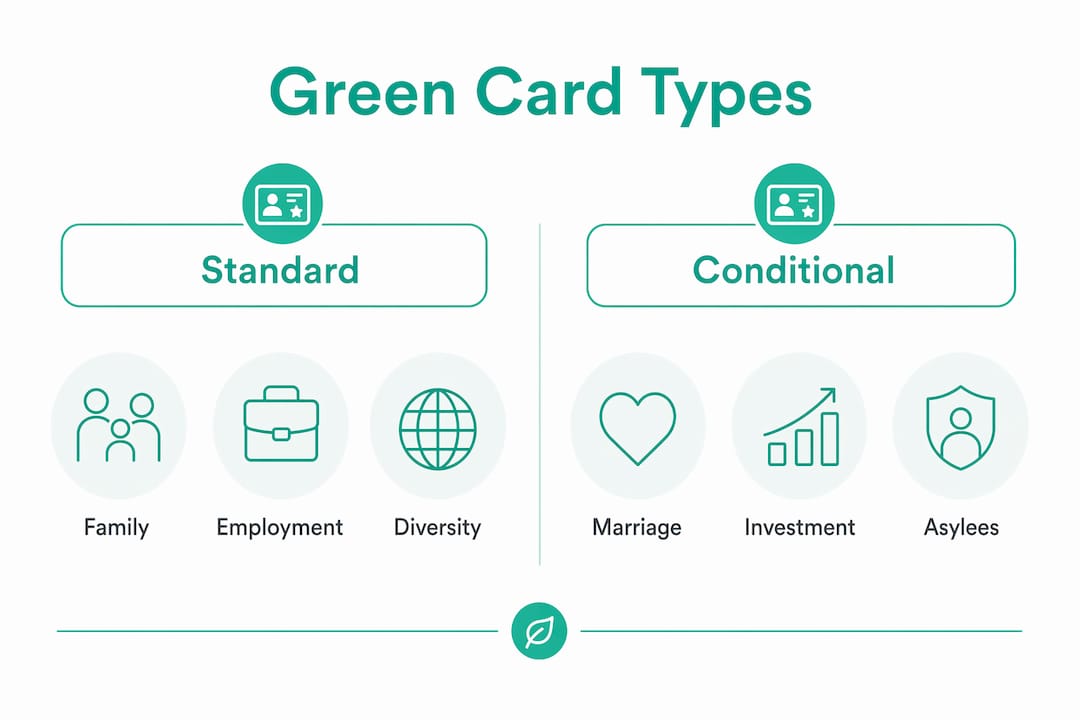
Green cards fall into several categories based on how you qualify. Understanding which type applies to you shapes the entire application process.
| Type | Basis | Validity |
|---|---|---|
| Standard permanent resident card | Family, employment, diversity lottery | 10 years |
| Conditional permanent resident card | Marriage (under 2 years) or EB-5 investment | 2 years |
| Asylee or refugee green card | Granted asylum or refugee status | 10 years |
| Special immigrant green card | Religious workers, certain broadcasters, others | 10 years |
Standard green cards are valid for 10 years, while conditional green cards issued through marriage or investment carry only a 2-year validity. That shorter window is not a penalty. It is a verification mechanism. USCIS uses the 2-year period to confirm that a qualifying marriage is genuine or that an EB-5 investment has met its job-creation requirements.
Asylees and refugees represent a separate category entirely. If you were granted asylum in the U.S. or admitted as a refugee, you can apply for a green card after one year of continuous presence. Hasan-legal has guided many clients through this specific pathway, which carries its own documentation requirements distinct from family or employment-based cases. You can find detailed guidance on the asylee green card process on the Hasan-legal website.
Pro Tip: If you received your green card through a marriage of less than two years, your card is conditional. Mark your calendar 90 days before the 2-year expiration date. That is the window to file Form I-751 to remove conditions. Missing it can result in loss of status.
How do you apply for a green card?
The green card application process follows a structured sequence. Skipping steps or filing out of order causes delays or outright rejections.
- File an immigrant petition. Most applicants start with a petition filed on their behalf, such as Form I-130 for family-based cases or Form I-140 for employment-based cases. This establishes your eligibility category.
- Wait for a visa number to become available. Each category has a limited number of visas per year. USCIS and the Department of State publish a monthly Visa Bulletin showing which priority dates are current. Filing before your priority date is current results in automatic rejection.
- Choose your application method. If you are already inside the U.S. on a valid status, you can file Form I-485 to adjust your status without leaving the country. If you are abroad, you go through consular processing at a U.S. embassy or consulate.
- Attend biometrics and interviews. USCIS schedules a biometrics appointment to collect fingerprints and photos. Many applicants also attend an in-person interview, particularly for family-based cases.
- Receive a decision. USCIS approves or denies the application. If approved, your green card arrives by mail.
Adjustment of Status is the preferred route for applicants already in the U.S. because it avoids international travel during a pending application. For those outside the country, consular processing is the only option, and timelines vary significantly by country and embassy workload.
Timelines across both methods range from several months to several years depending on your category and country of birth. Employment-based applicants from India and China face the longest waits due to per-country annual caps.
Pro Tip: Gather your immigration document checklist before you file anything. Missing a single supporting document is one of the most common reasons USCIS issues a Request for Evidence, which adds months to your timeline.
What rights and responsibilities come with a green card?
Permanent residency gives you a strong set of legal protections and freedoms. It also comes with specific obligations you cannot ignore.
Rights you gain as a green card holder:
- You can live and work anywhere in the United States without employer sponsorship.
- You can travel internationally and return to the U.S. with your green card as proof of status.
- You qualify for Social Security benefits and most federal benefit programs after meeting residency requirements.
- You can sponsor certain family members for their own green cards.
- You receive the same legal protections under U.S. law as citizens, including due process rights.
Restrictions compared to U.S. citizens:
- Green card holders cannot vote in federal, state, or most local elections.
- You cannot hold sensitive federal positions that require U.S. citizenship.
- You cannot obtain a U.S. passport.
- Extended absences from the U.S. can jeopardize your permanent resident status.
One obligation that catches people off guard: you must carry your green card at all times as proof of your legal status. This is a federal legal requirement, not just a recommendation. Failing to produce it when requested by immigration authorities can create unnecessary complications.
Maintaining continuous residency is also critical. Trips abroad lasting more than six months raise questions about abandonment of residency. Absences over one year generally trigger a presumption that you have abandoned your status, which can prevent reentry.
How do you renew your green card and maintain your status?
Renewal and maintenance are two separate concerns. Renewal refers to getting a new physical card. Maintenance refers to keeping your permanent resident status active.
Key renewal and maintenance facts:
- Standard green cards require renewal every 10 years using Form I-90. You can file up to six months before expiration.
- Conditional green cards cannot be renewed. You must file Form I-751 (marriage-based) or Form I-829 (investment-based) to remove conditions and receive a standard 10-year card.
- Conditional residents must file to remove conditions before the 2-year card expires. Failure to file results in loss of permanent resident status, not just an expired card.
- An expired green card does not cancel your permanent resident status, but it creates real practical problems. Employers cannot verify your work authorization, airlines may deny boarding, and banks may refuse to process transactions.
- If you plan to travel while your renewal is pending, file Form I-131A for a travel document or carry your Form I-90 receipt notice alongside your expired card.
The distinction between an expired card and lost status is one of the most misunderstood points in immigration law. Your status remains intact even with an expired card. The card is evidence of status, not the status itself. That said, operating without a valid card creates friction at every turn, so renewing on time is the practical choice.
Protecting your permanent residency long-term means filing taxes as a U.S. resident, maintaining a U.S. address, and limiting time abroad. If you need to spend extended time outside the country, a reentry permit filed before departure can protect your status for up to two years.
Key takeaways
A green card is permanent proof of U.S. residency status, and understanding its types, application steps, and renewal rules is the difference between a smooth process and costly delays.
| Point | Details |
|---|---|
| Green card definition | A Permanent Resident Card issued by USCIS granting the right to live and work in the U.S. permanently. |
| Two main card types | Standard cards are valid for 10 years; conditional cards last 2 years and require removal of conditions. |
| Application sequence | File a petition, wait for a current priority date, then apply via Adjustment of Status or consular processing. |
| Rights vs. restrictions | Holders can work freely and travel but cannot vote in federal elections or hold certain federal positions. |
| Renewal vs. status | An expired card does not end your status, but it blocks work verification, travel, and official transactions. |
What I've learned after years of handling green card cases
After working through hundreds of green card cases at Hasan-legal, the pattern I see most often is not a complicated legal issue. It is timing. Applicants either file too early, before their priority date is current, or they wait too long on renewals and conditional card filings until a crisis forces their hand.
The conditional green card situation deserves special attention. Many clients who received their green card through a marriage of less than two years do not realize their card is conditional until they try to renew it and discover the process is completely different. The I-751 petition to remove conditions requires evidence of a bona fide marriage, joint finances, shared residence, and more. Gathering that documentation under pressure, close to the expiration date, is stressful and avoidable.
My honest advice: treat your green card expiration date the same way you treat a passport expiration. Set a reminder 12 months out. For conditional cards, set it 18 months out. The extra time gives you room to gather documents, respond to any USCIS requests, and avoid the practical disruptions that come with an expired card.
One more thing I tell every client who reaches permanent residency: start thinking about naturalization from day one. With nearly 9 million green card holders already eligible for citizenship, the path is well-traveled. Most holders qualify after five years of continuous residence. Citizenship eliminates the renewal cycle, restores full political rights, and removes the risk of status loss entirely. The green card is not the finish line. It is the most important step toward it.
— Mahmudul
How Hasan-legal can help with your green card
Hasan-legal PC is a U.S. immigration law firm where managing attorney Mahmudul Hasan, Esq. personally oversees every case. Whether you are starting your green card application, removing conditions on a conditional card, or preparing for naturalization, the team provides direct, personalized guidance at every stage.

Hasan-legal assists clients both inside the United States and internationally, covering family-based, employment-based, and humanitarian pathways. From preparing your immigrant petition to navigating visa types and green card categories, the firm handles the details so you do not have to. Explore the full range of immigration legal services or schedule a consultation to discuss your specific situation with an attorney who will know your case by name.
FAQ
What does a green card actually prove?
A green card proves that you hold lawful permanent resident status in the United States, issued by USCIS. It authorizes you to live and work in the U.S. permanently without employer sponsorship.
How long does it take to get a green card?
Timelines vary widely by category and country of birth. Family-based cases for immediate relatives of U.S. citizens can take one to two years, while employment-based cases for applicants from India or China can take a decade or more due to per-country visa caps.
Can I lose my green card if it expires?
An expired card does not cancel your status, but it creates serious practical problems with employment verification, travel, and official transactions. Renew using Form I-90 before expiration to avoid disruptions.
What is the difference between Adjustment of Status and consular processing?
Adjustment of Status allows applicants already inside the U.S. to apply for a green card without leaving the country. Consular processing is for applicants abroad and takes place at a U.S. embassy or consulate in their home country.
How many green card holders are eligible for U.S. citizenship?
Of the approximately 12.8 million green card holders in the U.S., nearly 9 million are eligible for naturalization. Most qualify after five years of continuous permanent residence, or three years if married to a U.S. citizen.
Recommended
- Adjustment of Status, Explained: How to Apply for a Green Card from Inside the U.S. | Hasan Legal PC
- Consular Processing, Explained: How to Obtain a Green Card from Outside the United States | Hasan Legal PC
- Green Card for Asylees: Eligibility, How to Apply, and What to Submit | Hasan Legal PC
- How Visa Availability and Priority Dates Work | Hasan Legal PC