

A sponsor in immigration is a U.S. citizen or lawful permanent resident who petitions for a foreign national's admission and signs Form I-864, accepting legal financial responsibility for that person. This document, the Affidavit of Support, is not a formality. It is a binding contract between the sponsor and the U.S. government. The sponsor's core obligation is to prevent the immigrant from relying on means-tested public benefits. Understanding this role fully, before you commit, protects both you and the person you are sponsoring.
What is a sponsor in immigration, and who qualifies?
An immigration sponsor is the person or organization that formally petitions for an immigrant and guarantees their financial support. In formal immigration law, this role is often called the "petitioner" for the visa or green card, and the financial guarantor under Form I-864. Both functions frequently belong to the same person, though not always. Knowing which role you are filling determines which forms you must file.
To qualify as a sponsor in the family-based immigration process, you must meet all of the following criteria:
- Age: You must be at least 18 years old at the time of filing.
- Status: You must be a U.S. citizen or a lawful permanent resident (green card holder).
- Domicile: You must be domiciled in the United States or a U.S. territory. Living abroad temporarily does not disqualify you, provided you intend to return and can demonstrate strong ties to the U.S. before the immigrant's admission date.
- Income: Your household income must meet or exceed 125% of the Federal Poverty Guidelines for your household size.
Employment-based sponsorship follows different rules. The sponsor is typically a U.S. employer, not an individual, and the employer files Form I-140 rather than Form I-130. The employer must prove a legitimate job offer exists and that no qualified U.S. workers are available for the position.
Pro Tip: If your income falls short of the 125% threshold, a joint sponsor can step in. However, a joint sponsor must meet the income requirement entirely on their own. You cannot add your incomes together to reach the threshold.

What are the legal responsibilities of an immigration sponsor?
Signing the Affidavit of Support is one of the most serious legal commitments in the U.S. immigration system. Most people do not realize the full weight of what they are agreeing to until a problem arises. The responsibilities are specific, enforceable, and long-lasting.
Here is what you take on when you sign Form I-864:
- Financial support obligation. You must maintain the immigrant's income at no less than 125% of the Federal Poverty Guidelines annually. This applies to your entire household size, including the immigrant.
- Liability for public benefits. If the immigrant receives means-tested public benefits, the government agency providing those benefits can sue you to recover costs. Legal fees can be added on top of the repayment amount.
- Duration of obligation. Your responsibility does not end when the immigrant gets their green card. It continues until one of four conditions is met: the immigrant becomes a U.S. citizen, the immigrant earns 40 work quarters (roughly 10 years), the immigrant permanently leaves the United States, or either you or the immigrant dies.
- Reporting changes. You must notify USCIS of any change of address using Form I-865 within 30 days of moving.
- No exit clause for relationship changes. Divorce, separation, or estrangement does not end your obligation. The contract runs with the immigrant's status, not your relationship to them.
"The Affidavit of Support is a legally enforceable contract. Sponsors can be taken to court to recover public benefit costs, including attorney fees." — USCIS Form I-864 Guidance
Pro Tip: Keep copies of your most recent three years of federal tax returns, current pay stubs, and an employment verification letter. USCIS requires this documentation with your I-864, and having it organized in advance prevents delays.
How do family-based and employment-based sponsorships differ?
The immigration sponsorship process looks very different depending on whether the case is family-based or employment-based. The table below shows the core distinctions.
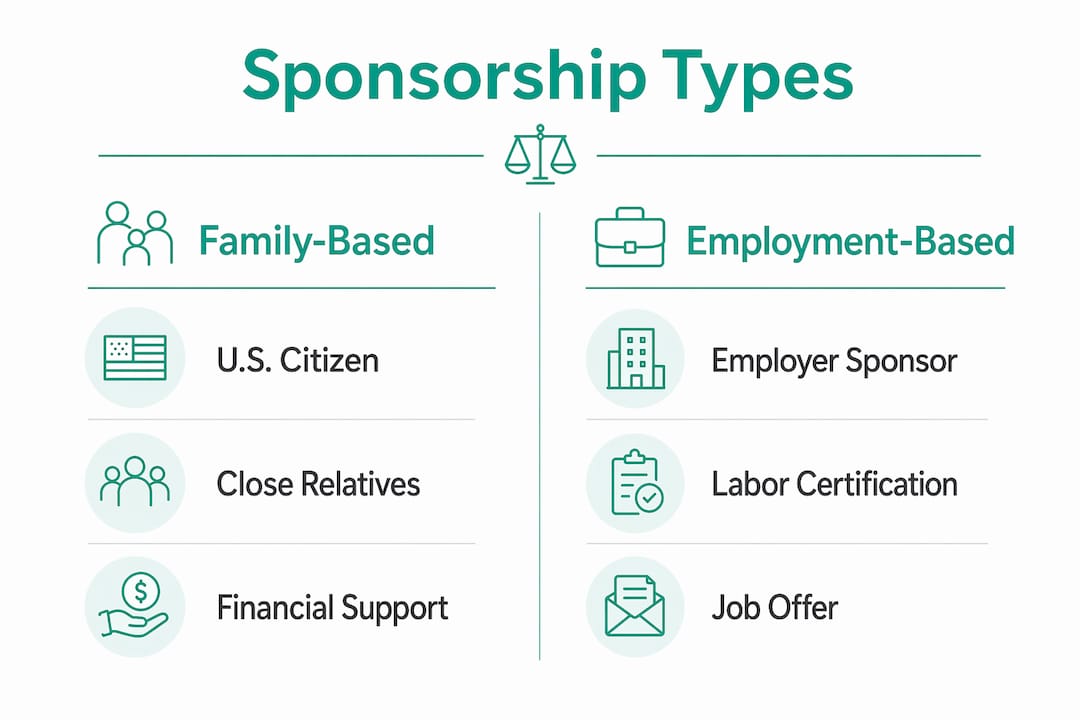
| Factor | Family-based sponsorship | Employment-based sponsorship |
|---|---|---|
| Who is the sponsor? | A U.S. citizen or lawful permanent resident relative | A U.S. employer |
| Primary petition form | Form I-130 (Petition for Alien Relative) | Form I-140 (Immigrant Petition for Alien Workers) |
| Financial guarantee form | Form I-864 (Affidavit of Support) | Form I-864 may still be required in some categories |
| Key requirement | Proof of qualifying family relationship | Proof of job offer and labor certification |
| Recruitment obligation | None | Must show no qualified U.S. workers are available |
| Sponsor's ongoing liability | Yes, under I-864 | Varies by visa category |
Family-based sponsorship is the most common path to a green card in the United States. A U.S. citizen sponsoring an immediate relative, such as a spouse, parent, or unmarried child under 21, files Form I-130 to establish the relationship. Once approved, the financial guarantee through Form I-864 follows.
Employment-based sponsorship places the burden on the employer. The employer must complete a labor certification process through the Department of Labor, proving that recruitment efforts found no qualified U.S. workers for the role. This process is more document-intensive and often takes longer than family-based cases. For a detailed look at the visa categories involved, the types of U.S. work visas page at Hasan-legal covers the major employment-based options clearly.
What risks and misconceptions should sponsors know?
Many sponsors enter the process with incomplete information. The gaps in understanding tend to surface at the worst possible time. These are the most common and consequential misconceptions.
- Divorce does not end your obligation. Sponsorship obligations persist through divorce unless the immigrant meets one of the four termination conditions. Sponsors who divorce and assume their financial duty ends are legally exposed.
- Joint sponsor income cannot be combined. A joint sponsor must independently meet the 125% Federal Poverty Guideline threshold. The joint sponsor's income stands alone. This surprises many families who assume they can pool resources.
- Living abroad does not automatically disqualify you. Sponsors temporarily living outside the U.S. can still qualify if they demonstrate clear intent to return and maintain strong U.S. ties before the immigrant's admission date.
- Sponsorship does not guarantee visa approval. The Affidavit of Support is one factor in the public charge determination. USCIS evaluates the totality of circumstances, including the immigrant's health, age, assets, and employment history. A strong I-864 improves the case but does not decide it alone.
- The obligation survives the immigrant's green card. Many sponsors believe their duty ends once the immigrant receives lawful permanent resident status. It does not. The clock runs until naturalization or 40 work quarters are credited.
Understanding these points before you file is not optional. It is the difference between a manageable commitment and an unexpected legal liability years down the road.
What practical steps should sponsors and immigrants take?
The immigration sponsorship process involves multiple filings and documentation requirements. Following a clear sequence reduces errors and avoids delays.
- File the correct petition. Family-based sponsors file Form I-130 with USCIS. Employment-based sponsors file Form I-140. Filing the wrong form or missing supporting documents causes rejection and restarts the clock.
- Prepare and submit Form I-864. The Affidavit of Support must accompany the immigrant's visa or adjustment of status application. Attach your most recent federal tax return, W-2s, and current proof of income.
- Gather supporting documentation. USCIS requires evidence of the qualifying relationship for family cases (birth certificates, marriage certificates) and proof of employment and income for all sponsors.
- Work with a qualified immigration attorney. The I-824 follow-to-join process and other related filings have specific procedural requirements that are easy to miss without legal guidance. An attorney reviews your full picture before submission.
- Track your ongoing obligations. After approval, monitor the four termination conditions for your I-864 obligation. File Form I-865 within 30 days of any address change. Keep records of your annual income in case a public benefits claim arises.
The sponsorship process is more complex than a single form submission. Each step builds on the last, and a mistake at any stage can delay or derail the immigrant's case.
Key Takeaways
An immigration sponsor takes on a legally binding financial obligation that can last a decade or more, and that obligation survives divorce, green card approval, and most relationship changes.
| Point | Details |
|---|---|
| Sponsor definition | A U.S. citizen or lawful permanent resident who petitions for an immigrant and signs Form I-864. |
| Income threshold | Sponsors must maintain the immigrant at 125% of the Federal Poverty Guidelines for their household size. |
| Duration of obligation | Responsibility ends only at naturalization, 40 work quarters, permanent departure, or death. |
| Joint sponsor rule | A joint sponsor must independently meet the income threshold; incomes cannot be combined. |
| Sponsorship vs. approval | A strong Affidavit of Support improves a case but does not guarantee visa or green card approval. |
What I have learned after years of sponsorship cases
After working through hundreds of sponsorship cases at Hasan-legal, the single most consistent problem I see is sponsors who did not read Form I-864 carefully before signing it. They treated it like a character reference. It is not. It is a contract with the federal government, and it can follow you into court.
The second most common issue is the divorce scenario. A sponsor and immigrant couple separates two years after the green card is issued. The sponsor assumes the obligation is gone. Then a public benefits claim surfaces, and they are suddenly facing a lawsuit they thought was impossible. The law is clear on this point, and it does not make exceptions for changed relationships.
My honest advice: before you sign anything, sit down with an immigration attorney and walk through the financial scenarios. What happens if the immigrant loses their job? What happens if your income drops? What does your household size look like on paper versus in reality? These are not hypothetical questions. They are the exact questions that determine your exposure.
Sponsorship is a generous act. Done with full information, it changes lives. Done without understanding the commitment, it creates real financial and legal risk for the sponsor. Take the time to get it right.
— Mahmudul
How Hasan-legal can help you through the sponsorship process
Sponsoring an immigrant involves more than goodwill. It requires precise filings, documented financials, and a clear understanding of obligations that can last years.
Hasan-legal, led by Mahmudul Hasan, Esq., assists sponsors and immigrants with Form I-130, Form I-140, and Form I-864 filings from start to finish. Every case receives direct attorney oversight, not a paralegal handoff. Whether you are sponsoring a spouse, a parent, or an employee, the team at Hasan-legal reviews your eligibility, prepares your documentation, and flags issues before they reach USCIS. Explore the full range of immigration legal services available, or schedule a consultation with an immigration attorney in Manhattan to get started.
FAQ
What is the difference between a petitioner and a sponsor?
A petitioner files the immigration petition (Form I-130 or I-140) to establish eligibility. A sponsor signs Form I-864 to guarantee financial support. In family-based cases, the same person often fills both roles.
How long does a sponsor's obligation last?
The obligation under Form I-864 lasts until the immigrant naturalizes, earns 40 work quarters, permanently leaves the United States, or either party dies. Divorce does not end the obligation.
Can a green card holder sponsor a family member?
Yes. Lawful permanent residents can sponsor certain family preference immigrants, including spouses and unmarried children, though processing times are longer than for U.S. citizen sponsors.
Does signing Form I-864 guarantee the immigrant gets a visa?
No. The Affidavit of Support is one factor in the public charge determination. USCIS reviews the immigrant's full circumstances, including health, age, assets, and employment history, before making a decision.
What happens if a sponsor cannot meet the income requirement?
A joint sponsor can file a separate Form I-864 and take on the financial obligation independently. The joint sponsor must meet the 125% Federal Poverty Guideline threshold on their own household income alone.