

An immigration attorney is a licensed legal professional who represents individuals, families, and businesses in all matters related to U.S. immigration law. Understanding what is immigration attorney role means recognizing that these professionals do far more than fill out forms. They file petitions, defend clients against deportation, advise on visa strategy, and represent clients before agencies like USCIS, the Department of Labor, and immigration courts. Because immigration law is federal, an attorney licensed in any U.S. state bar can represent clients nationwide. That federal scope makes the role uniquely powerful and uniquely demanding.
What are the primary responsibilities of an immigration attorney?
Immigration attorneys handle a wide range of legal matters, and their responsibilities go well beyond paperwork. Their duties span visa applications, asylum claims, removal defense, and naturalization processes. Each of these areas carries its own procedural rules, deadlines, and evidentiary standards. Missing a single deadline can end a case permanently.
The core functions of an immigration attorney include:
- Visa applications and renewals. Attorneys prepare and file family-based, employment-based, and humanitarian visa petitions. They also handle extensions and status changes when circumstances shift.
- Removal and deportation defense. When a client faces removal proceedings, an attorney builds a legal defense, gathers evidence, and argues the case before an immigration judge.
- Asylum representation. Asylum cases require detailed declarations, country condition evidence, and credibility arguments. Legal representation is a critical factor in asylum outcomes, serving as a primary barrier against detention and deportation.
- Naturalization and citizenship petitions. Attorneys guide clients through the N-400 application, prepare them for the civics interview, and address any complications in their immigration history.
- Compliance counseling. Businesses that sponsor foreign workers need ongoing legal advice to stay compliant with Department of Labor rules and USCIS requirements.
Pro Tip: If you are unsure whether your situation requires an attorney, request a free case evaluation before filing anything on your own. A single procedural error can trigger a denial or a Request for Evidence that delays your case by months.
The immigration attorney's role in legal advocacy carries real weight. Clients with legal representation consistently achieve better outcomes in removal and asylum proceedings than those who appear without counsel.

How do immigration attorneys specialize within their practice?
Specialization defines the quality of legal strategy an attorney can offer. An attorney who has handled more than 100 EB-1A extraordinary ability petitions builds pattern recognition that a generalist simply cannot replicate. Specialists applying patterns from large case volumes develop superior evidence strategies for complex petitions. That advantage is measurable in approval rates and response quality to USCIS Requests for Evidence.
The most common specializations in immigration law are employment-based immigration, family-based immigration, humanitarian and asylum law, removal defense, and naturalization. Each area requires deep familiarity with a distinct set of regulations, forms, and agency expectations.
| Attorney type | Best for | Limitation |
|---|---|---|
| Employment-based specialist | EB-1A, EB-2 NIW, H-1B, L-1 petitions | May charge premium fees for routine filings |
| Family-based specialist | Spousal petitions, F-preference visas, adjustment of status | Less experienced with employment or asylum law |
| Humanitarian/asylum specialist | Asylum claims, VAWA, U visa, T visa | Narrow focus outside humanitarian categories |
| Removal defense specialist | Deportation hearings, cancellation of removal | Not ideal for proactive visa planning |
| Generalist attorney | H-1B extensions, spouse petitions, straightforward filings | Limited strategic depth in complex cases |
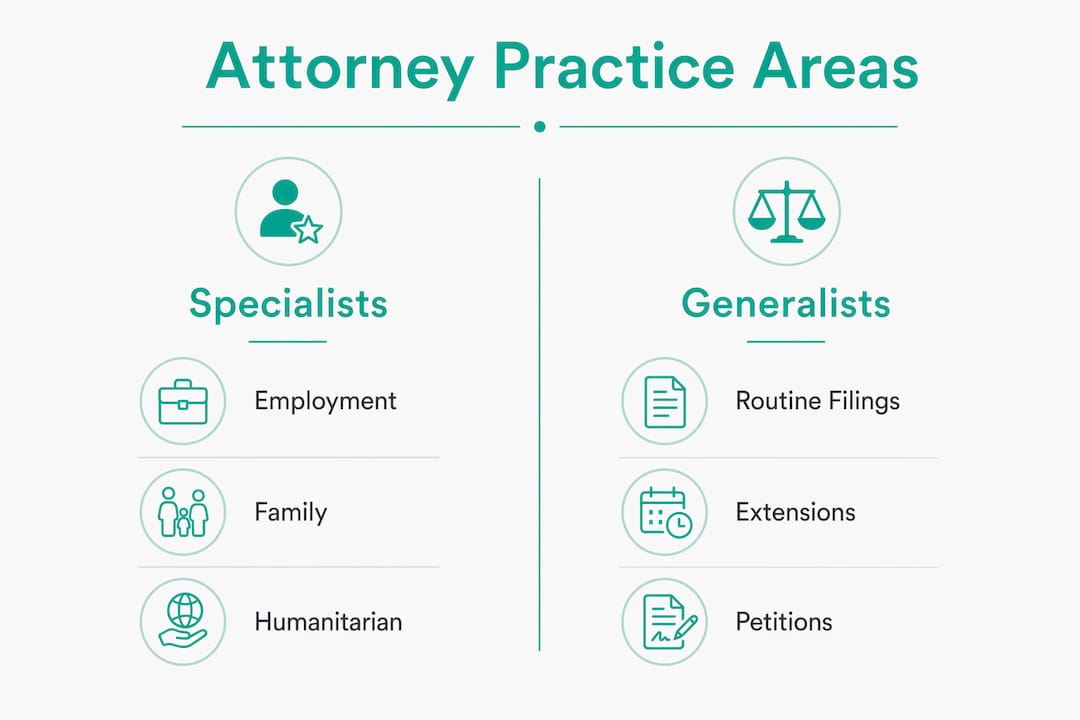
Routine filings like H-1B extensions or spouse petitions can be effectively managed by a competent generalist, balancing cost and reliability. The decision between a specialist and a generalist should match the complexity of your case, not just the attorney's marketing.
What qualities make an effective immigration attorney?
The best immigration attorneys combine sharp legal skills with strong interpersonal abilities. Successful practitioners emphasize empathy, cultural sensitivity, and communication as critical skills alongside legal expertise. Immigration clients often face high-stakes, emotionally charged situations. An attorney who cannot communicate clearly or connect with a client from a different cultural background will struggle to build the trust a case requires.
The key qualities to look for include:
- Legal research and analysis. Immigration law changes frequently. An effective attorney tracks USCIS policy updates, Board of Immigration Appeals decisions, and federal court rulings that affect their clients.
- Written and oral communication. Petitions require precise legal writing. Hearings require confident oral argument. Both skills must be strong.
- Empathy and cultural competency. Clients come from dozens of countries and speak many languages. An attorney who understands cultural context builds stronger client relationships and gathers better case evidence.
- Ethical standards and licensing. Every immigration attorney must be licensed by a state bar. Verify any attorney's bar status through your state's bar association website before signing a retainer.
Pro Tip: Ask any prospective attorney how many cases similar to yours they have handled in the past two years. A specific number tells you far more than a general claim of "experience."
Ongoing legal education is not optional in this field. Federal immigration regulations and enforcement priorities shift with each administration. An attorney who is not actively updating their knowledge is not fully equipped to represent you.
When should you hire an immigration attorney?
The right time to hire an immigration attorney is before you file, not after a denial. Early attorney engagement helps navigate procedural complexities and meet legal deadlines. Waiting until a problem arises limits your options significantly.
Here is a practical framework for deciding when legal representation is necessary:
- You are facing removal or deportation. This is the highest-stakes scenario in immigration law. Appearing without an attorney in immigration court puts you at a severe disadvantage.
- Your petition involves complex eligibility criteria. EB-1A extraordinary ability, EB-2 National Interest Waiver, and asylum cases all require detailed evidence strategies that benefit from specialist knowledge.
- You have a prior denial, criminal record, or immigration violation. These factors complicate any filing and require careful legal analysis before you proceed.
- Your employer is sponsoring you for a work visa. PERM labor certification and I-140 petitions involve both USCIS and the Department of Labor. Errors affect both the employer and the employee.
- You are filing a family petition with complications. Prior marriages, children from previous relationships, or gaps in documentation all create issues a generalist attorney can help resolve.
To verify an attorney's credentials, check their state bar status through the American Bar Association's directory or your state bar's public lookup tool. Confirm they are in good standing and have no disciplinary history. Fee structures vary: flat fees are common for defined filings like green card petitions, while hourly billing applies to complex litigation. Always get a written fee agreement before work begins.
You can learn more about the practical benefits of working with a licensed attorney in this 2026 guide from Hasan-legal. For clients in the Washington, D.C. area, Hasan-legal's D.C. immigration attorneys represent clients before USCIS, the Department of Labor, and immigration courts nationwide.
Key Takeaways
An immigration attorney's role covers legal representation, petition strategy, and advocacy across federal agencies, making professional guidance the single most important factor in complex immigration cases.
| Point | Details |
|---|---|
| Federal practice scope | A single state bar license allows an attorney to represent clients nationwide in immigration matters. |
| Core responsibilities | Attorneys handle visa petitions, removal defense, asylum claims, naturalization, and compliance counseling. |
| Specialization matters | Specialists in EB-1A, asylum, or removal defense offer strategic advantages that generalists cannot match in complex cases. |
| Hire early | Engaging an attorney before filing prevents procedural errors and protects legal deadlines. |
| Verify credentials | Always confirm bar status and disciplinary history through your state bar's public directory before signing a retainer. |
The role has changed more than most people realize
I have watched immigration law shift dramatically over the past several years. The immigration attorney role has evolved from simple legal assistance to essential advocacy amid increasingly complex laws. That evolution is not abstract. I see it in the cases that come through our office.
What strikes me most is how often clients arrive after attempting to file on their own, not because they were careless, but because the system genuinely appears manageable until it is not. A missed checkbox on an I-485, a misunderstood priority date, a failure to disclose a prior visa overstay. These are not rare edge cases. They are the most common reasons cases get denied or delayed by years.
The human element of this work is something I think gets undervalued in discussions about immigration law. Legal skill matters enormously. But so does the ability to sit across from someone who has waited a decade for a green card and explain, clearly and honestly, what their options are. Balancing legal expertise with empathy and cultural sensitivity is not a soft skill. It is a core professional requirement.
My honest view on specialization: hire a specialist when the stakes are high and the eligibility criteria are narrow. For a straightforward H-1B extension or a spousal petition with clean documentation, a reliable generalist is a reasonable and cost-effective choice. But for an EB-1A petition or an asylum case, the pattern recognition a specialist brings is worth the additional cost. The difference between an approval and a denial in those cases often comes down to how evidence is framed, not whether the evidence exists.
— Mahmudul
Hasan-legal: personalized immigration legal services
Hasan-legal's full range of immigration legal services covers visa petitions, family immigration, deportation defense, and naturalization. Every case at Hasan Legal PC is directly overseen by Mahmudul Hasan, Esq., so clients receive consistent, expert attention from start to finish.

Whether you are beginning a green card process, facing removal proceedings, or sponsoring a family member, the right legal guidance makes the process clearer and your position stronger. Schedule a free case evaluation to discuss your specific situation with an experienced immigration attorney who can assess your options and outline a clear path forward.
FAQ
What does an immigration attorney do?
An immigration attorney represents clients in visa applications, removal defense, asylum proceedings, naturalization, and compliance matters before USCIS, the Department of Labor, and immigration courts.
Can an immigration attorney licensed in one state represent clients in other states?
Yes. Because immigration law is federal, a single state bar license allows an attorney to represent clients nationwide in immigration courts and before federal agencies.
When is hiring an immigration attorney most critical?
Hiring an attorney is most critical when facing removal proceedings, filing complex petitions like EB-1A or asylum claims, or when a prior denial or immigration violation complicates your case.
How do I verify an immigration attorney's credentials?
Check the attorney's status through your state bar association's public directory or the American Bar Association's lawyer locator to confirm they are licensed and in good standing.
What is the difference between a specialist and a generalist immigration attorney?
A specialist focuses on a narrow area like employment-based visas or removal defense and brings deeper case pattern knowledge, while a generalist handles routine filings across multiple immigration categories at a lower cost.