

An immigration bond is a financial guarantee paid to the Department of Homeland Security (DHS) that secures the release of a detained immigrant from ICE custody while their case moves through the courts. Think of it as a promise backed by money: the detainee is released, but someone guarantees they will show up to every scheduled immigration hearing. The minimum bond amount is $1,500, paid as a single lump sum. For families watching a loved one sit in a detention facility, understanding this process is the first step toward getting them home.
What is an immigration bond and how does it work?
An immigration bond, formally called an immigration surety bond or delivery bond depending on the type, is a legal mechanism under U.S. immigration law that allows ICE to release a detainee without abandoning oversight of their case. ICE or an immigration judge sets the bond amount based on factors like flight risk and community ties. Once someone pays the bond, the detainee is released and must attend all future immigration proceedings. Missing even one hearing triggers forfeiture of the entire bond amount.
The bond functions as a financial contract between the obligor (the person paying) and the U.S. government. The obligor accepts legal responsibility for making sure the detainee appears in court. This is not a fine or a fee. It is a deposit held by the government until the case concludes.
What are the types of immigration bonds?
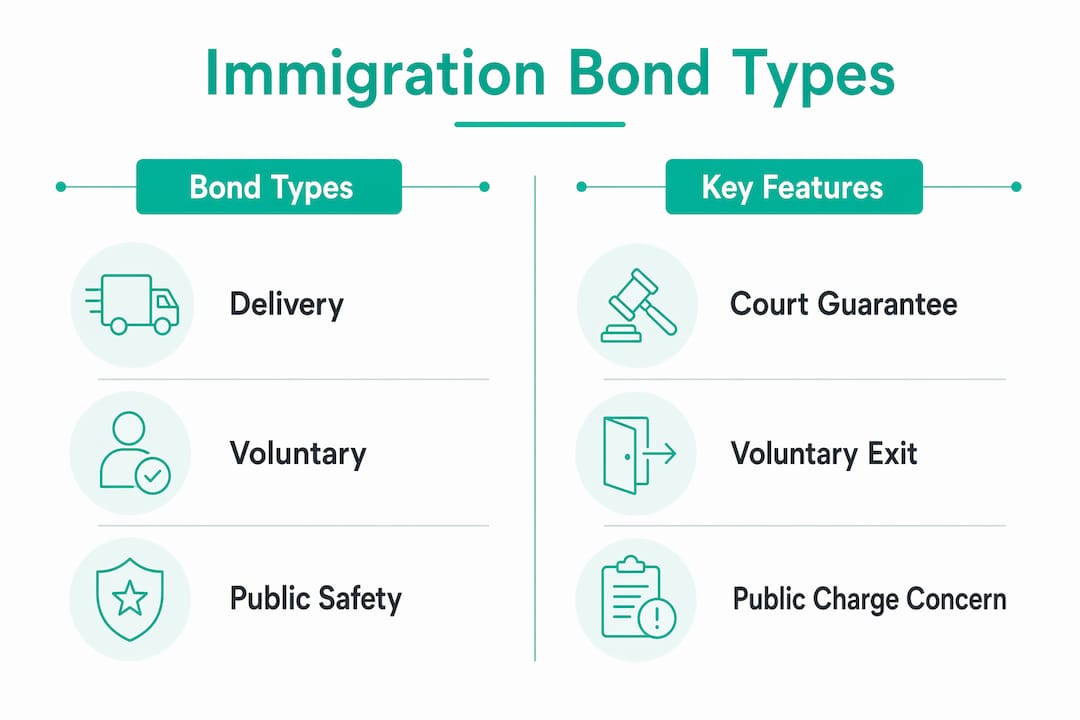
Three primary bond types exist: delivery bonds, voluntary departure bonds, and public safety bonds. Each serves a different purpose and comes with different refund conditions.
| Bond Type | Purpose | Refundable? |
|---|---|---|
| Delivery bond | Guarantees court appearance; most common type | Yes, if all conditions met |
| Voluntary departure bond | Detainee agrees to leave the U.S. by a set date | Yes, if departure confirmed |
| Public safety bond | Covers public charge concerns; rare | Yes, if conditions met |
Delivery bonds are by far the most common. ICE issues a Notice of Custody Determination, and the detainee or their family arranges payment. The bond is refunded after the case ends, provided the detainee attended all hearings.
Voluntary departure bonds apply when a detainee agrees to leave the country voluntarily by a specific date. If they depart on time and provide proof, the bond is refunded. If they stay past the deadline, the bond is forfeited and additional immigration penalties apply.
Public safety bonds are rare and tied to concerns that a detainee may become a public charge. You can read more about this specific bond type in Hasan Legal PC's detailed breakdown of Form I-945, which covers the public charge bond process directly.
Pro Tip: Always confirm in writing which bond type ICE has issued before making any payment. Paying toward the wrong bond type can cause significant delays in the release process.
Who is eligible for an immigration bond?
Eligibility is determined first by ICE and then, if contested, by an immigration judge. Not every detained person qualifies. Mandatory detention applies to certain individuals based on criminal or immigration history, meaning no bond is available regardless of how much money a family can pay.
The following categories typically result in mandatory detention with no bond option:
- Individuals convicted of certain aggravated felonies
- Those with prior deportation orders who re-entered the country
- Individuals convicted of specific drug offenses or crimes of moral turpitude
- Those deemed a threat to national security
- Individuals subject to certain terrorism-related grounds of inadmissibility
If ICE denies bond or sets an amount the family cannot afford, the detainee has the right to request a bond hearing before an immigration judge. Immigration judges hold jurisdiction over bond redetermination, including cases where ICE has denied release entirely. The judge reviews factors like community ties, employment history, family relationships, and any criminal record before setting or adjusting the bond amount.
Pro Tip: Request the bond hearing as early as possible. Immigration courts operate on tight schedules, and delays in filing can mean weeks of additional detention time for your loved one.
Criminal history does not automatically disqualify someone from bond, but it heavily influences the amount set. A detainee with a minor offense and strong community ties may receive a lower bond than someone with no criminal record but a history of missed hearings. Consulting an immigration attorney before the bond hearing gives you the best chance of a favorable outcome.
How does the immigration bond payment process work?
Two payment methods exist: cash bonds and surety bonds. Each has distinct costs, risks, and procedures.
Cash bonds require the full bond amount paid directly to ICE. Cash bonds are fully refundable once the case concludes and all conditions are met. This is the more straightforward option if the family has the funds available.
Surety bonds involve hiring a licensed immigration bond company. The family pays a nonrefundable premium, typically 10 to 15% of the total bond amount, plus collateral. Surety bond contracts often require substantial collateral such as property liens or large cash deposits. That collateral can be difficult to recover even after the case ends.
Key payment requirements to know before you go to an ICE facility:
- Obligor eligibility: The person paying must be a legal U.S. resident or citizen with valid government-issued photo ID
- Accepted payment forms: ICE facilities typically require cashier's checks or money orders. Personal checks and credit cards are rarely accepted
- Payment hours: ICE bond offices have specific operating hours. Arriving outside those hours means the detainee stays in custody another day
- Bond paperwork: Bring the detainee's full legal name, A-Number (Alien Registration Number), and the facility address
Pro Tip: Call the specific ICE detention facility the day before you plan to post bond. Confirm their accepted payment forms, hours, and any documentation requirements. Policies vary by facility and can change without public notice.
The notarization requirements for bond documents can also be a source of confusion. Understanding the role of notaries in immigration paperwork helps families avoid last-minute delays at the facility.
What happens after posting bond?
Once bond is posted, ICE processes the release, which can take anywhere from a few hours to several days depending on the facility. The obligor becomes legally responsible for the detainee's compliance with all court orders from that point forward.
The consequences of non-compliance are serious:
- Bond forfeiture: Missing any immigration court hearing causes the full bond amount to be forfeited. The government keeps the money permanently.
- Arrest warrant: ICE issues a warrant for the detainee's arrest, making future release far less likely.
- Damaged immigration case: A missed hearing often results in an in absentia removal order, which can bar the person from future immigration benefits for years.
- Obligor liability: The obligor may face legal action to recover the forfeited bond amount if a surety company paid on their behalf.
The bond is not just a financial transaction. It is a legal commitment. Every hearing date must be treated as non-negotiable, regardless of personal circumstances or perceived conflicts.
Bond refunds are processed after the immigration case concludes, whether through a final order, voluntary departure, or approval of a benefit. The obligor must submit a written request to ICE with proof that all conditions were met. Refunds can take several months to process, so plan accordingly.
Common challenges in immigration bond cases
Bond cases are rarely straightforward. Families face a range of legal and logistical obstacles that can delay release or result in financial loss.
The most common challenges include:
- High bond amounts: ICE sometimes sets bonds at $10,000, $15,000, or higher. Families who cannot afford cash bonds turn to surety companies, which adds nonrefundable costs on top of an already difficult situation.
- Mandatory detention surprises: Families often discover mid-process that their loved one falls under mandatory detention rules, making bond legally unavailable. Understanding unlawful presence bars and prior immigration violations helps set realistic expectations before pursuing bond.
- Bond hearing preparation: Detainees who appear before an immigration judge without legal representation consistently receive less favorable outcomes. An attorney can present evidence of community ties, employment, and family relationships that directly influence the bond amount.
- Tight deadlines: Bond hearings have strict filing windows. Missing a deadline can reset the clock entirely.
- Criminal record complications: Even minor offenses can affect bond eligibility. Reviewing the detainee's full history with an attorney before the hearing prevents surprises.
Families navigating these challenges benefit most from early legal consultation. An immigration attorney reviews the detainee's full case file, identifies mandatory detention risks, and prepares the strongest possible argument for a reasonable bond amount.
Key takeaways
An immigration bond is a refundable financial guarantee paid to DHS that secures a detainee's release from ICE custody, with eligibility, bond type, and payment method each carrying distinct legal and financial consequences.
| Point | Details |
|---|---|
| Bond definition | A financial guarantee to DHS securing release while immigration proceedings continue. |
| Three bond types | Delivery, voluntary departure, and public safety bonds serve different purposes and conditions. |
| Eligibility limits | Mandatory detention rules bar some detainees from bond regardless of payment ability. |
| Payment methods | Cash bonds are fully refundable; surety bond premiums of 10 to 15% are never refunded. |
| Compliance is critical | Missing one court hearing forfeits the entire bond and triggers an arrest warrant. |
What I've learned from working immigration bond cases
After working with families through the immigration bond process, the pattern I see most often is this: families move fast on payment and slow on legal preparation. They post bond quickly, which is understandable. But they underestimate what comes next.
The surety bond market is where I see the most financial harm. Families sign contracts under pressure without reading the collateral clauses. A 10 to 15% premium on a $15,000 bond is $1,500 to $2,250 gone permanently. Add a property lien as collateral, and the family has put their home at risk for a case they do not fully understand yet.
The bond hearing is where cases are actually won or lost. I have seen judges reduce bonds from $20,000 to $3,000 when an attorney presents the right evidence. Community letters, employment records, proof of family ties, and a clean local record all matter. Walking into that hearing without representation is a significant disadvantage.
My strongest advice: contact an immigration attorney before you post bond, not after. The consultation costs far less than a forfeited bond or a surety premium on an amount that could have been reduced. Clear, early legal guidance also reduces the stress families carry through what is already a difficult time.
— Mahmudul
How Hasan Legal PC can help with your bond case
Facing an immigration detention situation is stressful, and the bond process has real financial and legal stakes. Hasan Legal PC provides direct, personalized support for families working through immigration bond cases, from evaluating eligibility and preparing for bond hearings to guiding obligors through the payment process.

Attorney Mahmudul Hasan, Esq. personally oversees every case, so you work with an experienced attorney from day one. Whether your loved one needs a bond hearing before an immigration judge or you need help understanding your obligations as an obligor, the team at Hasan Legal PC is ready to help. Explore the full range of immigration legal services available, or contact the firm directly to schedule a consultation and get clear answers for your specific situation.
FAQ
What is the minimum amount for an immigration bond?
The minimum immigration bond amount is $1,500, paid as a single lump sum to ICE. The actual amount set in any case depends on factors like flight risk, criminal history, and community ties.
Can anyone pay an immigration bond?
The obligor must be a legal U.S. resident or citizen with valid government-issued photo ID. Undocumented individuals cannot serve as bond obligors.
Is an immigration bond refundable?
Cash bonds are fully refundable after the case concludes if all hearing attendance requirements are met. Surety bond premiums are never refunded, regardless of the case outcome.
What happens if the detainee misses a court hearing?
Missing a court hearing causes immediate bond forfeiture, an ICE arrest warrant, and likely an in absentia removal order. The financial loss is permanent and the legal consequences are severe.
Can an immigration judge change the bond amount?
Yes. If ICE denies bond or sets an unaffordable amount, the detainee can request a bond redetermination hearing before an immigration judge, who has authority to lower, raise, or eliminate the bond based on the evidence presented.