

An immigration petition is a formal application submitted to U.S. Citizenship and Immigration Services (USCIS) to establish a foreign national's eligibility for an immigration benefit before they can apply for a visa or green card. Think of it as the official first step that opens the door to the entire immigration process. Without an approved petition, no visa or green card application can move forward. Understanding what a petition is, who files it, and what happens after approval gives you a clear picture of how U.S. immigration actually works.
What is an immigration petition and why does it matter?
An immigration petition is a formal request that establishes eligibility for an immigrant classification, filed with USCIS either by a qualifying relative, an employer, or in some cases the foreign national themselves. The person filing the petition is called the petitioner, and the foreign national seeking the benefit is called the beneficiary. These two roles are distinct, and understanding the difference matters because each carries specific legal responsibilities.
The petition does not grant a visa or green card on its own. It simply tells USCIS: "This person qualifies for a specific immigration category." Once USCIS approves the petition, the beneficiary can then move to the next phase, which is actually applying for the visa or lawful permanent resident status. Skipping this step or confusing it with the visa application itself is one of the most common misunderstandings families face.

USCIS processes millions of petitions each year across multiple categories. Each category has its own form, evidence requirements, and processing timeline. Knowing which category applies to your situation is the single most important decision you will make at the start of the immigration process.
What types of immigration petitions exist and who can file them?
The U.S. immigration system recognizes several major petition categories, each designed for a specific relationship or qualification. Here are the most common types:
- Family-based petitions (Form I-130): A U.S. citizen or lawful permanent resident files this petition to sponsor an eligible relative. The I-130 petition establishes the qualifying relationship but does not grant immigration status on its own.
- Employment-based petitions (Form I-140): Typically filed by an employer on behalf of a foreign worker. USCIS requires the petitioner to demonstrate the beneficiary's qualifications for the specific immigrant classification being sought.
- Self-petitions (Form I-360): In certain categories, the beneficiary files on their own behalf. The Violence Against Women Act (VAWA) petition is a well-known example, allowing abused spouses, children, or parents to petition without relying on their abuser.
- Nonimmigrant worker petitions (Form I-129): Employers file this form to bring foreign workers to the U.S. temporarily in categories like H-1B, L-1, or O-1.
The petitioner's role and responsibilities vary significantly across these categories. Employers must maintain compliance with wage and working condition requirements. Family petitioners must prove the qualifying relationship with documents like birth certificates or marriage records. Self-petitioners must independently gather and present all supporting evidence.
Pro Tip: If you are an employer filing a Form I-140, confirm that your labor certification is still valid before submitting. Labor certifications expire 180 days after issuance, and filing after that window results in automatic rejection regardless of the worker's qualifications.
What happens after filing an immigration petition?
Petition approval is a milestone, but it is not the finish line. Here is what the process looks like after USCIS receives your petition:
- USCIS reviews the petition. The agency examines the evidence, confirms the petitioner's eligibility to file, and verifies that the beneficiary qualifies for the requested classification.
- USCIS issues a decision. If approved, USCIS sends a Form I-797 Notice of Action. This document serves as official evidence of the approved classification and is used in subsequent steps.
- A priority date is established. For most immigrant petitions, the approval creates a priority date. This date determines where the beneficiary stands in the visa queue, which matters greatly in oversubscribed categories like certain employment-based or family preference categories.
- The beneficiary waits for visa availability. Immediate relatives of U.S. citizens do not face a wait, but most other categories are subject to annual numerical limits. The State Department's Visa Bulletin tracks monthly visa availability.
- The beneficiary applies for status. If the beneficiary is already in the U.S., they file Form I-485 for adjustment of status. If they are abroad, they go through consular processing at a U.S. embassy or consulate.
Petition approval establishes eligibility and classification but does not confer any visa or lawful status. This distinction is critical. Many applicants mistakenly believe an approval letter means they can begin living or working in the U.S. immediately. It does not. The adjustment or consular processing step is where actual status is granted, and USCIS outcomes at that stage depend on a separate set of eligibility requirements.
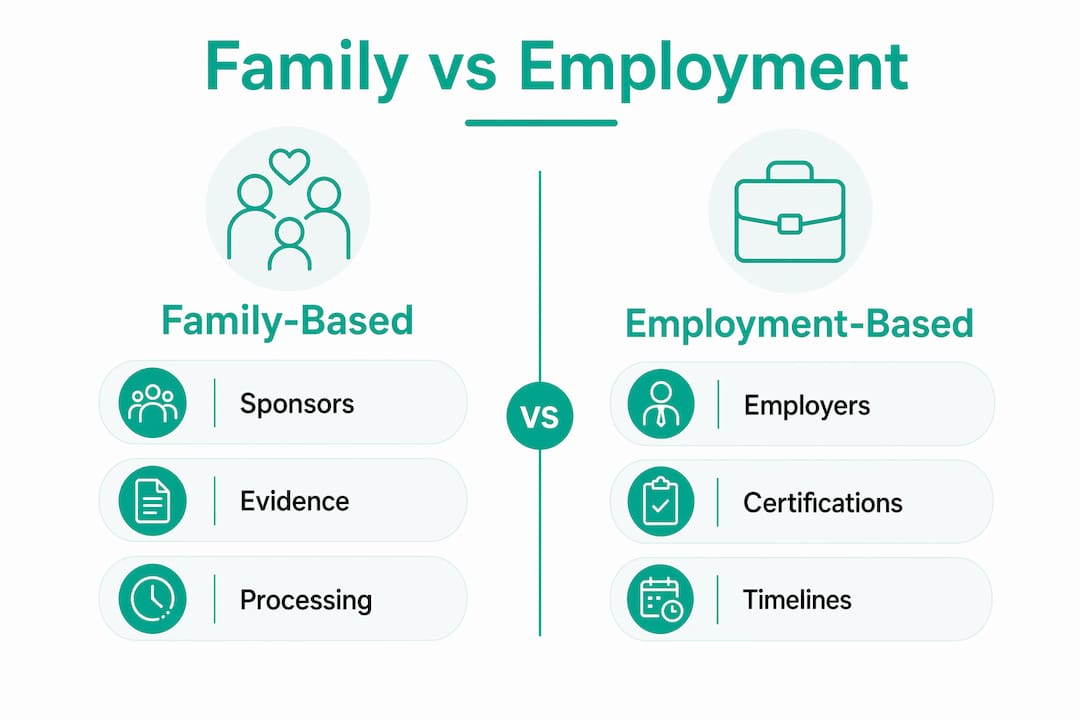
How do family-based and employment-based petitions compare?
Family and employment petitions share the same basic structure but differ significantly in evidence, procedure, and common pitfalls.
| Feature | Family-based (Form I-130) | Employment-based (Form I-140) |
|---|---|---|
| Who files | U.S. citizen or permanent resident | Employer (or self-petitioner in some categories) |
| Core evidence | Proof of qualifying relationship | Proof of worker qualifications and job offer |
| Labor certification | Not required | Required for most EB-2 and EB-3 categories |
| Self-petition option | Limited (VAWA, widowers) | Available for EB-1A, EB-1B, and EB-2 NIW |
| Processing complexity | Moderate | High, especially with PERM labor certification |
Family petitions center on proving a real, qualifying relationship. USCIS scrutinizes documents like marriage certificates, birth records, and photos to confirm the relationship is genuine. Employment petitions require proving the worker meets the job's minimum qualifications and, in most cases, that no qualified U.S. worker was available for the position. This second requirement is satisfied through the PERM labor certification process, which the Department of Labor oversees before the I-140 is even filed.
One critical timing issue affects employment petitions specifically. Labor certifications expire 180 days after the Department of Labor issues them. If an employer delays filing the I-140 and the certification lapses, the entire PERM process must restart. That can add one to two years to the timeline.
Pro Tip: For employment-based petitions, track your PERM certification's expiration date on a calendar the day it arrives. Missing the 180-day filing window is a procedural error that no amount of legal skill can fix after the fact.
What is self-petitioning in U.S. immigration and who qualifies?
Self-petition immigration refers to cases where the foreign national files the petition on their own behalf, without needing an employer or family member to sponsor them. This option exists in specific, well-defined categories:
- VAWA self-petitioners: Abused spouses, children, or parents of U.S. citizens or permanent residents can file Form I-360 under VAWA without the abuser's knowledge or cooperation. USCIS keeps these petitions confidential.
- EB-1A (Extraordinary Ability): Foreign nationals with extraordinary ability in sciences, arts, education, business, or athletics can self-petition without a job offer. They must demonstrate sustained national or international acclaim.
- EB-1B (Outstanding Researchers and Professors): This category still requires an employer, so it is not a true self-petition, but it is worth noting as a near-equivalent for academics.
- EB-2 National Interest Waiver (NIW): Foreign nationals whose work benefits the U.S. national interest can request a waiver of the job offer and labor certification requirements, effectively self-petitioning.
Self-petitions establish eligibility for immigrant classification but do not automatically grant lawful permanent resident status. The beneficiary must still complete adjustment of status or consular processing after approval. The key advantage of self-petitioning is independence. You are not relying on an employer who might withdraw sponsorship or a family member who might become uncooperative. That independence is especially meaningful for VAWA petitioners and high-achieving professionals who qualify under EB-1A or EB-2 NIW.
Key takeaways
An immigration petition is the mandatory first step with USCIS that establishes eligibility for a visa or green card, but approval alone does not grant any immigration status.
| Point | Details |
|---|---|
| Petition vs. visa application | A petition establishes eligibility; a separate application grants the actual visa or green card. |
| Main petition types | Form I-130 covers family-based cases; Form I-140 covers employment-based cases; Form I-360 covers self-petitions including VAWA. |
| Priority date significance | Petition approval creates a priority date that determines your place in the visa queue for most categories. |
| Labor certification timing | Employment-based I-140 petitions must be filed within 180 days of labor certification issuance or the certification expires. |
| Self-petition independence | Categories like VAWA, EB-1A, and EB-2 NIW allow filing without a sponsor, offering critical flexibility for qualifying applicants. |
What I've learned from years of handling immigration petitions
After working with hundreds of clients on immigration petitions, the single most damaging misconception I encounter is the belief that petition approval means the hard part is over. Families celebrate the I-797 approval notice, then are blindsided when they learn months of additional processing remain before anyone gets a green card.
The second issue I see constantly is choosing the wrong petition type. A client who qualifies for both a family-based and an employment-based pathway may assume one is faster without understanding how priority dates, visa availability, and processing times interact. Filing the wrong form does not just cause a delay. It can reset the clock entirely and, in some cases, create complications that affect future filings.
I also want to be direct about self-petitioning under EB-1A or EB-2 NIW. These categories are genuinely powerful options for accomplished professionals, but USCIS sets a high evidentiary bar. I have seen applicants submit petitions with impressive credentials that still get denied because the evidence was not organized to meet USCIS's specific legal standards. The qualification and the petition are two different things. You can be extraordinary and still file a weak petition.
My honest advice: treat the petition as a legal document, not a form. Every piece of evidence you include should directly address a specific USCIS requirement. If you are unsure which petition type fits your situation or how to structure your evidence, get professional guidance before you file, not after a denial.
— Mahmudul
How Hasan Legal PC can help with your petition
Filing an immigration petition correctly the first time protects your timeline and your future options. At Hasan Legal PC, attorney Mahmudul Hasan, Esq. personally reviews every case to identify the right petition category, gather the right evidence, and submit a petition that meets USCIS's exact standards. Whether you are a family member sponsoring a relative, an employer petitioning for a worker, or an individual exploring self-petition options, the firm provides direct, personalized guidance at every step. Explore the full range of immigration petition services available, or start with a free case evaluation to understand your options before you file.
FAQ
What is an immigration petition in simple terms?
An immigration petition is a formal request filed with USCIS to prove that a foreign national qualifies for a specific immigration category, such as a family-based or employment-based green card. It is the required first step before applying for a visa or green card.
Does an approved petition mean I have a green card?
No. Petition approval only establishes eligibility and classification. You must still file Form I-485 for adjustment of status or complete consular processing abroad to actually receive a green card.
What is the difference between Form I-130 and Form I-140?
Form I-130 is used for family-based petitions filed by a U.S. citizen or permanent resident to sponsor a qualifying relative. Form I-140 is used for employment-based petitions, typically filed by an employer to sponsor a foreign worker.
Who can self-petition for a green card?
Foreign nationals in categories like VAWA (Form I-360), EB-1A extraordinary ability, and EB-2 National Interest Waiver can self-petition without a sponsor. Each category has specific eligibility criteria that must be met with documented evidence.
How long does the immigration petition process take?
Processing times vary widely by petition type, USCIS workload, and whether a visa number is immediately available. Family-based petitions for immediate relatives of U.S. citizens move faster than family preference categories, which can take years due to annual numerical limits tracked in the State Department's Visa Bulletin.