

Immigrant intent is defined as the legal presumption under INA 214(b) that any foreign national applying for a U.S. nonimmigrant visa intends to remain permanently in the United States unless they prove otherwise. This presumption is not a judgment of character. It is a statutory default that places the burden of proof squarely on the applicant. Understanding the immigrant intent definition, and knowing how to rebut it, is the single most consequential factor in whether your visa application succeeds or fails. Whether you are applying for a B-2 tourist visa, an F-1 student visa, or an H-1B work visa, this concept shapes every step of the process.
What is immigrant intent under U.S. immigration law?
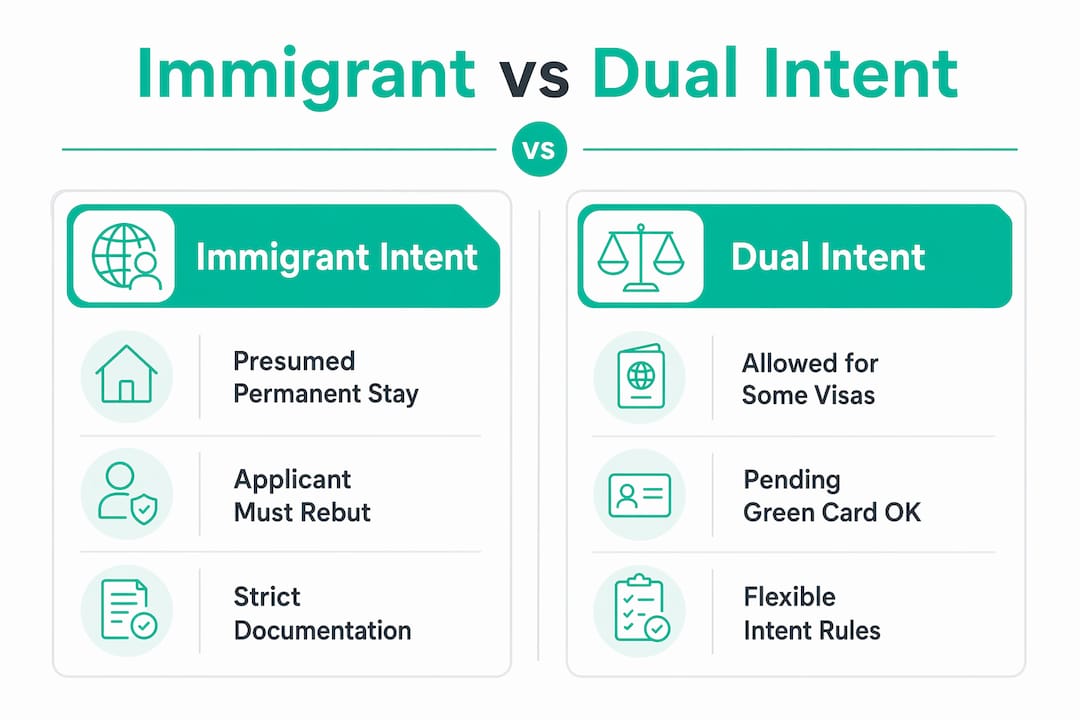
Immigrant intent, formally governed by INA 214(b), is the presumption that a visa applicant seeks to permanently immigrate to the United States rather than visit temporarily. The law does not require officers to prove you plan to stay. You must prove you do not. This reversal of the usual burden of proof surprises many first-time applicants who assume good faith is assumed until evidence suggests otherwise.
The State Department and USCIS both apply this standard during visa adjudication. Consular officers at U.S. embassies abroad evaluate it during visa interviews. Customs and Border Protection officers apply it again at ports of entry. The immigrant intent criteria are assessed at multiple checkpoints, not just once.

The practical meaning of immigrant intent is straightforward: your application must affirmatively demonstrate that you have compelling reasons to return home after your authorized stay. The law does not care how honest your stated intentions are. It evaluates objective evidence of ties to your home country and whether your stated purpose aligns with the visa category you are requesting.
How is immigrant intent evaluated during visa applications?
Adjudicators evaluate immigrant intent as a fact-based inquiry based on the totality of circumstances, not on any single piece of evidence. This means no one document guarantees approval, and no one red flag guarantees denial. Officers weigh the full picture of your life, your ties abroad, and the consistency between your stated purpose and the evidence you present.
The core factors officers examine include:
- Employment ties: A current job, a letter from an employer confirming your position is held, or a business you own in your home country
- Family ties: A spouse, children, or dependent parents who remain in your home country
- Financial ties: Property ownership, bank accounts, or ongoing financial obligations that require your presence abroad
- Social ties: Community involvement, educational enrollment, or long-term commitments that anchor you to your home country
- Purpose consistency: Whether your reason for visiting the United States matches the visa category you applied for
Intent is inferred from objective ties rather than declared desire alone. Telling an officer "I promise I will leave" carries almost no weight without supporting documentation. What carries weight is a pay stub, a property deed, a school enrollment letter, or a dependent family member who cannot travel with you.
Pro Tip: Most applicants focus on what they will do in the United States and neglect to document what they are leaving behind. Officers spend more time evaluating your home country ties than your U.S. itinerary. Bring evidence of both, but prioritize the former.
One frequently overlooked aspect of immigrant intent documentation is quality over quantity. A single strong piece of evidence, such as a letter from a government employer confirming your leave of absence, outweighs a stack of generic bank statements. Officers are trained to spot thin documentation assembled purely for the interview.
What exceptions exist to the immigrant intent presumption?
The most significant exception to the standard immigrant intent rule is the concept of dual intent. Dual intent visas allow applicants to simultaneously hold nonimmigrant status and pursue permanent residence without violating their visa terms. This is a deliberate policy choice by Congress for specific visa categories where the U.S. economy benefits from long-term skilled workers.
The following table compares common visa categories and how immigrant intent applies to each:
| Visa category | Immigrant intent rule | Dual intent allowed? |
|---|---|---|
| B-1/B-2 (visitor) | Must rebut presumption of immigrant intent | No |
| F-1/M-1 (student) | Must show present intent to depart after studies | No |
| J-1 (exchange visitor) | Must demonstrate nonimmigrant intent | No |
| H-1B (specialty occupation) | Immigrant intent does not bar eligibility | Yes |
| L-1 (intracompany transfer) | Immigrant intent does not bar eligibility | Yes |
| K-1 (fiancé(e)) | Specifically designed to lead to permanent residence | Yes |
For H-1B and L-1 holders, a pending green card petition does not automatically disqualify you from maintaining or renewing your nonimmigrant status. Dual intent categories ease the legal burden by allowing both statuses to coexist, which reduces the risk of visa denial for workers in active green card processes. This is why many employment-based immigration strategies route through H-1B status before pursuing permanent residence.
Contrast this with F-1 students or B-2 visitors. If you are in one of these categories and you file an immigrant petition, officers may view that as direct evidence of immigrant intent, which can result in visa denial or revocation. The distinction between dual intent and single intent visa categories is not a technicality. It is the difference between a legal path forward and a potential bar on reentry.
How do student and visitor visas handle immigrant intent?
Student visa applicants face a specific version of the immigrant intent standard. F-1 and M-1 applicants must demonstrate present intent to depart after completing their studies and must maintain a foreign residence they do not intend to abandon. Critically, USCIS policy evaluates present intent to leave the United States, not a guaranteed plan to return to the passport country. This distinction matters because it gives students flexibility in their post-graduation plans while still requiring a credible departure intent.
Common pitfalls for student visa applicants include:
- Failing to show a foreign residence they intend to return to, such as a family home or a prior address
- Applying for Optional Practical Training (OPT) extensions without addressing how those extensions affect their departure timeline
- Submitting applications that show no connection to their home country's job market or academic institutions
- Disclosing plans to apply for a green card during a student visa interview, which directly triggers the immigrant intent presumption
For visitor visa applicants, the B-1/B-2 categories carry the strictest nonimmigrant intent requirements. Officers expect you to demonstrate strong ties to your home country through concrete, verifiable evidence. Vague statements about wanting to return home are not sufficient.
Pro Tip: If you have a pending immigrant petition filed by a family member or employer, disclose it proactively and pair that disclosure with strong evidence of your current nonimmigrant intent. Hiding a pending petition and having it discovered during the interview is far more damaging than addressing it directly.
Pending immigrant petitions do not automatically negate nonimmigrant eligibility if credible temporary intent is demonstrated. Officers can and do issue visitor or student visas to applicants with pending petitions when the evidence of present nonimmigrant intent is convincing. The key is consistency between what you say, what you submit, and what your life circumstances actually reflect.
What practical steps prove nonimmigrant intent effectively?
Proving nonimmigrant intent is not about crafting a persuasive story. It is about assembling objective evidence that makes your temporary intent credible. Key evidence for nonimmigrant intent includes strong ties to your home country such as employment, family, financial, and social connections. Each category of evidence serves a specific purpose in the officer's analysis.
Strong evidence to gather before your visa interview or application includes:
- A current employment contract or letter from your employer confirming your position and approved leave
- Property ownership documents, lease agreements, or utility bills showing your established residence abroad
- Bank statements demonstrating financial activity in your home country over the past six to twelve months
- Family records showing dependents, a spouse, or elderly parents who rely on your presence
- Enrollment records if you are a student, or professional licenses tied to your home country's regulatory system
Beyond documentation, how you present your intent matters. Your answers during a visa interview must align precisely with your written application and supporting documents. Officers are trained to identify inconsistencies between what applicants say verbally and what their paperwork shows. A single contradiction, such as mentioning a job offer in the United States while applying for a tourist visa, can override an otherwise strong application.
For applicants navigating visa categories and circumstances where immigrant intent is treated differently, such as workers facing visa backlogs, the strategy requires careful coordination between your nonimmigrant status maintenance and your long-term immigration goals. Maintaining nonimmigrant status requires intent consistent with visa terms, and USCIS evaluates this intent again at the time of any extension or status change filing.
Key takeaways
Immigrant intent is a statutory presumption under INA 214(b) that every nonimmigrant visa applicant must actively rebut with objective, consistent evidence of ties to their home country and purpose aligned with their visa category.
| Point | Details |
|---|---|
| Default presumption | INA 214(b) presumes immigrant intent; applicants must rebut it with evidence, not declarations. |
| Totality of circumstances | Officers weigh employment, family, financial, and social ties together, not any single document. |
| Dual intent exception | H-1B and L-1 visa holders may pursue permanent residence without violating nonimmigrant status. |
| Student visa nuance | F-1 applicants must show present intent to depart, not a guaranteed plan to return to their home country. |
| Pending petitions | A pending immigrant petition does not automatically bar a nonimmigrant visa if temporary intent is credible. |
Why immigrant intent is more strategic than most applicants realize
After working on immigration cases across a wide range of visa categories, the pattern I see most often is this: applicants treat immigrant intent as a checkbox rather than a legal argument. They gather a few documents, assume their honest intentions will speak for themselves, and walk into a consular interview unprepared for the officer's actual line of questioning.
The reality is that officers are not evaluating your character. They are evaluating whether your evidence tells a coherent story. I have seen applicants with genuinely temporary intentions get denied because their documentation was thin or contradictory. I have also seen applicants with pending green card petitions receive nonimmigrant visas because they presented a clear, consistent, and well-documented case for their present temporary intent.
The most common misconception I encounter is that dual intent is a loophole. It is not. It is a deliberate legal framework that Congress built for specific visa categories. If you are in an H-1B or L-1 category, you are legally permitted to pursue permanent residence. If you are in a B-2 or F-1 category, you are not. Treating these two situations as interchangeable is one of the fastest ways to create a problem that takes years to resolve.
Preparation is the real differentiator. Applicants who understand the immigrant intent criteria before they apply, who organize their evidence around the officer's actual evaluation framework, and who address potential red flags proactively rather than hoping they go unnoticed, consistently achieve better outcomes. The law gives you a clear standard to meet. Meeting it is a matter of preparation, not luck.
— Mahmudul
How Hasan Legal PC can help with your visa case

Immigrant intent issues affect applicants across nearly every visa category, and the consequences of getting it wrong range from a single denial to a multi-year bar on reentry. At Hasan Legal PC, attorney Mahmudul Hasan, Esq. directly reviews every case to build a strategy that addresses your specific circumstances, whether you are applying for a first-time nonimmigrant visa, managing a pending immigrant petition alongside a temporary status, or preparing for a consular interview. You can explore the full range of immigration legal services Hasan Legal PC offers, or start with a free case evaluation to discuss your situation directly with our team. Clear guidance from the start prevents the kind of documentation gaps and inconsistencies that lead to denials.
FAQ
What is the immigrant intent definition under U.S. law?
Immigrant intent is the statutory presumption under INA 214(b) that a nonimmigrant visa applicant intends to permanently remain in the United States. The applicant bears the burden of rebutting this presumption with evidence of ties abroad and purpose consistent with the visa category.
What are examples of evidence that prove nonimmigrant intent?
Strong evidence includes a current employment contract, property ownership documents, bank statements showing financial activity abroad, and family records showing dependents in the home country. Officers evaluate the totality of these ties rather than any single document.
How does immigrant intent differ from dual intent?
Immigrant intent refers to the presumption that an applicant plans to stay permanently, which disqualifies most nonimmigrant visa applicants. Dual intent is a legal exception that applies to H-1B and L-1 visa holders, allowing them to pursue permanent residence without violating their nonimmigrant status.
Does a pending green card petition automatically cause a visa denial?
No. A pending immigrant petition does not automatically bar a nonimmigrant visa if the applicant can credibly demonstrate present temporary intent. Officers may issue nonimmigrant visas despite pending petitions when the evidence of temporary purpose is consistent and well-documented.
How does immigrant intent apply to F-1 student visas?
F-1 applicants must show present intent to depart after completing their studies and must maintain a foreign residence they do not intend to abandon. USCIS evaluates present intent to leave the United States, not a guaranteed plan to return to the applicant's passport country.