

Immigration court is an administrative tribunal within the U.S. Department of Justice that decides whether noncitizens may be removed from the United States. Formally managed by the Executive Office for Immigration Review (EOIR), it operates as a civil court, not a criminal one. If you or a family member has received a Notice to Appear, understanding what immigration court is and how it works is the first step toward protecting your rights. This guide explains the full process, the role of immigration judges, appeal rights, and what to expect at every stage.
What is immigration court and how does it work?
Immigration court is an administrative court within the Department of Justice that handles removal proceedings for noncitizens. There is no jury. An immigration judge presides over each hearing and decides both whether a person is removable and whether any form of relief applies. The Department of Homeland Security (DHS) acts as the opposing party, represented by attorneys from Immigration and Customs Enforcement (ICE).
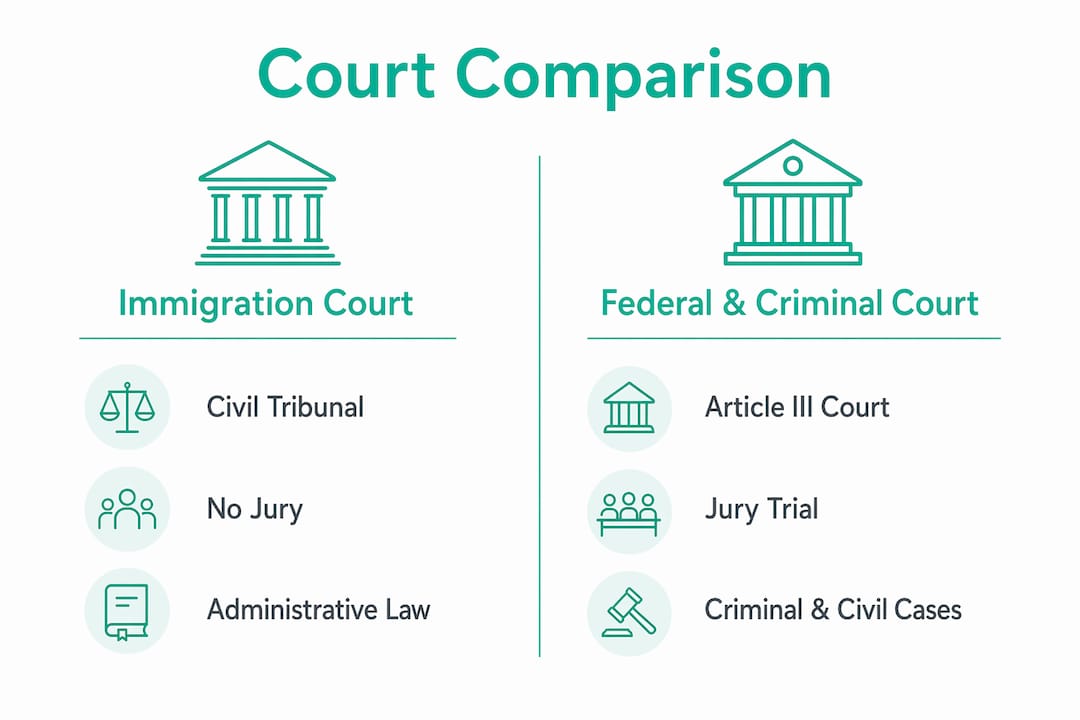
These courts are not Article III federal courts. They are civil administrative tribunals, which means the procedural rules and rights differ significantly from what you see in a criminal trial. Immigration courts operate as trial-like civil courts inside EOIR, but respondents do not have the same constitutional protections that criminal defendants receive. That distinction shapes everything from how evidence is handled to what happens if you cannot afford an attorney.

How does the immigration court process work from start to finish?
The removal case begins when DHS files a Notice to Appear, known as Form I-862, with the immigration court. The Notice to Appear serves as the charging document that formally initiates proceedings. DHS first serves the NTA on the noncitizen, then files it with the court. Understanding the content and timing of your NTA is critical because it lists the specific charges you must respond to at your hearings.
The typical immigration court process follows these steps:
- DHS serves the Notice to Appear (Form I-862) on the noncitizen, listing charges and allegations.
- DHS files the NTA with the immigration court, which officially opens the case.
- Master Calendar Hearing takes place. This is a short, scheduling-focused hearing where the judge confirms your identity, explains the charges, and sets future hearing dates.
- Individual Hearing (Merits Hearing) follows. This is the full hearing where both sides present evidence, witnesses testify, and the judge evaluates relief requests.
- Immigration judge issues a decision on removability and any relief sought.
- Appeal window opens. Either party has 30 calendar days to file an appeal with the Board of Immigration Appeals (BIA).
Immigration judges decide removability and adjudicate relief requests using evidence from both the respondent and DHS. They may also conduct credible fear and reasonable fear reviews in certain cases. Hearings can span months or even years depending on court backlog and case complexity.
Pro Tip: Always verify that DHS has actually filed your NTA with the court, not just served it on you. If DHS serves the NTA but does not file it with the court before your first hearing, this is called a "failure to prosecute" and can delay or pause your proceedings. Check your case status directly through the EOIR automated case information system.
How does immigration court differ from federal and criminal courts?
Immigration court authority comes from federal statute and DOJ regulations, not from Article III of the Constitution. That single fact creates major differences in how proceedings run. Immigration proceedings are civil, not criminal, which means respondents do not have a Sixth Amendment right to a government-appointed attorney. DHS is the opposing party, represented by ICE attorneys, and the burden of proof rules differ by the type of relief being sought.
The table below shows the key differences between immigration court, federal district court, and criminal court.
| Feature | Immigration court | Federal district court | Criminal court |
|---|---|---|---|
| Type | Civil administrative | Article III civil | Article III criminal |
| Jury | No | Yes (in most cases) | Yes |
| Right to free attorney | No | No (civil) | Yes (6th Amendment) |
| Presiding officer | Immigration judge | Federal judge | Federal/state judge |
| Governing body | DOJ/EOIR | Judicial branch | Judicial branch |
| Standard of proof | Varies by relief type | Preponderance | Beyond reasonable doubt |
Immigration judges exercise adjudicative independence, meaning they rule on cases without political interference in individual decisions. However, administration is handled separately by the Office of the Chief Immigration Judge, which explains why hearings are decentralized across dozens of immigration courts nationwide.
Pro Tip: Because you have no guaranteed right to a free attorney in immigration court, preparing your own legal representation before your Master Calendar Hearing is critical. Showing up without counsel at an Individual Hearing puts you at a serious disadvantage against an experienced ICE attorney.
What happens after an immigration judge makes a decision?
An immigration judge's decision becomes final unless one of the parties files a timely appeal. Immigration judge decisions are final unless timely appealed to the BIA. The BIA, which stands for the Board of Immigration Appeals, is the highest administrative body for immigration cases in the United States. It reviews decisions on removability, relief, and bond, but it does not review every type of ruling.
The appeals process works as follows:
- File Form EOIR-26 (Notice of Appeal) with the BIA within 30 calendar days of the judge's decision.
- Include the filing fee or a fee waiver request with your submission. Missing either will invalidate the appeal.
- BIA reviews the record. The BIA generally does not hold new hearings. It reviews the written record and legal arguments submitted.
- BIA issues a decision. It may affirm, reverse, or remand the case back to the immigration judge.
- Federal court review is possible after BIA if the BIA rules against you. You may petition a U.S. Court of Appeals for review of legal questions.
The Notice of Appeal must be received by the BIA within 30 calendar days after the immigration judge's decision. Missing that deadline finalizes the removal order. Not all immigration judge decisions can be appealed to the BIA. Credible fear reviews, for example, are excluded from BIA review. Families hoping for a second look after an unfavorable ruling need to confirm whether the specific decision is appealable before counting on that option.
Pro Tip: Appeal deadlines are determined by when the BIA physically receives your form, not when you mail it. Mailing delays and incomplete fee paperwork have finalized removal orders for people who believed they filed on time. Use certified mail with tracking and submit well before the 30-day deadline.
What types of hearings and relief are available in immigration court?
Immigration court hearings fall into two main categories. The Master Calendar Hearing is brief and administrative. It is where the judge confirms basic facts, the respondent enters pleadings, and future hearing dates are set. The Individual Hearing, also called the Merits Hearing, is where the real legal work happens. Both sides present evidence, witnesses testify under oath, and the judge evaluates whether any form of relief applies.
Common forms of relief available in immigration court include:
- Asylum: Protection for individuals who face persecution based on race, religion, nationality, political opinion, or membership in a particular social group. Readers facing removal can learn more about affirmative asylum eligibility and how it applies in court proceedings.
- Cancellation of removal: Available to certain lawful permanent residents and non-permanent residents who meet specific residency and good moral character requirements.
- Adjustment of status: Allows eligible respondents to apply for lawful permanent residence directly in immigration court.
- Withholding of removal and Convention Against Torture (CAT) protection: Alternative protections for those who do not qualify for asylum but face serious harm if returned.
- Voluntary departure: Allows a respondent to leave the U.S. voluntarily within a set period, avoiding a formal removal order on their record.
Credible fear and reasonable fear interviews are separate screenings, typically conducted by USCIS asylum officers before a case reaches immigration court. A positive credible fear determination can lead to an asylum merits interview with USCIS or referral to immigration court for full proceedings. The type of evidence you present, including country condition reports, personal declarations, and witness testimony, directly affects which relief options the judge will consider.
Key Takeaways
Immigration court is a civil administrative tribunal under the DOJ's EOIR that decides removability and relief for noncitizens, with no jury, no right to a free attorney, and strict appeal deadlines that determine case finality.
| Point | Details |
|---|---|
| Court type | Immigration court is a civil administrative court, not a criminal or Article III federal court. |
| Case initiation | DHS starts removal proceedings by filing Form I-862 (Notice to Appear) with the immigration court. |
| Hearing stages | Cases move from a short Master Calendar Hearing to a full Individual Hearing where evidence is presented. |
| Appeals deadline | Form EOIR-26 must be received by the BIA within 30 calendar days of the judge's decision. |
| Relief options | Asylum, cancellation of removal, adjustment of status, and voluntary departure are common forms of relief. |
What I've learned after years of immigration court cases
Most people walk into immigration court expecting something like a criminal trial. They expect a jury, a public defender, and a presumption of innocence. None of those apply here. Immigration court is a civil administrative proceeding, and that gap between expectation and reality causes real harm when people are unprepared.
The single most common mistake I see is confusion between receiving a Notice to Appear and having an active court case. Families assume that because DHS served the NTA, the clock is running and the case is live. That is not always true. If DHS serves the NTA but does not file it with the court, the case has not formally started. I have seen clients miss critical preparation windows because they were tracking the wrong document.
The appeals process is where I see the most preventable losses. The 30-day deadline to file Form EOIR-26 with the BIA is not a suggestion. The BIA counts the date of receipt, not the postmark. I have reviewed cases where a removal order became final because a form arrived one day late or a fee waiver was incomplete. These are not legal defeats. They are logistical ones, and they are entirely avoidable with proper planning.
My honest advice: treat every deadline in immigration court as if missing it ends your case. Because it often does.
— Mahmudul
How Hasan-legal can help with your immigration court case
Facing immigration court without experienced legal support puts you at a serious disadvantage. Hasan-legal's principal attorney, Mahmudul Hasan, Esq., directly oversees every case and provides personalized guidance at every stage of the process.

Whether you are preparing for a Master Calendar Hearing, responding to a removal order, or filing an appeal with the BIA, Hasan-legal offers comprehensive immigration legal services tailored to your situation. The firm also provides specialized deportation defense representation for individuals facing removal proceedings. Schedule a free case evaluation to discuss your options with an attorney who will review your specific circumstances and help you understand your next steps.
FAQ
What is immigration court in the United States?
Immigration court is a civil administrative tribunal within the U.S. Department of Justice's Executive Office for Immigration Review (EOIR). It decides whether noncitizens are removable from the United States and adjudicates requests for relief such as asylum or cancellation of removal.
What is an immigration judge and what do they decide?
An immigration judge is a federal administrative law judge appointed by the Attorney General who presides over removal proceedings. They determine removability, evaluate evidence from both DHS and the respondent, and rule on relief applications.
How long does the immigration court process take?
The immigration court process varies widely based on court location, case complexity, and current backlog. Some cases resolve in months, while others take several years to reach a final Individual Hearing.
Can an immigration court decision be appealed?
Yes. Immigration judge decisions can be appealed to the Board of Immigration Appeals by filing Form EOIR-26 within 30 calendar days of the decision. Not all decisions are eligible for BIA review, and missing the deadline finalizes the order.
Do I need a lawyer for immigration court?
You are not entitled to a government-appointed attorney in immigration court because proceedings are civil, not criminal. Retaining private legal counsel significantly improves your ability to present evidence, meet deadlines, and pursue available relief options.