

Immigration parole is a temporary legal authorization granted by the Department of Homeland Security that allows certain foreign nationals to enter or remain in the United States without formal admission. Authorized under INA Section 212(d)(5), this discretionary tool applies to individuals who would otherwise be inadmissible. It does not confer permanent status, a visa, or a path to a Green Card. Parole exists for urgent humanitarian situations or cases of significant public benefit, and it requires the parolee to depart when the authorization expires. Parolees may apply for work authorization during their stay, but that benefit is separate from parole itself.
What is immigration parole and how does it work legally?
Immigration parole is defined under INA Section 212(d)(5) as a discretionary authority allowing DHS to permit otherwise inadmissible foreign nationals to enter and remain temporarily in the U.S. The legal term "parole" here has nothing to do with criminal parole. It is a specific immigration mechanism with its own rules, timelines, and consequences.
Parole is typically granted for less than one year, though the exact duration depends on the circumstances of each case. That short window reflects its intended purpose: a temporary bridge, not a permanent solution. Parolees are legally classified as applicants for admission, not as admitted noncitizens. That distinction matters because it means they remain subject to removal if parole expires or is terminated.

Work authorization is not automatic. A parolee must separately apply for an Employment Authorization Document from USCIS. Approval of parole does not guarantee that work authorization will follow, and the two processes run on different timelines.
How does the immigration parole process work?
The immigration parole process begins with filing Form I-131 along with Form I-134, which demonstrates that a financial sponsor can support the beneficiary. Both forms must be submitted with a thorough evidence package. USCIS adjudicates these requests on a discretionary basis, and the burden of proof rests entirely on the petitioner.
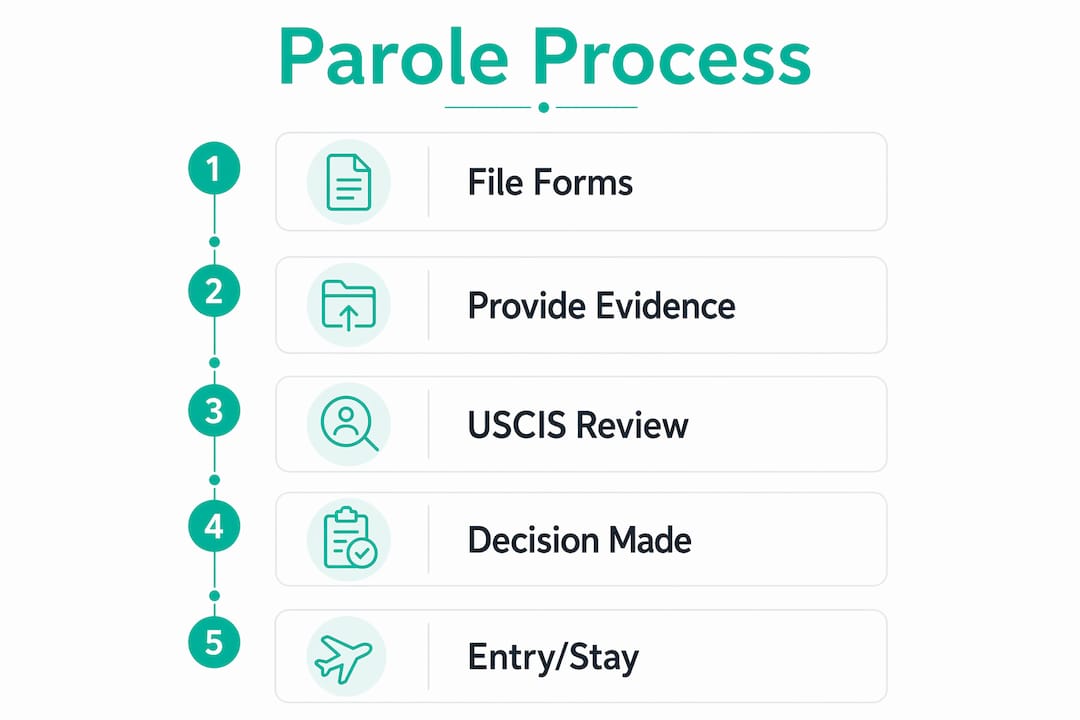
USCIS does not process parole requests in the order they are received. Instead, cases are triaged by urgency, meaning a recently filed case involving a medical emergency may be reviewed before an older, less urgent request. Processing delays have increased due to high request volumes. Petitioners can track case status and submit additional evidence through their USCIS online account.
A mandatory parole fee took effect on october 16, 2025, and it is separate from Form I-131 filing fees. Petitioners who qualify for a fee exemption must request it explicitly. Failing to pay the correct fees or request an exemption can result in rejection.
Even after USCIS approves a parole request, the process is not finished. CBP officers at the port of entry hold final authority to grant or deny physical entry into the United States. A USCIS approval document does not guarantee admission. CBP conducts its own review at the border or airport, and that decision is final.
- File Form I-131 and Form I-134 with supporting evidence.
- Pay the mandatory parole fee or request a fee exemption.
- Track your case through your USCIS online account.
- Respond promptly to any USCIS requests for additional evidence.
- Present your parole approval document to CBP at the port of entry.
- Understand that CBP makes the final admission decision.
Pro Tip: Prepare your evidence package as if USCIS will not ask a single follow-up question. Include medical records, letters from doctors or family members, financial documents, and any country condition reports that support your humanitarian claim. A thin file is the most common reason for unfavorable discretionary decisions.
What are the eligibility requirements for immigration parole?
Eligibility for immigration parole falls into two broad categories: urgent humanitarian reasons and significant public benefit. Neither category has a rigid statutory definition, which gives DHS wide discretion. That flexibility is both a feature and a challenge for applicants.
Urgent humanitarian reasons typically include:
- Medical emergencies requiring treatment available only in the United States
- Family reunification in cases of serious illness or death of a close relative
- Protection from imminent harm or persecution in the home country
- Cases involving unaccompanied minors or vulnerable individuals
Significant public benefit cases often involve law enforcement cooperation, national security interests, or specific government policy goals. USCIS has used this category to support programs like the family reunification parole processes for nationals of certain countries.
Meeting one of these categories is necessary but not sufficient. Parole applicants bear the burden of proof to show that the beneficiary merits a favorable exercise of discretion based on all submitted evidence. USCIS weighs positive factors, such as compelling humanitarian need and strong community ties, against negative ones, such as prior immigration violations or criminal history. A prior overstay or unauthorized entry does not automatically disqualify an applicant, but it must be addressed directly in the filing.
Parole is not a route to permanent residency. Applicants who believe they may qualify for asylum, a visa, or another immigration status should pursue those pathways separately. Parole is not a substitute for those processes.
Pro Tip: Document both the humanitarian justification and your positive discretionary factors in separate, clearly labeled sections of your evidence package. USCIS officers review many files quickly. Making their job easier increases your chances of a favorable outcome.
How does immigration parole differ from asylum, TPS, and visa status?
Parole and other immigration permissions are often confused, but they carry very different legal consequences. Parole offers no immigration status, no formal admission, and no direct pathway to a Green Card. Asylum, Temporary Protected Status, and immigrant visas each provide specific legal protections and, in some cases, a route to permanent residence.
The table below compares these four categories across the dimensions that matter most.
| Category | Duration | Legal effect | Pathway to status | Work authorization |
|---|---|---|---|---|
| Immigration parole | Usually less than 1 year | No formal admission; applicant for admission | None directly | Separate EAD application required |
| Asylum | Indefinite pending case; 1 year to apply for Green Card | Grants protected status | Yes, to Green Card | Automatic after 180 days |
| Temporary Protected Status | Designated by DHS; renewable | Lawful status, not admission | Limited; no direct path | Included with TPS grant |
| Immigrant visa | Permanent | Lawful permanent resident upon entry | Yes, immediate | Authorized as LPR |
Temporary Protected Status is granted to nationals of countries experiencing ongoing armed conflict, environmental disasters, or other extraordinary conditions. Unlike parole, TPS confers lawful status and includes work authorization automatically. Asylum protects individuals who face persecution based on race, religion, nationality, political opinion, or membership in a particular social group. Both pathways offer more legal security than parole.
Parole is best understood as an emergency or public interest measure. It fills a gap when no other legal pathway is immediately available and the need is urgent. Using it as a long-term immigration strategy creates serious legal risk.
What happens when immigration parole expires?
When parole expires, the individual must depart the United States or obtain another legal status before the expiration date. Staying beyond the parole period means accruing unlawful presence, which can trigger the 3-year or 10-year bar to future admission depending on how long the unlawful presence accumulates. That bar can block future visa applications, Green Card petitions, and reentry for years.
Key practical considerations when parole is approaching expiration:
- Apply for re-parole well before the current parole period ends; USCIS does not guarantee approval.
- Consult an immigration attorney about whether another status, such as asylum or a visa, may be available.
- Understand that re-parole is possible but requires a new application and a new showing of humanitarian need or public benefit.
- Do not travel internationally during parole without advance parole authorization. Departing without it may be treated as abandonment of a pending immigration application.
- Monitor your parole expiration date carefully. USCIS does not send automatic reminders.
The 3-year and 10-year bars are among the most serious consequences in immigration law. A single period of unlawful presence after parole expiration can affect a person's immigration options for a decade. Acting before the deadline, not after, is the only way to avoid that outcome.
Key Takeaways
Immigration parole is a temporary, discretionary authorization under INA Section 212(d)(5) that permits entry without formal admission and carries serious legal consequences if it expires without action.
| Point | Details |
|---|---|
| Parole is not admission | Parolees remain applicants for admission and can be removed when parole expires. |
| Burden of proof is on the petitioner | USCIS requires compelling evidence of humanitarian need and positive discretionary factors. |
| CBP has final authority | A USCIS parole approval does not guarantee entry; CBP decides at the port of entry. |
| Parole expiration triggers unlawful presence | Staying beyond the parole period can trigger the 3-year or 10-year bar to future admission. |
| Parole is not a status pathway | Unlike asylum or TPS, parole provides no direct route to permanent residence or formal immigration status. |
What I have learned from parole cases that most guides miss
After working through parole cases across a wide range of circumstances, the pattern I see most often is not a weak humanitarian claim. It is a weak evidence package supporting an otherwise strong claim. Petitioners assume that a compelling situation speaks for itself. It does not. USCIS officers review hundreds of files. A file that does not clearly and immediately communicate the urgency and the positive factors gets deprioritized or denied.
The second thing I see is a misunderstanding about what parole approval actually means. Clients sometimes believe that once USCIS approves the request, the process is over. The CBP step at the port of entry catches people off guard. That officer can and does make independent decisions. Preparing your client for that interaction is as important as preparing the USCIS filing.
The third issue is timing. People wait too long to think about what happens when parole ends. Re-parole is not guaranteed. Asylum has a one-year filing deadline. Other status options have their own timelines. The moment parole is granted, the clock is running on the next step. I tell every client: parole is the beginning of a legal strategy, not the end of one.
Parole cases reward preparation, attention to detail, and proactive planning. They punish assumptions. If you are navigating this process, get qualified legal counsel early. The stakes are too high for guesswork.
— Mahmudul
How Hasan-legal can help with your parole case
Parole applications require precise documentation, a clear understanding of USCIS discretionary standards, and awareness of what happens at every stage, including at the port of entry.
Hasan-legal provides personalized legal guidance for humanitarian parole applications, family reunification cases, and related immigration matters. Attorney Mahmudul Hasan, Esq. directly oversees every case, so you receive expert attention at each step. Whether you are filing for the first time or responding to a USCIS request for evidence, the team at Hasan-legal is ready to help. Request a free case evaluation today and get a clear picture of your options before the clock runs out.
FAQ
What is immigration parole in simple terms?
Immigration parole is a temporary permission granted by DHS that allows a foreign national to enter or stay in the United States without formal admission. It does not provide immigration status or a path to a Green Card.
How long does immigration parole last?
Parole is typically granted for less than one year, though the exact duration depends on the specific case. Re-parole is possible but requires a new application and approval.
Can a parolee apply for a Green Card?
Parole does not provide a direct pathway to permanent residence. A parolee must qualify for and apply through a separate immigration process, such as an immigrant visa or asylum, to pursue a Green Card.
Does USCIS approval guarantee entry into the United States?
No. CBP officers at the port of entry hold final authority to grant or deny physical admission, regardless of USCIS parole approval. A parole document does not guarantee entry.
What happens if immigration parole expires without action?
Staying in the United States after parole expires results in unlawful presence, which can trigger the 3-year or 10-year bar to future admission depending on the length of the overstay.