

Interfiling in immigration is defined as the procedural transfer of the underlying immigrant petition supporting a pending Form I-485 application to a different, already-approved petition, allowing you to change your employment basis without starting the adjustment process over. The formal term used by USCIS is "transfer of the underlying basis," though immigration practitioners commonly call it interfiling. This process matters enormously for employment-based green card applicants who change jobs, switch employers, or gain access to a more favorable immigrant category while their I-485 is still pending. Understanding how interfiling works, when Supplement J is required, and how USCIS evaluates job portability under INA 204(j) can protect your priority date and keep your green card timeline on track.
What is interfiling in the immigration process and why does it matter?
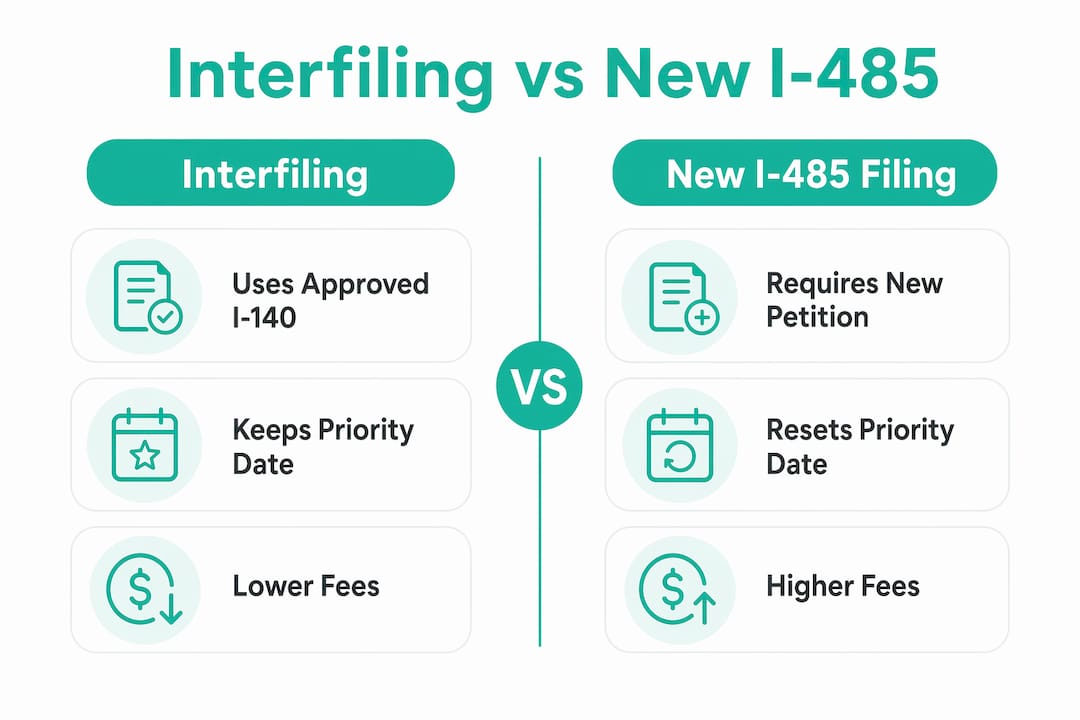
Interfiling is the mechanism that lets you switch underlying petitions without refiling Form I-485, saving you both time and filing fees when your eligibility remains valid. Think of your I-485 as a container. The underlying immigrant petition, typically a Form I-140, is the foundation inside that container. Interfiling replaces that foundation with a stronger or more current one while the container stays in place.

This distinction matters because filing a brand-new I-485 would reset your priority date and require you to pay filing fees again, often thousands of dollars. Interfiling preserves your original filing date, which is critical in oversubscribed categories like EB-2 and EB-3 for nationals of India and China, where priority dates can lag by years or even decades.
One of the most common misconceptions is that interfiling requires a separate, standalone USCIS form. It does not. Interfiling is a procedural request attached to your existing application, sometimes accompanied by Supplement J and supporting documentation, but never submitted as its own independent filing. Many applicants waste time searching for a form that simply does not exist.
USCIS has updated its procedural guidance on interfiling requests multiple times, and the current policy reflects a more structured evidentiary standard. You should expect to provide documentation that demonstrates your continued eligibility under the new petition basis.
Pro Tip: If you receive a Request for Evidence (RFE) or Notice of Intent to Deny (NOID) on your I-485, that moment is often the right time to submit an interfiling request alongside your response, not after.
- Interfiling preserves your original I-485 priority date
- No new I-485 filing fee is required
- The process is procedural, not a separate USCIS form
- Supporting evidence is still required to establish eligibility under the new petition
What is the role of Supplement J in interfiling and job portability?
Supplement J, formally titled "Confirmation of Valid Job Offer or Request for Job Portability Under INA Section 204(j)," serves two distinct functions. It either confirms that a valid job offer still exists for your original petition, or it formally requests job portability to a new employer or position. Understanding which function applies to your situation determines how and when you file it.
Supplement J is required for portability requests submitted on or after January 17, 2017. Before that date, portability requests were handled through letters and supporting documents. Today, the form is the standard vehicle for most portability scenarios, but it is not always required for every type of underlying basis transfer. An experienced attorney will verify whether your specific situation calls for Supplement J before you submit anything.
Here are the primary situations that require or strongly benefit from filing Supplement J:
- You are filing an initial I-485 and need to confirm the original job offer remains valid
- You are responding to an RFE that questions whether your job offer is still bona fide
- You are responding to a NOID that challenges the basis of your adjustment application
- You have changed employers and want to port your petition to the new job under INA 204(j)
- Your job title, duties, or employer has changed materially since the original I-140 was filed
The new job offer must be full-time and permanent, and it must fall within the same or similar occupational classification as the original petition. USCIS does not accept temporary, part-time, or contract positions as qualifying offers for portability purposes.
Pro Tip: Do not file Supplement J online when you are requesting a transfer of the underlying basis. Filing online for this purpose can disrupt USCIS processing workflow and cause delays or denials. Mail it directly to the appropriate USCIS lockbox with your supporting documentation.
How does USCIS determine if a new job is the same or similar?
USCIS evaluates "same or similar occupational classification" by analyzing the totality of employment circumstances, not just whether two jobs share a Standard Occupational Classification (SOC) code. This is a critical point that many applicants misunderstand. Two jobs can have different SOC codes and still qualify as same or similar, while two jobs with identical SOC codes can fail the test if the duties, skills, and requirements diverge significantly.
The factors USCIS weighs include job duties, required skills, educational requirements, wage levels, and the SOC code as one data point among many. A software engineer moving from a backend development role to a full-stack development role at a new company would likely satisfy the same or similar standard. A software engineer attempting to port to a project management role would face a much harder evidentiary burden, even if both positions require a computer science degree.
| Factor | What USCIS Examines |
|---|---|
| SOC code | Compared between original and new position, but not determinative alone |
| Job duties | Degree of overlap in day-to-day responsibilities |
| Required skills | Technical and soft skills needed to perform the role |
| Education requirements | Whether both positions require the same level and field of study |
| Wage level | Whether compensation is consistent with the same occupational tier |
For applicants switching jobs or employers, the practical implication is clear. You need a detailed job description for the new position, a comparison letter from an attorney or HR professional, and ideally a letter from the new employer confirming the offer is full-time and permanent. Relying on a matching SOC code alone is a strategy that frequently fails at adjudication.
What are the practical steps for filing an interfiling request?
The interfiling process does not follow a single rigid script, because the right approach depends on your specific case posture. That said, most successful interfiling requests share a common structure. You should gather your documentation before initiating any contact with USCIS, not after.
Start by confirming that your new I-140 petition is approved and that your priority date remains current or will become current under the new category. Then assess whether your I-485 has been pending for at least 180 days, which is the threshold for job portability under INA 204(j). If your I-485 has not yet reached 180 days, portability is not available, and you would need to rely on a concurrent or already-approved petition under the same employer.
- Confirm the new I-140 is approved and the priority date is current
- Verify your I-485 has been pending 180 or more days if portability is the goal
- Prepare a cover letter clearly stating you are requesting a transfer of the underlying basis
- Attach Supplement J if your situation requires it, and mail it rather than filing online
- Include the new employer's job offer letter, a detailed position description, and any evidence supporting same or similar classification
- Review the required adjustment documentation checklist to avoid missing supporting exhibits
Timing your interfiling request strategically also matters. If your I-485 is approaching interview stage or has already been scheduled for an interview, submit the interfiling request well in advance. USCIS officers adjudicating at interview will expect the record to already reflect the new underlying basis.
Pro Tip: Keep a copy of every document you send to USCIS, along with certified mail receipts. If USCIS later claims it did not receive your interfiling request, your mailing records are your only defense.
Interfiling vs. filing a new I-485: which approach fits your situation?
Interfiling and filing a new I-485 are not interchangeable options. Each serves a different set of circumstances, and choosing the wrong path can cost you years of waiting time or significant filing fees.
| Scenario | Interfiling | New I-485 Filing |
|---|---|---|
| Approved I-140 under new employer available | Yes, preferred | Not necessary |
| Original I-485 pending 180+ days | Yes, portability applies | Possible but wasteful |
| No existing approved I-140 for new basis | No, not available | Required |
| Priority date retrogressed under new category | Risky, evaluate carefully | May not help either |
| Changing from employment-based to family-based | Possible in some cases | May be required |
Interfiling is the right choice when you have an approved I-140 under a new employer or category and your existing I-485 has been pending long enough to qualify for portability. Filing a new I-485 makes sense only when no approved petition exists under the new basis, or when the original application has a fundamental defect that cannot be corrected through transfer. You can learn more about when transfers are permitted in specific category-change scenarios.
The cost difference is also significant. A new I-485 filing currently carries a base fee of $1,440 for most applicants, plus biometrics and medical exam costs. Interfiling carries no additional USCIS filing fee beyond any required Supplement J submission.
Key takeaways
Interfiling immigration is the most cost-effective and time-preserving option for adjustment of status applicants who gain access to a new approved I-140 while their original I-485 remains pending.
| Point | Details |
|---|---|
| Definition of interfiling | Transfer of the underlying I-140 petition basis for a pending I-485 without refiling. |
| Supplement J filing rule | Mail Supplement J for underlying basis transfers; never file it online for this purpose. |
| 180-day portability threshold | Job portability under INA 204(j) requires the I-485 to have been pending at least 180 days. |
| Same or similar standard | USCIS evaluates job duties, skills, education, wages, and SOC codes together, not SOC codes alone. |
| Cost advantage | Interfiling avoids the I-485 refiling fee and preserves your original priority date. |
Why interfiling cases fail more often than they should
In my experience handling employment-based adjustment cases at Hasan-legal, the most common reason interfiling requests fail is not a legal deficiency. It is a documentation deficiency. Applicants submit Supplement J with a one-paragraph job offer letter and expect USCIS to fill in the gaps. USCIS does not fill in gaps. Officers adjudicate on the record in front of them, and a thin record produces a thin result.
The second most common error I see is applicants filing Supplement J through the online portal for underlying basis transfers. The USCIS website makes online filing look like the default option, but for this specific purpose, it is the wrong channel. I have seen cases delayed by months because the online submission created a processing conflict with the paper I-485 file.
What actually works is treating the interfiling request like a mini-petition. Write a detailed cover letter. Attach a thorough job description. Include a comparison of the original and new positions. Provide wage evidence. Anticipate the same or similar question before USCIS asks it. The USCIS adjustment memo issued in recent years signals that officers are applying more scrutiny to portability claims, not less. Proactive documentation is the only reliable response to that trend.
The applicants who succeed are the ones who treat interfiling as a legal argument, not a paperwork exercise.
— Mahmudul
How Hasan-legal can help with your interfiling case
Interfiling is one of the most procedurally sensitive steps in the entire green card process. A misstep in documentation, timing, or filing method can set your case back significantly.
At Hasan-legal, attorney Mahmudul Hasan, Esq. personally reviews every employment-based adjustment case, including interfiling requests and Supplement J submissions. The firm's team helps you build a complete evidentiary record, assess whether your new position meets the same or similar standard, and submit your request through the correct USCIS channel. Explore Hasan-legal's full range of immigration legal services or request a free case evaluation to discuss your specific situation with an attorney who will actually review your file.
FAQ
What is interfiling in immigration?
Interfiling is the process of transferring the underlying immigrant petition for a pending Form I-485 to a different approved petition, allowing you to change your employment basis without refiling your adjustment application.
When can I use job portability to interfile?
Job portability applies once your I-485 has been pending for 180 days or more, and the new job must be full-time, permanent, and in the same or similar occupational classification as the original petition.
Do I need to file Supplement J for every interfiling request?
Not always. Supplement J is required for portability requests filed on or after January 17, 2017, but practitioners verify the exact context before submission to avoid unnecessary filing errors.
Can I file Supplement J online for an interfiling request?
No. USCIS instructs applicants not to file Supplement J online when transferring the underlying basis for a pending I-485. Mail it to the appropriate USCIS lockbox with supporting documentation.
How does USCIS decide if my new job is the same or similar?
USCIS evaluates multiple employment factors including job duties, required skills, education, wages, and SOC codes together. A matching SOC code alone does not guarantee approval.