

An immigration lawyer is a licensed professional authorized to represent you before U.S. government agencies and immigration courts, and hiring one can be the single most consequential decision you make in your immigration process. U.S. immigration law operates across multiple federal agencies including USCIS, ICE, CBP, and EOIR, each with distinct procedural rules, filing deadlines, and evidentiary standards. A qualified immigration attorney manages those requirements on your behalf, reduces the risk of costly errors, and serves as your official government point of contact. Whether you are pursuing a Green Card, a visa, or defending against removal, understanding why hire an immigration lawyer starts with understanding what authorized legal representation actually means.
Why legal authorization matters in immigration cases
Legal authorization is not a formality. It is the mechanism that determines who can officially communicate with the government on your behalf and who cannot.
When you hire a licensed immigration attorney, they file Form G-28 with agencies like USCIS, ICE, and CBP. This form designates your attorney as your official government point of contact, meaning all case updates, evidence requests, and notices go directly to them. That single step changes how your case is managed at every stage. Without it, you are solely responsible for tracking every government communication, often under tight deadlines.

For matters before immigration court or the Board of Immigration Appeals, a separate form applies. The G-28 covers DHS agencies only; representation in immigration court requires Form EOIR-28. This distinction matters because the two systems operate under different rules, and mixing them up can create gaps in your representation.
Only attorneys or fully accredited representatives are authorized to appear before immigration court or the Board of Immigration Appeals. This is a hard legal boundary, not a guideline. Non-lawyer consultants and notarios, regardless of how experienced they appear, cannot legally represent you in those forums. Their involvement can produce invalid filings, missed deadlines, and case outcomes that are difficult or impossible to reverse.
Here is what unauthorized help typically looks like in practice:
- A notario charges fees to complete immigration forms but has no legal authority to represent you if problems arise
- A document preparation service fills out paperwork without reviewing your legal eligibility or spotting admissibility issues
- A friend or community contact with "experience" cannot file a G-28 or respond to a Request for Evidence on your behalf
- Unauthorized consultants can cause invalid filings and increased case delays or denials
Pro Tip: Before paying anyone for immigration help, ask them to show you their bar admission or EOIR accreditation. If they cannot produce either, they are not authorized to represent you.
How to assess whether your case needs a lawyer
Case complexity, not just affordability, should determine whether you hire an immigration lawyer or self-file. This is the most overlooked factor in the decision.
A structured four-variable framework helps you evaluate your situation honestly:
- Legal consistency: Does your immigration history contain any gaps, overstays, prior denials, or status violations? Any inconsistency raises your risk profile significantly.
- Admissibility risk: Do you have any criminal history, health-related grounds of inadmissibility, or prior removal orders? These factors can bar approval regardless of how well your forms are completed.
- Evidence threshold: Does your case require substantial documentation such as employer letters, financial records, expert opinions, or medical evaluations? Higher evidence demands increase the margin for error.
- Procedural complexity: Does your case involve multiple agencies, concurrent filings, or a hearing before EOIR? Multi-forum cases are rarely suitable for self-filing.
Score yourself honestly across those four variables. A straightforward renewal with no legal complications and a clean history may be manageable without full representation. A family-based Green Card application with a prior overstay and a pending RFE is not.
| Case type | Recommended approach |
|---|---|
| Simple renewal, clean history, no complications | Consultation or document review only |
| Family petition with minor complications | Unbundled legal services or limited scope representation |
| Employment-based visa with employer sponsorship | Full attorney representation |
| Removal defense or prior denial | Full attorney representation, no exceptions |
The unbundled legal service model is worth knowing about. Rather than paying for full representation, you hire an attorney for specific tasks only, such as reviewing your completed forms, advising on a single legal question, or preparing you for an interview. Limited legal support like document review or consultation can be a cost-effective middle ground for many applicants. This approach balances cost with risk without leaving you entirely on your own.
Pro Tip: If you are unsure where your case falls on the complexity scale, a one-hour paid consultation with a licensed attorney is almost always worth the cost. You will leave with a clear picture of your risk exposure.
Practical benefits of hiring an immigration attorney
The concrete advantages of professional legal help extend well beyond form completion. Immigration lawyers help spot hidden legal risks, avoid mistakes that cause delays or refusals, and build a consistent evidence narrative across your entire application. Each of those functions addresses a different failure point in the process.
Consider what a qualified attorney actually does throughout your case:
- Paperwork accuracy: Immigration forms are interdependent. An inconsistency between your I-130 and your I-485, for example, can trigger an RFE or a denial. An attorney reviews every form as a set, not in isolation.
- Deadline management: USCIS and EOIR operate on strict timelines. Missing a response deadline for an RFE or a Notice to Appear can result in automatic denial or an in absentia removal order. Your attorney tracks every deadline and responds within the required window.
- Evidence structuring: A strong application tells a consistent story. Attorneys organize supporting documents to reinforce each other and anticipate the specific questions a USCIS officer or immigration judge is likely to ask.
- RFE response strategy: Receiving a Request for Evidence is not a denial, but responding incorrectly can make it one. Attorneys know how to address the government's specific concerns without introducing new problems into the record.
- Interview preparation: For cases requiring an in-person interview at a USCIS field office or consulate, your attorney prepares you for the types of questions you will face and how to present your case clearly and consistently.
- Emotional and logistical support: Immigration processes can take months or years. Having a professional manage communications with government agencies reduces anxiety and allows you to focus on your daily life rather than tracking bureaucratic timelines.
You can learn more about how attorneys structure filings by reviewing what an immigration petition involves at each stage of the process.
Common misconceptions about attorney involvement
Several widely held beliefs about immigration lawyers are simply wrong, and correcting them helps you set realistic expectations before you hire anyone.
The most common misconception is that your attorney must attend your USCIS biometric appointment. Applicants typically do not need their lawyer at biometric services appointments. USCIS schedules these appointments independently, and the appointment notice contains all the instructions you need. You may bring a translator or a family member if needed, but attorney presence adds no procedural value at this stage. Understanding this also helps you recognize that many applicants mistakenly believe a lawyer must attend biometrics, which creates unnecessary stress and cost.
A second misconception is that hiring a lawyer guarantees approval. No attorney can guarantee a government decision. What a lawyer controls is the quality, consistency, and completeness of your submission. The decision authority rests entirely with USCIS, EOIR, or the relevant consular officer.
A third misconception is that an attorney's value is visible in the paperwork. Much of what effective immigration attorneys do is invisible until it matters. They sequence filings to avoid triggering inadmissibility reviews, identify contradictions in your record before the government does, and structure evidence to preempt questions rather than react to them. That behind-the-scenes work is often the difference between approval and a denial letter.
Pro Tip: Ask any attorney you consult to walk you through what they will do at each stage of your case. If they cannot explain their process clearly, that is a signal to keep looking.
How to choose the right immigration lawyer for your case
Choosing the right immigration attorney requires more than a Google search. You need to verify credentials, assess relevant experience, and confirm that their service model fits your budget and case needs.
Start with these verification steps:
- Bar admission: Confirm the attorney is licensed to practice law in at least one U.S. state. You can verify this through your state bar's public directory.
- EOIR authorization: If your case involves immigration court, confirm the attorney is authorized to appear before EOIR. Not all immigration attorneys handle removal defense.
- Case-specific experience: An attorney who focuses on employment-based visas may not be the right fit for a complex asylum case. Ask directly how many cases similar to yours they have handled in the past two years.
- Fee structure transparency: Reputable attorneys offer fixed-fee arrangements for defined services or clearly explain their hourly billing. Vague pricing is a warning sign.
- Communication standards: You should know who handles your case day to day, how quickly they respond to questions, and what happens if your case changes scope.
The immigration attorney selection checklist published by Hasan-legal walks through each of these criteria in detail and is a practical starting point for your search. For those in the Washington D.C. area, working with a local immigration attorney who knows regional USCIS field office practices can provide an additional practical advantage.
Key takeaways
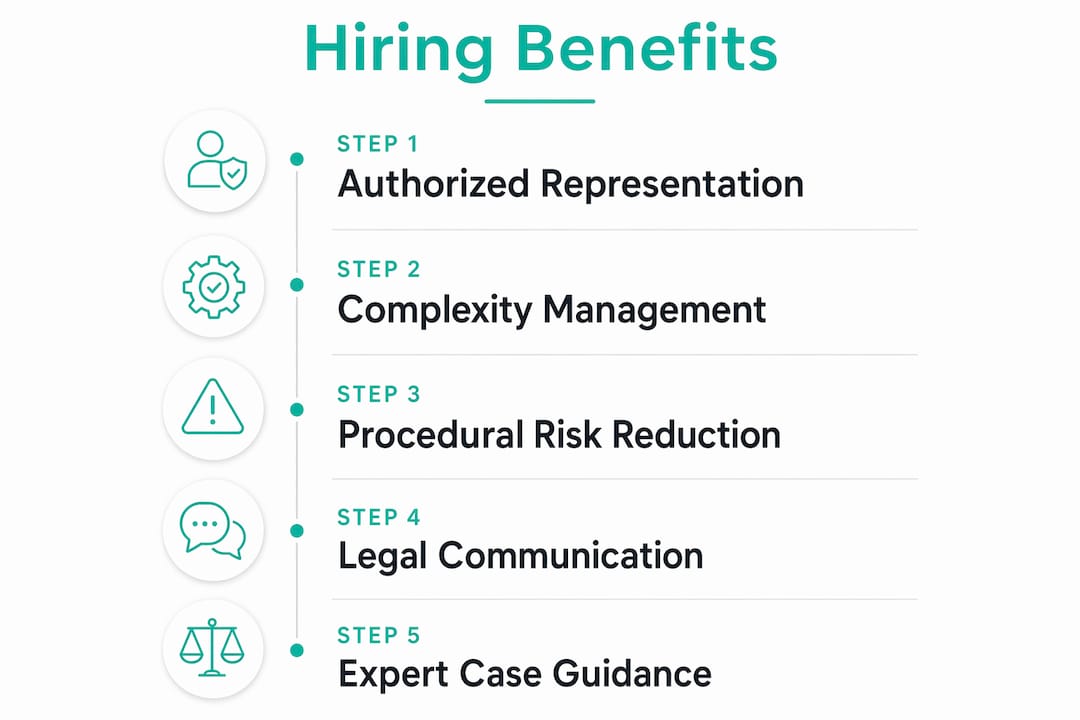
Hiring an immigration lawyer provides authorized representation that reduces procedural risk, manages case complexity, and improves your application's consistency across every stage of the U.S. immigration process.
| Point | Details |
|---|---|
| Legal authorization is formal | Form G-28 and EOIR-28 designate your attorney as the official government contact for your case. |
| Complexity drives the decision | Assess legal consistency, admissibility risk, evidence demands, and procedural scope before deciding on full representation. |
| Unauthorized help carries real risk | Notarios and non-accredited consultants cannot legally represent you and can cause invalid filings or denials. |
| Attorney value is often invisible | Lawyers sequence filings, preempt contradictions, and structure evidence in ways that matter most when problems arise. |
| Unbundled services offer a middle path | Consultation-only or limited-scope representation can provide professional oversight without the cost of full representation. |
What I have learned about the real cost of going it alone
After years of working with clients at Hasan Legal PC, the pattern I see most often is not people who hired a lawyer unnecessarily. It is people who waited too long to get help, often after a denial or an RFE that could have been avoided with an early review.
The cases that concern me most are the ones that look simple on the surface. A client with a clean record and a straightforward family petition assumes they can handle it themselves. Then we discover a prior entry discrepancy from ten years ago, or a sponsor's tax return that does not meet the income threshold. Those details are not obvious to someone without legal training, but they are exactly what a USCIS officer will flag.
I also want to be honest about the other side. Not every case requires full representation. If your situation is genuinely low complexity, a paid consultation or a document review may be all you need. The goal is to match the level of legal support to the actual risk in your case, not to sell you services you do not need.
What I tell every client is this: the cost of a consultation is fixed. The cost of a denial, a delay, or a removal proceeding is not. Early professional review almost always costs less than fixing a problem after it has been filed.
— Mahmudul
Work with Hasan Legal PC on your immigration case
Hasan-legal provides authorized immigration legal representation across a full range of U.S. immigration matters, with principal attorney Mahmudul Hasan, Esq. directly overseeing every case. Whether you need full representation for a Green Card application, a visa petition, or removal defense, or you are looking for a focused consultation to assess your options, Hasan-legal offers service models designed to match your case and budget. Start with a free case evaluation to get a clear picture of your legal position before committing to any path. You can also explore the full range of U.S. immigration services available through Hasan-legal, or connect directly with the Washington D.C. immigration team if you are in the greater D.C. or Northern Virginia area.
FAQ
What does an immigration lawyer actually do for your case?
An immigration lawyer files Form G-28 to become your official government contact, manages all communications with USCIS, ICE, or CBP, prepares and reviews your filings, and responds to Requests for Evidence on your behalf. Their work includes organizing evidence, meeting deadlines, and preparing you for interviews.
Should I hire an immigration lawyer for a simple application?
Case complexity, not simplicity, should drive the decision. A consultation or limited-scope document review may be sufficient for genuinely straightforward cases, but even simple applications can carry hidden risks that only a licensed attorney will recognize.
Can a notario or immigration consultant represent me?
No. Only attorneys or fully accredited representatives are authorized to appear before immigration courts or the Board of Immigration Appeals. Using unauthorized consultants can result in invalid filings and serious harm to your case.
Do I need my lawyer at my USCIS biometrics appointment?
No. USCIS biometric appointments do not require attorney presence. The appointment notice provides all necessary instructions, and you may bring a translator or family member if needed.
What is the difference between Form G-28 and EOIR-28?
Form G-28 authorizes an attorney to represent you before DHS agencies like USCIS, ICE, and CBP. Form EOIR-28 is required separately for representation before immigration court or the Board of Immigration Appeals.