

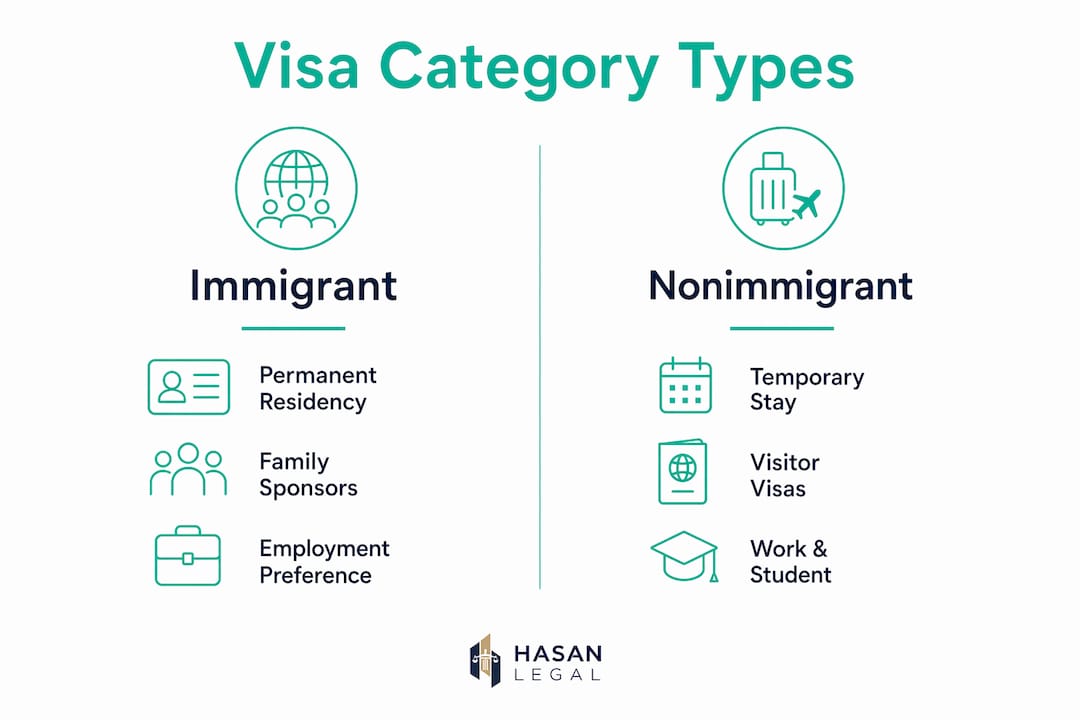
U.S. immigration visa categories explained define the legal pathways by which foreign nationals enter the United States, either temporarily or permanently. U.S. immigration law divides all visas into two fundamental classes: immigrant visas, which lead to permanent residency, and nonimmigrant visas, which authorize temporary stays for specific purposes. USCIS and the U.S. Department of State jointly administer these categories, each with distinct eligibility rules, application workflows, and legal consequences. Knowing which category applies to your situation is the first step toward a successful application.
What are the main immigrant visa categories and how do they work?
Immigrant visas are divided into two broad groups: immediate relatives of U.S. citizens and family preference categories. Immediate relatives, which include spouses, unmarried children under 21, and parents of U.S. citizens, face no annual numerical cap. Family preference categories cover more distant relationships and are subject to annual limits, which creates waiting periods that can stretch for years depending on the applicant's country of origin.
Employment-based immigrant visas follow a five-tier preference system, commonly called EB-1 through EB-5. Approximately 140,000 immigrant visas are allocated annually across all five employment-based tiers, and that total includes the applicant's spouse and children. The practical effect is that the per-person availability is lower than the headline number suggests, especially for applicants from high-demand countries like India and China.

Here is a quick reference for the five employment-based preference tiers:
| Preference | Category | Key requirement |
|---|---|---|
| EB-1 | Priority workers | Extraordinary ability, outstanding professors, or multinational managers |
| EB-2 | Advanced degree or exceptional ability | Labor certification or National Interest Waiver |
| EB-3 | Skilled workers and professionals | Labor certification required |
| EB-4 | Special immigrants | Religious workers, broadcasters, certain juveniles |
| EB-5 | Immigrant investors | Minimum capital investment and job creation |
The EB-5 Immigrant Investor Program requires a qualifying capital investment and the creation of at least 10 full-time jobs for U.S. workers. It is one of the few pathways that does not require an employer sponsor, which makes it attractive to entrepreneurs.
Key facts about employment-based immigrant visas:
- EB-1A and EB-1B allow self-petition without employer sponsorship in certain cases.
- EB-2 applicants may qualify for a National Interest Waiver, bypassing the labor certification process.
- EB-3 requires a PERM labor certification, which verifies that no qualified U.S. worker is available for the position.
- Priority dates determine when an applicant can move forward, and backlogs can delay green cards by a decade or more for some nationalities.
Pro Tip: If you qualify for both EB-1A and EB-2 NIW, compare priority dates before filing. Choosing the right self-petition path can save years of waiting.
What are the major types of nonimmigrant visas and their typical uses?
Nonimmigrant visas cover temporary visits for purposes including tourism, business, study, work, and cultural exchange. Each category carries its own authorized period of stay, work authorization rules, and renewal options. Choosing the wrong category, or entering on one category while intending to pursue another, creates serious legal problems.
The most commonly used nonimmigrant visa categories include:
- B-1/B-2: Business visitors and tourists. B-1 covers business meetings and conferences; B-2 covers tourism, medical treatment, and family visits. Neither authorizes paid employment.
- F-1: Full-time academic students enrolled at USCIS-approved schools. F-1 holders may work on campus and, after completing a degree, may apply for Optional Practical Training (OPT).
- H-1B: Specialty occupation workers who hold at least a bachelor's degree in a relevant field. Employers must file a petition, and annual caps apply.
- J-1: Exchange visitors participating in approved programs, including research scholars, au pairs, and summer work travel participants.
- L-1: Intracompany transferees moving from a foreign affiliate to a U.S. office in a managerial, executive, or specialized knowledge role.
- O-1: Individuals with extraordinary ability or achievement in their field.
- R-1: Nonimmigrant religious workers serving a qualifying religious organization. The R-1 visa requires a formal job offer from a nonprofit religious organization and proof of the applicant's religious vocation.
The single most misunderstood requirement across all nonimmigrant categories is nonimmigrant intent. Applicants must demonstrate strong ties to their home country to show they will return after their authorized stay ends. Ties include employment, property ownership, family obligations, and financial accounts. Consular officers weigh these factors heavily during interviews.
Pro Tip: Prepare a clear, documented picture of your home-country ties before your visa interview. Bank statements, employment letters, and property records are the most persuasive evidence.
How does the visa application process work, and what steps should you take?
The visa application process follows a defined sequence for both immigrant and nonimmigrant categories. Missing a step or submitting incomplete documents is the most common reason for delays and denials. Preparing 4–6 weeks before your intended appointment date gives you enough time to gather everything correctly.
Follow these steps for a standard nonimmigrant visa application:
- Determine your visa category. Match your purpose of travel to the correct visa type before filing anything.
- Complete Form DS-160. This is the online nonimmigrant visa application form required by the U.S. Department of State for most categories.
- Pay the application fee. Visa application fees typically range from $185 to $265 or more depending on visa classification. Fees are nonrefundable and subject to change, so verify the current amount on the official State Department website before paying.
- Schedule your interview. Most nonimmigrant visa applicants aged 14 to 79 must attend an in-person interview at a U.S. embassy or consulate. Immigrant visa interviews are required for all applicants regardless of age.
- Prepare your documents. Visa applications require official documents in specified formats, including recent stamped bank statements, passport photos that meet exact specifications, and supporting evidence specific to your visa category.
- Attend the interview. Answer questions clearly and honestly. Bring all original documents plus copies.
- Wait for processing. Processing times vary by post and category. Check the State Department's website for current estimates at your specific consulate.
For employment-based immigrant visas, the process adds several steps before the interview stage. Your employer typically files Form I-140 (Immigrant Petition for Alien Workers) with USCIS. Categories requiring a PERM labor certification must complete that process first, which can take six months or longer. Once I-140 is approved and your priority date becomes current, you either apply for an immigrant visa at a consulate abroad or file for adjustment of status inside the United States.
Pro Tip: Applicants who book appointments without complete documents frequently face rescheduling delays. Compile every required document before touching the scheduling portal.
What are the key legal differences between immigrant and nonimmigrant visas?
The legal distinction between immigrant and nonimmigrant status goes far beyond the length of your stay. Immigrant visa holders receive lawful permanent resident status, commonly called a green card, which grants the right to live and work anywhere in the United States indefinitely. Nonimmigrant visa holders are authorized only for the specific purpose and duration stated on their visa.
| Factor | Nonimmigrant visa | Immigrant visa (green card) |
|---|---|---|
| Duration | Fixed period, extendable in some categories | Permanent, subject to renewal every 10 years |
| Work authorization | Limited to specific employer or category | Unrestricted across all employers |
| Travel | Must maintain nonimmigrant intent | Can travel freely with valid travel document |
| Path to citizenship | Not directly; requires status change | Eligible to apply after 3–5 years |
| Dual intent | Allowed for H-1B and L-1; not for B or F | Not applicable |
Adjustment of status is the process by which a nonimmigrant visa holder inside the United States applies to become a permanent resident without leaving the country. Not all visa holders are eligible to adjust status in the United States. Eligibility depends on the visa category, how the person entered, and whether any immigration violations occurred. Those who are ineligible must pursue consular processing abroad.
One common misconception is that holding a nonimmigrant visa with dual-intent protection, such as H-1B, automatically guarantees a smooth path to a green card. It does not. Dual intent simply means that applying for a green card while on H-1B status does not by itself trigger a visa denial. The underlying petition, priority date, and eligibility requirements still apply in full.
Key Takeaways
U.S. immigration visas fall into two legally distinct classes: immigrant visas for permanent residency and nonimmigrant visas for temporary, purpose-specific stays, each with separate eligibility rules and application processes.
| Point | Details |
|---|---|
| Two core visa classes | Immigrant visas grant permanent residency; nonimmigrant visas authorize temporary stays only. |
| Employment-based annual cap | Roughly 140,000 employment-based visas are available each year, including family members of the principal applicant. |
| Nonimmigrant intent requirement | All nonimmigrant applicants must prove strong ties to their home country to avoid refusal. |
| Interview requirement | Most nonimmigrant applicants aged 14–79 and all immigrant visa applicants must attend an in-person consular interview. |
| Adjustment of status limits | Not every nonimmigrant visa holder qualifies to adjust status inside the United States; eligibility depends on visa type and entry history. |
What I've learned from watching applicants navigate visa categories
Working through immigration cases day after day, the pattern that stands out most is how often applicants treat visa categories as interchangeable labels rather than legally binding frameworks. Choosing the wrong category does not just delay your case. It can trigger a finding of misrepresentation that follows you through every future application.
The nonimmigrant intent requirement catches people off guard more than almost any other rule. Applicants assume that because they genuinely plan to return home, the officer will simply take their word for it. Officers do not. They look for documented evidence, and applicants who cannot produce it at the interview window pay the price. I have seen well-prepared applicants with strong ties get approved in minutes, and I have seen applicants with legitimate intentions denied because they could not show a single piece of paper connecting them to their home country.
On the employment-based side, the priority date system is the detail most applicants underestimate. Knowing your preference category is only the beginning. Understanding where your country of birth sits in the Visa Bulletin, and planning your petition timeline around that, can mean the difference between a three-year wait and a fifteen-year one. Applicants who explore immigrant pathways for entrepreneurs, including EB-1A, EB-2 NIW, and EB-5, often find options they did not know existed.
The single most consistent predictor of a successful application is document preparation. Not legal strategy, not interview coaching. Documents. Get them right, get them early, and match them exactly to the official instructions.
— Hasan Legal Desk
How Hasan-legal can help with your U.S. visa case
Navigating the different visa categories, preference tiers, and application requirements takes more than reading a guide. A single filing error or missing document can set your case back by months.
Hasan-legal provides personalized legal guidance across employment-based, family-based, and nonimmigrant visa applications. Attorney Mahmudul Hasan, Esq., directly oversees every case, which means you receive focused attention rather than a form letter. Whether you need help with an EB-2 NIW petition, a family preference application, or a nonimmigrant visa strategy, the team at Hasan-legal builds your case from the ground up. Review the full range of immigration legal services available, or request a free case evaluation to discuss your specific situation with an experienced attorney.
FAQ
What is the difference between an immigrant and a nonimmigrant visa?
An immigrant visa grants lawful permanent residency in the United States, while a nonimmigrant visa authorizes a temporary stay for a specific purpose such as tourism, study, or work. The two categories carry different rights, durations, and legal obligations.
How many employment-based immigrant visas are available each year?
Approximately 140,000 employment-based immigrant visas are allocated annually across the EB-1 through EB-5 preference categories, including the applicants' spouses and children. High demand from certain countries creates significant backlogs in several preference tiers.
What does nonimmigrant intent mean, and why does it matter?
Nonimmigrant intent means you must prove you plan to return to your home country after your authorized stay ends. Applicants who cannot demonstrate strong home-country ties through documents like employment letters, property records, or bank statements risk visa refusal.
Do I need an interview for my visa application?
Most nonimmigrant visa applicants between the ages of 14 and 79 must attend an in-person interview at a U.S. embassy or consulate. All immigrant visa applicants are required to interview regardless of age.
Can I change from a nonimmigrant visa to permanent resident status inside the U.S.?
Some nonimmigrant visa holders can apply for adjustment of status inside the United States, but eligibility depends on the visa category, entry method, and immigration history. Those who do not qualify must complete consular processing abroad.