

An immigrant visa is a travel document issued by a U.S. embassy or consulate abroad that allows a foreign national to enter the United States and become a Lawful Permanent Resident. The formal industry term is "immigrant visa," and it is distinct from a nonimmigrant visa in one critical way: it grants permanent status, not a temporary stay. USCIS, the National Visa Center (NVC), and the U.S. Department of State each play a defined role in the process. Understanding what is an immigrant visa, and how it works, is the first step toward making your move to the U.S. a reality.
What is an immigrant visa, and how does it differ from a nonimmigrant visa?
An immigrant visa is the official authorization that lets a foreign national enter the U.S. to live permanently. A nonimmigrant visa, by contrast, covers temporary purposes such as tourism, study, or short-term work. The difference is not just semantic. It determines your rights, your timeline, and your path to a Green Card.
When you enter the U.S. on an immigrant visa, Customs and Border Protection (CBP) admits you as a Lawful Permanent Resident (LPR) on the spot. The immigrant visa itself serves as proof of status until USCIS mails your physical Form I-551, commonly called the Green Card. That temporary proof period lasts up to one year after entry.
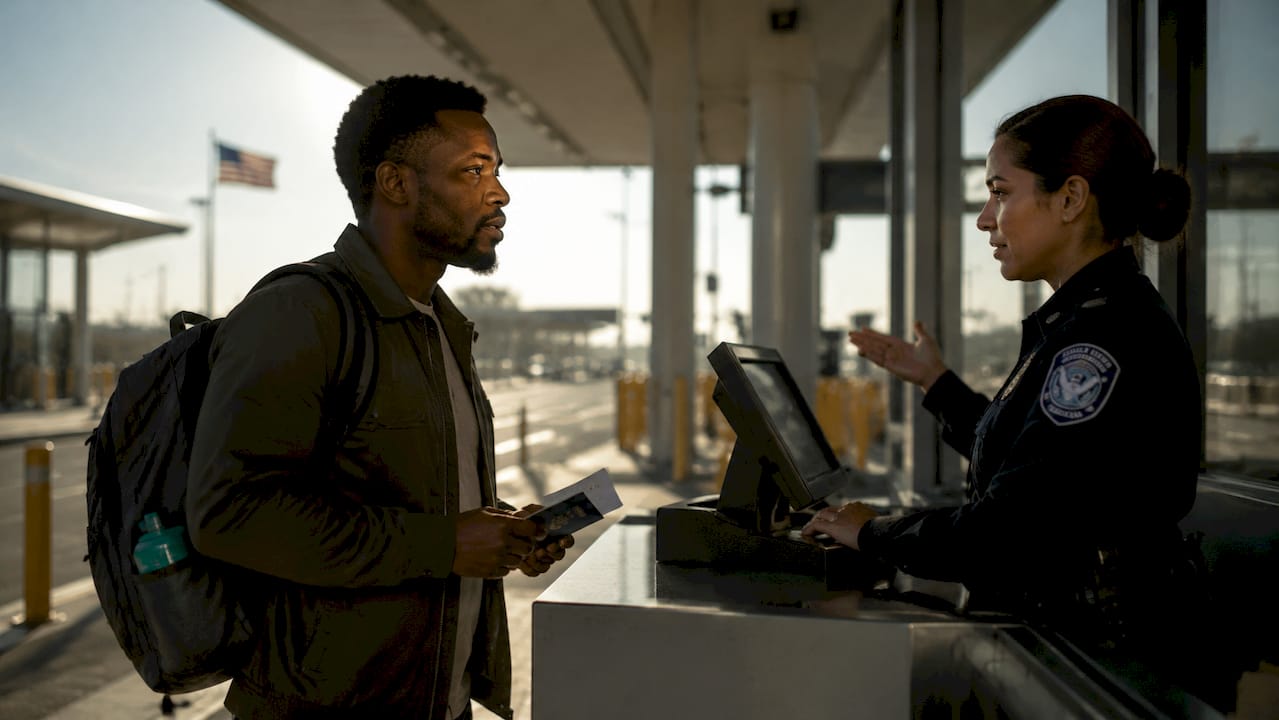
Nonimmigrant visas carry expiration dates tied to your purpose of travel. Overstaying a nonimmigrant visa triggers serious legal consequences. An immigrant visa carries no such expiration risk once you have entered and been admitted as an LPR.
What are the main types of immigrant visas?
Immigrant visa types fall into four broad categories. Each category has its own eligibility rules, annual limits, and processing timelines.
Family-based immigrant visas are the most common pathway. They divide into two groups:
- Immediate relative visas cover spouses, unmarried children under 21, and parents of U.S. citizens. These visas have no annual cap, which means shorter wait times.
- Family preference visas cover more distant relatives, such as adult children and siblings of U.S. citizens, and spouses and children of Green Card holders. These visas are subject to annual numerical limits and often involve multi-year waits. Hasan-legal provides dedicated support for family preference categories to help applicants understand where they stand in the queue.
Employment-based immigrant visas are capped by statute at approximately 140,000 visas per fiscal year, divided across five preference groups. EB-1 covers priority workers and multinational managers. EB-2 and EB-3 cover professionals and skilled workers. EB-4 covers special immigrants, and EB-5 covers immigrant investors. That 140,000 annual cap means wait times vary significantly by country of birth and preference category.
Diversity Visa (DV) lottery visas make up to 50,000 visas available each year to nationals of countries with historically low immigration rates to the U.S. Selection is random, but winners still must meet standard eligibility and documentation requirements.
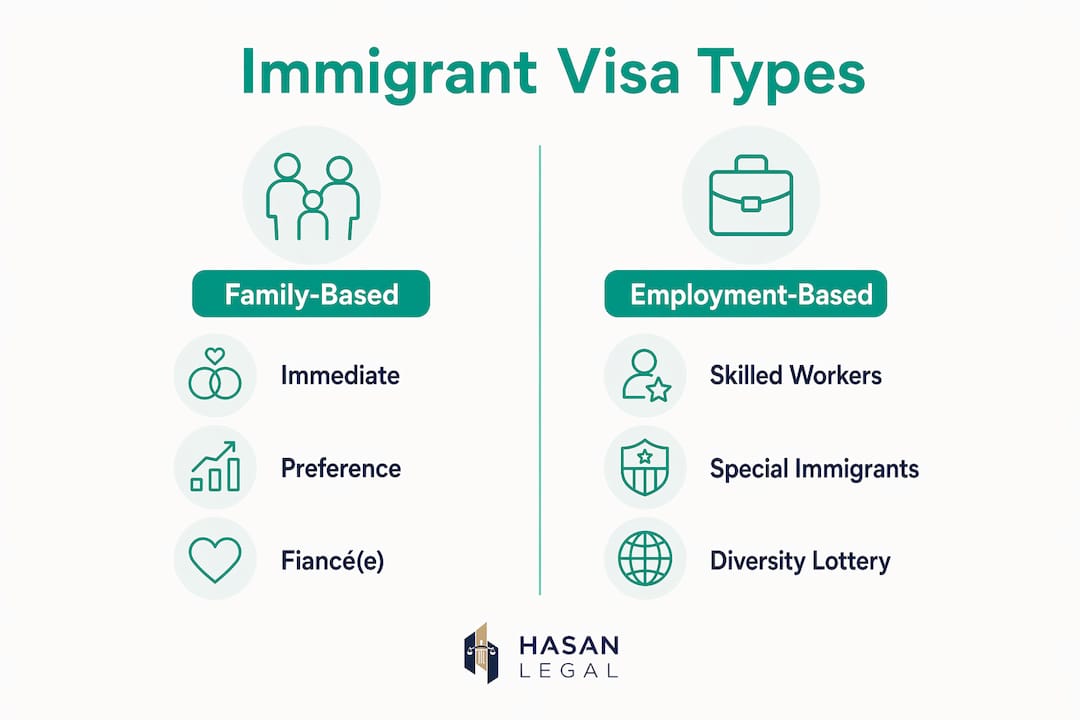
Other categories include the K-1 fiancé(e) visa, which leads to an immigrant visa after marriage in the U.S. Hasan-legal has a detailed breakdown of the K-1 visa process for couples navigating that specific path. Returning resident visas (SB-1) apply to LPRs who stayed abroad longer than one year and need to reclaim their status.
How to apply for an immigrant visa: step-by-step process
The immigrant visa process follows a defined sequence. Skipping or rushing any step causes delays.
-
File a petition. A U.S. citizen or LPR sponsor files a petition with USCIS, typically Form I-130 for family cases or Form I-140 for employment cases. USCIS reviews and approves the petition before anything else moves forward.
-
Transfer to the NVC. After USCIS approval, the case transfers to the National Visa Center. The NVC collects fees, civil documents, and financial evidence before scheduling the consulate interview.
-
Pay fees. As of 2026, applicants pay a $325 fee for Form DS-260 and, in family-based cases, a $120 fee for Affidavit of Support processing. Both fees are paid through the Consular Electronic Application Center (CEAC).
-
Complete Form DS-260. This is the online immigrant visa application. Accuracy is non-negotiable. Once submitted, DS-260 cannot be edited, so gather every document before you begin filling it out.
-
Achieve documentarily qualified status. The NVC reviews your submission. When all documents are confirmed complete and accurate, the NVC grants "documentarily qualified" status. Only then does the NVC schedule your consulate interview.
-
Attend the consulate interview. A consular officer reviews your file and assesses your admissibility. This is the decisive step in the entire process.
-
Receive visa issuance. If approved, the consulate prints and delivers your immigrant visa. You then have a limited window to enter the U.S.
Pro Tip: Gather every civil document, financial record, and identification before opening Form DS-260. You cannot go back and fix errors after submission, and incomplete submissions delay your documentarily qualified status.
Hasan-legal's guide on consular processing steps walks through each phase in detail, including what to bring to the interview.
What documents are needed for an immigrant visa?
Documentation requirements are strict, and missing even one item can stall your case. The NVC will not schedule your interview until your file is complete.
Core civil documents include:
- Valid passport (must remain valid for at least six months beyond your intended entry date)
- Birth certificate with official translation if not in English
- Marriage certificate (if applicable)
- Police clearance certificates from every country where you have lived for six or more months since age 16
- Court and prison records (if applicable)
- Military records (if applicable)
Financial documentation centers on the Affidavit of Support, Form I-864. The sponsor must prove financial ability to support the applicant at or above 125% of the U.S. federal poverty guidelines. Consular officers treat this document as a core eligibility factor, not a formality. Weak financial evidence is one of the most common reasons for visa denial.
Medical examination is required from a USCIS-designated civil surgeon or panel physician. The medical exam results determine part of your visa's validity period. If your medical exam expires before your visa interview, you will need a new exam.
Pro Tip: Request police clearance certificates early. Some countries take weeks or months to process them, and the NVC will not move your case forward without them.
Common pitfalls include submitting documents without certified translations, providing tax returns that do not match the sponsor's stated income, and missing the NVC's document deadlines. A missed deadline can push your case back months.
What happens after an immigrant visa is granted?
Visa approval is not the finish line. You must enter the U.S. within the visa's validity period to activate your permanent resident status.
The immigrant visa is typically valid for up to six months, tied to the expiration of your medical exam. Failing to enter before the visa expires means your visa becomes void. Restarting the process from the consulate stage is possible in some cases, but it costs time and money.
| Stage | What happens | Who is responsible |
|---|---|---|
| U.S. entry | CBP officer inspects and admits you as an LPR | Customs and Border Protection |
| Temporary proof | Immigrant visa serves as proof of LPR status | USCIS / applicant |
| Green Card issuance | USCIS mails Form I-551 to your U.S. address | USCIS |
| Green Card validity | Physical card valid for 10 years (conditional: 2 years) | USCIS |
Once CBP admits you, USCIS issues the physical Green Card and mails it to your U.S. address. The immigrant visa itself stops being valid after entry but functions as temporary proof of LPR status for up to one year while you wait for the card.
If you are already a Green Card holder who stayed abroad too long, a returning resident visa (SB-1) may restore your status. That process requires a separate application at a U.S. consulate and proof that your extended absence was beyond your control.
Key Takeaways
An immigrant visa is the single document that converts a foreign national's approved petition into lawful permanent residence upon U.S. entry.
| Point | Details |
|---|---|
| Core definition | An immigrant visa grants permanent resident status upon U.S. entry, unlike any nonimmigrant visa. |
| Visa types | Family-based, employment-based, diversity lottery, and fiancé(e) visas each have distinct eligibility rules. |
| DS-260 accuracy | Form DS-260 cannot be edited after submission, so prepare all documents before you start. |
| Document completeness | Police clearances, Form I-864, and medical exams must all be current before the NVC schedules your interview. |
| Entry deadline | You must enter the U.S. within the visa's validity period, typically six months, or the visa becomes void. |
The interview is where cases are won or lost
The visa interview gets less attention than it deserves in most guides. Applicants spend months gathering documents, then walk into the consulate underprepared for the actual conversation. That is a mistake I see repeatedly.
The consular officer is not just checking your paperwork. They are assessing whether your story is consistent, whether your sponsor's financial support is credible, and whether you meet admissibility standards. The Affidavit of Support is a particular sticking point. Sponsors who submit tax returns showing income below the required threshold, or who fail to include all household members, create problems that are very hard to fix at the interview stage.
Form DS-260 deserves the same level of care. Because it cannot be changed after submission, any inconsistency between what you wrote and what you say at the interview raises red flags. Treat the form like a legal declaration, because that is exactly what it is.
My honest advice: do not treat the immigrant visa process as a paperwork exercise. It is a legal proceeding with real consequences for errors. If your case involves any complexity, such as prior visa denials, criminal history, or a sponsor with irregular income, professional legal guidance is not optional. It is the difference between approval and a years-long delay.
— Hasan Legal Desk
How Hasan-legal can support your immigrant visa case
Hasan-legal works with applicants at every stage of the immigrant visa process, from petition filing through consulate interview preparation.
Attorney Mahmudul Hasan, Esq. personally oversees each case, which means your file does not get passed to a paralegal and forgotten. Whether you are applying through a family petition, an employment-based category, or a diversity visa, Hasan-legal's team prepares your documents, reviews your Form DS-260 before submission, and helps you present a strong case at the consulate. Start with a free case evaluation to understand your options, or review the full range of U.S. immigration services Hasan-legal provides.
FAQ
What is an immigrant visa in simple terms?
An immigrant visa is an official document issued by a U.S. embassy or consulate that allows a foreign national to enter the United States and live there permanently as a Lawful Permanent Resident.
How long does the immigrant visa process take?
Processing time varies by visa category and consulate. Immediate relative cases can take several months, while family preference and employment-based categories may take years due to annual numerical caps.
What is the difference between an immigrant and a nonimmigrant visa?
An immigrant visa leads to permanent residence, while a nonimmigrant visa authorizes only a temporary stay for a specific purpose such as tourism, study, or short-term work.
Can I work in the U.S. with an immigrant visa?
Yes. Once admitted as a Lawful Permanent Resident on an immigrant visa, you have the right to live and work anywhere in the United States without employer sponsorship restrictions.
What happens if I do not enter the U.S. before my immigrant visa expires?
Your visa becomes void if you do not enter within its validity period, which is typically up to six months. You would need to contact the consulate to determine whether revalidation or a new application is required.